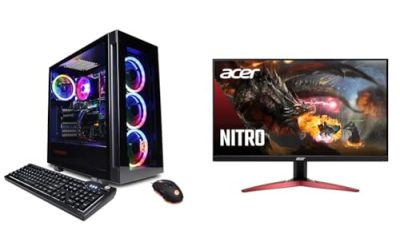
The best gaming PC for a beginner in 2026 is a prebuilt desktop with a Ryzen 5 or Ryzen 7 processor, an RTX 5060 Ti or Radeon RX 9060 XT with 16 GB of memory (or an RTX 5070 class card if you have a 1440p monitor), 32 GB of DDR5 RAM and a 1 TB NVMe SSD. That combination plays almost every current game at high settings at 1080p and most at 1440p, comes with a single warranty, and needs no assembly. If this is your first PC, the right order of decisions is: pick your monitor, choose the graphics card to match it, then choose the brand and warranty, and only then look at looks and RGB.
This guide is written for someone who has never bought a gaming PC before. It is based on published specifications and professional coverage, not on personal benchmarking, and it avoids quoting prices because they change often. Every term is explained the first time it appears.
As an Amazon Associate we earn from qualifying purchases at no extra cost to you.


Our Top Picks
Top 3 picks at a glance
Step 1: Decide What You Will Actually Play
The games you play decide how much PC you need. The graphics card does most of the work, and different games ask for very different amounts.
| What you play | Example games | GPU class that suits it | Realistic monitor |
|---|---|---|---|
| Esports and older games | Valorant, Counter-Strike 2, League of Legends, Fortnite (performance mode) | RTX 5050 or RX 9060 XT 8 GB | 1080p 144 to 240 Hz |
| Popular modern games | Baldur’s Gate 3, Elden Ring, Cyberpunk 2077, Call of Duty | RTX 5060 Ti 16 GB or RX 9060 XT 16 GB | 1080p 144 Hz or 1440p 60 to 100 Hz |
| High settings at 1440p | Same, with high refresh rates and ray tracing options | RTX 5070 or RX 9070 | 1440p 144 to 165 Hz |
| Max settings or 4K | Graphically demanding single-player games | RTX 5070 Ti, RX 9070 XT or better | 1440p 240 Hz or 4K 60 to 120 Hz |
If you are unsure, pick the second row. It handles nearly everything you will install in your first year and leaves room to grow.
Step 2: Understand the Five Parts That Matter
Graphics card (GPU)
This draws the images and decides your frame rate. The two makers are Nvidia (GeForce RTX) and AMD (Radeon RX). Higher model numbers are faster. VRAM, the card’s own memory, is also important: 8 GB is the floor for 1080p, and 16 GB is recommended if you want to play at higher settings or keep the PC for several years.
Processor (CPU)
This runs the game logic and background tasks. A Ryzen 5 or Core Ultra 5 is enough for a beginner build, and a Ryzen 7 or Core Ultra 7 gives headroom. AMD’s Ryzen 7 9800X3D is the fastest gaming processor class in published reviews but is more than most beginners need.
Memory (RAM)
Short-term memory for running programs. 16 GB is the minimum for gaming today and 32 GB is a safe choice, especially for open-world games and browsing with a game open. It should be two sticks, not one, so memory runs in dual-channel mode.
Storage (SSD)
Where games and Windows live. Choose an NVMe SSD of at least 1 TB. Hard drives are cheaper per gigabyte but slow load times noticeably.
Power supply (PSU)
Powers everything. A weak or unbranded unit is the part most likely to fail and the part beginners overlook. Look for a named brand, 80 Plus Bronze or better (Gold is better), and a wattage with headroom.
Worked Example: How Big Should the Power Supply Be?
For a typical beginner build with a Ryzen 5 9600X (about 65 W), an RTX 5060 Ti (about 180 W) and 60 W for the motherboard, memory, drive and fans, the peak draw is about 305 W. Dividing by 0.6 for a comfortable load gives roughly 510 W, so a 550 W to 650 W supply is a good fit. Nvidia’s own guidance for this card class is a 600 W system power supply, so 650 W is the safe choice. If you might upgrade to a stronger card later, a 750 W unit costs little extra and avoids a second purchase.
Step 3: Match the GPU to Your Monitor
A powerful graphics card on a 60 Hz 1080p monitor wastes money, and a weak card on a 4K monitor gives poor frame rates. Count the pixels your GPU has to draw each second: width times height times frame rate.
| Monitor | Pixels per second | Relative load | Suggested GPU |
|---|---|---|---|
| 1080p at 60 Hz | 124 million | 1.0x | RTX 5050 or RX 9060 XT 8 GB |
| 1080p at 144 Hz | 299 million | 2.4x | RTX 5060 or RX 9060 XT |
| 1440p at 144 Hz | 531 million | 4.3x | RTX 5070 or RX 9070 |
| 4K at 60 Hz | 498 million | 4.0x | RTX 5070 Ti or RX 9070 XT |
The table shows why 1440p at 144 Hz is a bigger step up than it looks: it asks more than four times the work of 1080p at 60 Hz. Frame rates also vary with the game, settings and patch. As a rough range from published reviews, a card in the RTX 5060 Ti class often reaches roughly 80 to 140 FPS at 1080p high in modern games and about 50 to 90 FPS at 1440p high.
Step 4: Choose the Type of PC
| Option | Best for | Pros | Cons |
|---|---|---|---|
| Prebuilt desktop | Most beginners | One warranty, no assembly, ready to use | Check parts quality; some use proprietary parts |
| Build it yourself | Learners with time and patience | Choose every part, lower cost when parts are in stock | Assembly risk, separate warranties |
| Gaming laptop | People who move often | Portable, includes screen and keyboard | Costs more per frame, limited upgrades |
| Custom builder service | Buyers who want a custom spec without building | Choose parts, builder assembles | Premium over parts cost |
For most first-timers, a prebuilt desktop is the least risky option, especially in 2026 when graphics card and memory prices have been above launch levels in published reports. System builders buy in volume, and a prebuilt can end up close to the price of the parts alone.
Step 5: Pick a Line and Check the Configuration
Corsair Vengeance: best all-around starting point
Spec line: Corsair-matched parts, Ryzen 7 9800X3D or Intel options, RTX 5070 Ti in the a7500 configuration according to published coverage.
Best for: a long-lasting first PC.
Skip if: your budget is tight, because this line sits above the entry tier.
- Pro: standard parts and strong support terms.
- Pro: easy upgrades.
- Pro: ranked as a top overall pick by several roundups.
- Con: costs more than entry lines.
- Con: more PC than a 1080p player needs.
NZXT Player: best clean and simple option
Spec line: tidy mid-tower, Ryzen 5 and 7 CPUs and RTX 5060 to 5080 class graphics.
Best for: a simple buying process and good looks.
Skip if: you want the lowest price.
- Pro: clean design and cable work.
- Pro: standard parts.
- Pro: straightforward support.
- Con: price above value builders.
- Con: fewer cheap configurations.
Lenovo Legion Tower 5: best value from a big brand
Spec line: Ryzen 7 or Core Ultra 7 CPUs with RTX 5060 Ti to 5070 Ti graphics.
Best for: 1440p value.
Skip if: you plan to replace the power supply.
- Pro: competitive pricing and frequent sales.
- Pro: easy to buy in stores or online.
- Pro: reputable support network.
- Con: some proprietary parts.
- Con: check RAM and PSU on each variant.
HP Victus and Omen: best for sales and promotions
Spec line: Victus for value, Omen for higher tiers, RTX 5050 to 5080 class GPUs.
Best for: shoppers who watch sales.
Skip if: you want a standard motherboard and PSU.
- Pro: widely sold with frequent discounts.
- Pro: simple warranty process.
- Pro: both AMD and Intel choices.
- Con: some HP-specific parts.
- Con: Victus trims cooling and component quality.
Skytech, iBUYPOWER and CyberPowerPC: best low-cost entry
Spec line: broad catalogs from RTX 5050 and RX 9060 XT to RTX 5080 and RX 9070 XT with standard parts.
Best for: the lowest cost for a given GPU.
Skip if: you want premium support.
- Pro: low prices and many configurations.
- Pro: standard parts support upgrades.
- Pro: AMD and Intel choices.
- Con: parts brands vary; verify the PSU and memory.
- Con: support quality varies.
The Beginner’s Checklist Before You Buy
- The GPU model and VRAM are named exactly (for example RTX 5060 Ti 16 GB, not just “RTX 5060 Ti”).
- The processor is from the current generation (Ryzen 7000 or 9000, Core Ultra 200S).
- There are two RAM sticks totalling at least 16 GB, preferably 32 GB.
- The SSD is NVMe and at least 1 TB.
- The power supply brand and wattage are listed.
- The warranty term is stated, and you know who pays shipping for repairs.
- The return policy gives you at least 14 to 30 days.
- Windows is included and activated.
What You Still Need to Buy
- Monitor: a 24 to 27 inch screen with a 144 Hz or higher refresh rate; 1080p for entry builds and 1440p for mid-range ones.
- Keyboard and mouse: any decent pair works to start; upgrade later.
- Headset or speakers: a wired headset is the cheapest good option.
- Cables: a DisplayPort or HDMI cable that supports your monitor’s refresh rate; many monitors ship with one.
- Surge protector: protects against power spikes.
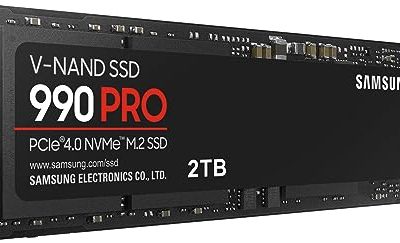
Worked Example: How Many Games Fit on the SSD?
Modern games are large. A 1 TB drive formats to about 930 GB of usable space, Windows and drivers take about 60 GB, and you want to leave 10 to 15 percent free for performance. That leaves around 780 GB. If your library averages 60 GB per game, the drive holds about 13 games. A 2 TB drive roughly doubles that, to about 28 games, and costs much less than twice as much per gigabyte. If you play several large titles at once, choose 2 TB or plan to add a second M.2 drive later.
First Day With Your New PC
- Connect the monitor to the graphics card, not the motherboard, so the GPU is used.
- Run Windows Update, then install the latest graphics driver from Nvidia or AMD.
- Set the monitor to its highest refresh rate in Windows display settings.
- Enable the memory’s XMP or EXPO profile in the BIOS if the seller did not already.
- Remove preinstalled trial software you will not use.
- Install your game launcher and a monitoring tool to watch temperatures.
- Back up your Windows recovery key and note your serial numbers for warranty claims.
Common Beginner Mistakes
- Buying the biggest GPU and forgetting the monitor. A 60 Hz monitor hides most of a fast card’s benefit.
- Picking an 8 GB card for the long term. It plays current games, but newer ones increasingly want more VRAM.
- Ignoring the power supply. A brand-less supply is a risk to every other part.
- Skipping the return window. Test the PC thoroughly in the first two weeks.
- Chasing RGB and glass. They add cost and no frames per second.
- Waiting for the perfect time. Parts and prices move constantly; buy when a configuration meets your needs at a price you accept.
Gaming Terms Explained
| Term | Plain meaning | Why it matters to you |
|---|---|---|
| FPS (frames per second) | How many images the PC draws each second | Higher is smoother; 60 is playable, 100 or more feels fluid |
| Refresh rate (Hz) | How many times the monitor updates per second | A 144 Hz monitor can show up to 144 FPS |
| Upscaling (DLSS, FSR) | Draws at a lower resolution then enlarges with software | Boosts frame rates with little visible loss in supported games |
| Ray tracing | Realistic lighting and reflections | Looks better but cuts frame rates; optional |
| Bottleneck | One part limiting another | A weak CPU can hold back a strong GPU |
| XMP or EXPO | A memory speed profile you switch on in the BIOS | Without it, RAM may run slower than its rating |
| TDP or board power | How much heat and power a part uses | Decides PSU size and cooling needs |
None of these need to be memorized. They are worth reading once so that a product page stops looking like a wall of abbreviations, and so that you can recognize when a listing is hiding something, such as a missing GPU memory size or an unnamed power supply.
Frequently Asked Questions
What is the best gaming PC for a beginner?
A prebuilt desktop with a Ryzen 5 or 7, an RTX 5060 Ti or RX 9060 XT 16 GB, 32 GB of DDR5 and a 1 TB NVMe SSD is the best starting point. It runs current games at high settings at 1080p and most at 1440p.
Should a beginner build or buy a gaming PC?
Most beginners are better off buying a prebuilt PC because it comes with one warranty and no assembly risk. Building is rewarding and can be cheaper, but it takes time and is harder when parts are in short supply.
How much RAM do I need for gaming?
Choose 16 GB as the minimum and 32 GB for a comfortable experience that will last several years. Make sure it is two sticks so the memory runs in dual-channel mode.
Do I need an expensive graphics card to start?
No. An RTX 5060 Ti or RX 9060 XT 16 GB class card plays nearly everything at 1080p and 1440p. Spend more only if your monitor or the games you play demand it.
Is a gaming laptop a good first gaming PC?
It is a good option if you need portability, but it costs more per frame and is harder to upgrade. A desktop with a monitor generally gives more performance for the same spend.
How long will a beginner gaming PC last?
With 16 GB of VRAM, 32 GB of RAM and a modern CPU, many players expect four to six years of good gaming, lowering settings gradually in newer titles. That is an estimate, and standard parts let you upgrade the GPU later.
Related guides
More from Amazon
Programs that pair well with the guide above. Offers and eligibility are set by Amazon and may change.
Free shipping on eligible items, Prime Video and more. Eligible new members can start with a free trial.
Start a Prime free trialAd-free music streaming. Eligible new subscribers can start with a free trial.
Try Music Unlimited freeA Prime membership for ages 18-24 with a trial period. Eligibility is set by Amazon.
See Prime for Young AdultsAudiobooks and podcasts to listen to on the go. Eligible new members can start with a free trial.
Try Audible freeAs an Amazon Associate we earn from qualifying purchases.