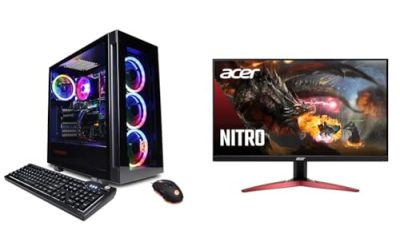
The best websites to buy a gaming PC in 2026 are the ones that match how you want to handle risk: Micro Center and Best Buy for buying with a store you can walk into, iBuyPower and CyberPowerPC for the most hardware per dollar from a specialist builder, NZXT and Corsair for standard parts plus longer support, and Dell for Alienware if you want a big-company service network. No single site wins every category, so this guide ranks eight real sellers on warranty length, build quality, parts used, shipping and upgrade friendliness, and shows you how to check any site yourself before you pay.
Everything below is based on publicly available policies, published specs and widely reported owner feedback as of late 2026. Warranty terms, shipping times and return windows change with promotions and by product line, so treat the figures as typical ranges and confirm the seller’s current terms on the product page before checkout.
Quick Comparison of the Eight Sites
| Site | Type | Typical warranty approach | Parts approach | Upgrade friendliness | Price tier | Best for |
|---|---|---|---|---|---|---|
| Micro Center | Retailer with stores plus custom builds | Varies by brand; store-built PCs carry the store’s own coverage | Retail parts you pick from shelves | High | Entry to premium | Buyers near a store who want to see parts first |
| Best Buy | Big-box retailer | Manufacturer warranty plus optional store protection plans | Mixed; many proprietary-leaning OEM boards | Medium | Entry to mid | Easy returns and in-person pickup |
| Newegg | Online parts and PC retailer | Depends on the brand and the third-party seller | Mixed | Medium to high | Entry to premium | Comparing many builders in one place |
| iBuyPower | Direct specialist builder | Typically 1 year parts with extended options; check current terms | Mostly standard parts | High | Entry to premium | Strong specs for the money |
| CyberPowerPC | Direct specialist builder | Typically 1 to 2 years depending on the line; check current terms | Mostly standard parts, some OEM boards | Medium to high | Entry to mid | Budget-focused shoppers |
| NZXT (Player series) | Direct builder and retail partner | Commonly 2 years plus lifetime technical support on Player PCs | Standard parts in NZXT cases | High | Mid to premium | Clean builds and long support |
| Corsair (Vengeance) | Direct builder and retail partner | Commonly 2 years on Vengeance PCs; check current terms | Corsair-branded PSU, cooling, RAM | High | Mid to premium | Brand-consistent components |
| Dell (Alienware) | Direct manufacturer | 1 year baseline with paid service upgrades; check current terms | More proprietary on some models | Low to medium | Mid to premium | Broad service network and design |
Read the “Price tier” column as relative position only. Prices on every one of these sites move weekly, and the same model can swing a lot between a regular week and a holiday sale.
1. Micro Center: Best When You Live Near a Store
Micro Center is a US electronics retailer with physical stores and an online catalog that sells both ready-made gaming PCs and the individual parts to build one. Its draw for PC buyers is the ability to pick up a PC or components the same day, look at the case in person and ask a staff member about compatibility. It also sells house-brand and third-party prebuilts, so you can compare several configurations in one visit.
Why it ranks here
- Parts quality: Because the shelves are stocked with retail motherboards, power supplies and graphics cards from major brands, store-assembled systems tend to use standard, replaceable parts.
- Upgrade friendliness: High. Standard ATX parts mean you can swap the GPU, add storage or change the cooler later.
- Shipping: Online orders can often be picked up in store, which skips shipping damage risk entirely.
Trade-offs
- You benefit most if a store is within driving distance; mail-order buyers lose the main advantage.
- Store-built coverage and return terms differ from manufacturer coverage, so read the specific terms for the PC you choose.
Best for: shoppers near a store who want to inspect hardware. Skip if: there is no store near you and you only plan to order online.
2. Best Buy: Best for Simple Returns and Pickup
Best Buy carries well-known prebuilt lines such as HP Omen, Lenovo Legion, MSI, ASUS and Alienware, plus a rotating set of other brands, and lets you pick up in store or have the PC shipped. The strength is convenience: familiar returns, in-person support at the counter and optional protection plans for people who want an extra layer beyond the manufacturer warranty.
Why it ranks here
- Warranty and support: The base coverage comes from the PC maker, and the store sells add-on protection. Compare what the protection plan actually covers (accidental damage, parts, labor) against its cost.
- Shipping: Same-day pickup is often available on in-stock models.
- Parts: Mainstream OEM designs frequently use custom power supplies or board layouts that limit later upgrades.
Trade-offs
- Selection skews toward large manufacturers, so you will see fewer boutique specs.
- Configurations are fixed; you cannot pick the exact SSD or RAM brand.
Best for: first-time buyers who value easy returns. Skip if: you want to choose specific components.
3. Newegg: Best for Comparing Many Builders in One Place
Newegg is an online retailer that lists its own selection plus items from third-party sellers, including several specialist PC builders. That makes it useful as a comparison engine: you can filter by graphics card, processor and memory and see how builders price the same core spec. It is also a natural place to price out a DIY build with the same cart.
Why it ranks here
- Selection: The widest mix of builders and configurations of any single website in this list.
- Upgrade friendliness: Medium to high, depending on the builder behind each listing.
Trade-offs
- Warranty and return terms depend on whether the item is sold by Newegg or by a marketplace seller, so check the seller line on every listing.
- Quality varies between sellers more than at a single-brand store.
Best for: spec-by-spec comparison shoppers. Skip if: you want one company responsible for the whole experience.
4. iBuyPower: Best Specs for the Money From a Specialist
iBuyPower sells prebuilt desktops directly and through large retailers, with a configurator that lets you pick processor, graphics card, memory and storage tiers. Its pitch is standard retail parts in an assembled, tested system at a competitive price for the hardware tier. The Element, Y40 and Trace-style families cover entry to high-end gaming, though specific model names rotate with each hardware generation, so look at the current lineup rather than a remembered name.
Why it ranks here
- Parts: Mostly mainstream motherboards, standard ATX-style power supplies and common cases, which helps later upgrades.
- Configurator: Useful for dialing in RAM, SSD size and cooling without paying for features you do not need.
- Warranty: A baseline term with optional extensions; read the current terms to see what is covered and for how long.
Trade-offs
- Owner feedback across prebuilt specialists is mixed on support speed, so choose the warranty extension only if the cost is low relative to the PC.
- Case and cable-management polish varies by model and batch.
Best for: shoppers who prioritize GPU and CPU tier over brand polish. Skip if: premium build finish matters more than raw hardware per dollar.
5. CyberPowerPC: Best Budget-Focused Specialist
CyberPowerPC is a long-running US builder that sells gaming desktops directly and via major retailers, with a very wide range from entry-level machines to flagship builds. It tends to target buyers who care most about the graphics card and processor tier and less about case finish, and its Gamer Xtreme and Gamer Master style series are the best-known names.
Why it ranks here
- Price position: Frequently one of the lowest-priced ways to get a given GPU tier.
- Customization: The builder site lets you adjust memory, storage and cooling.
Trade-offs
- Some budget models use OEM-style motherboards and power supplies that limit upgrades, so check the PSU wattage and board chipset in the listing.
- Warranty length differs by product line; confirm it on the exact configuration.
Best for: entry and mid-range buyers watching spend. Skip if: you want a showcase case with tidy internals out of the box.
6. NZXT: Best for Clean Builds and Long Support
NZXT sells its Player series of prebuilt gaming PCs through its own site and retail partners, built in NZXT cases with standard parts. The company has publicly promoted extended coverage and ongoing technical support on those systems, which is a major reason it ranks well for people who dislike troubleshooting alone. The cases are designed with airflow and cable routing in mind, so later upgrades are generally straightforward.
Why it ranks here
- Build quality: Neat cable routing and good airflow cases are consistent selling points in published reviews.
- Warranty: Commonly longer than the baseline at larger OEMs; confirm the current term and what it covers.
- Upgrade friendliness: High, thanks to standard components.
Trade-offs
- You often pay a premium for the design and support compared with a similarly specced budget builder.
- Configuration choices are narrower than at a configurator-first builder.
Best for: buyers who want a tidy, supported PC. Skip if: your priority is the cheapest possible GPU tier.
7. Corsair: Best for Matched, Brand-Consistent Components
Corsair builds its Vengeance gaming desktops with its own power supplies, cooling, memory and cases, which gives the company direct control over component quality. That consistency tends to show up in reviews as cleaner assembly and predictable thermals. Coverage on these systems has been publicized as longer than typical retail baselines, but verify current terms before buying.
Why it ranks here
- Parts: Matched first-party PSU, cooler and RAM reduce compatibility surprises.
- Support: One company covers most of the system, which simplifies troubleshooting.
Trade-offs
- Typically priced at the upper end for a given GPU tier.
- Fewer ultra-budget options than specialist builders.
Best for: buyers who want fewer vendors to deal with. Skip if: you are shopping at the lowest price tier.
8. Dell (Alienware): Best for Service Network and Design
Dell sells Alienware gaming desktops directly, including the full-size Area-51 line and smaller Aurora models. The appeal is a large service organization, frequent configuration options on the site and distinctive design. The compromise is that some Alienware designs use more proprietary parts than a standard ATX build, which can narrow your upgrade choices.
Why it ranks here
- Support: Dell offers paid service tiers, including options that add on-site service on eligible products and regions; check what is available for your address.
- Configuration: You can tune CPU, GPU, memory and storage in one flow.
Trade-offs
- Proprietary elements on some models make later upgrades less flexible.
- List prices are often higher until a promotion runs, so avoid buying at an unpromoted price if you can wait.
Best for: buyers who want a big-brand service network. Skip if: you plan to swap many parts over the years.
How to Choose Using Numbers, Not Brand Loyalty
A simple scoring method keeps the decision rational. Give each of five criteria a weight that adds up to 100, then score each site from 1 to 5 and multiply.
| Criterion | Suggested weight | What a 5 looks like | What a 1 looks like |
|---|---|---|---|
| Warranty and support | 30 | 2+ years parts and labor plus phone or chat support | 90 days, or unclear coverage |
| Parts quality and transparency | 25 | Full part list with PSU brand and wattage, motherboard model, SSD model | “Gaming motherboard” and “750W PSU” with no model |
| Upgrade friendliness | 20 | Standard ATX parts, accessible slots | Proprietary power supply or board shape |
| Return policy and shipping | 15 | Free returns window, tracked insured shipping | Restocking fees, uninsured freight |
| Hardware per dollar | 10 | Your target GPU and CPU at a competitive price | Same GPU tier costs far more elsewhere |
Example: if Site A scores 4, 4, 5, 3 and 3 and Site B scores 3, 5, 3, 4 and 5, then A totals (30×4 + 25×4 + 20×5 + 15×3 + 10×3) / 5 = 79 and B totals (30×3 + 25×5 + 20×3 + 15×4 + 10×5) / 5 = 77. A narrow gap like that tells you to pick on the one criterion you care about most, not to agonize over the total.
A Pre-Purchase Checklist That Works on Any Site
- Find the full parts list. If the seller will not name the power supply and motherboard model, assume they are budget parts.
- Check PSU wattage against the GPU. As a rough rule, mid-range cards in 2026 builds pair with 650W to 750W power supplies and high-end cards with 850W to 1000W or more, according to the card makers’ recommended specs.
- Confirm it ships with a current-generation graphics card. NVIDIA’s RTX 50 series and AMD’s Radeon RX 9000 series are the current families; a listing that does not state the exact GPU model is a red flag.
- Look at memory configuration. Two sticks of DDR5 are better than one for gaming bandwidth, and 32GB is a sensible floor for a new mid- to high-end build.
- Read the return and warranty page, not the marketing summary. Look for who pays return shipping and whether opening the box voids anything.
- Open the PC on arrival, check that the GPU is seated and the cables are connected, and run a stress test within the return window.
Retailer Versus Direct Builder: Which Side to Pick
| Factor | Retailer (Micro Center, Best Buy, Newegg) | Direct builder (iBuyPower, CyberPowerPC, NZXT, Corsair, Dell) |
|---|---|---|
| Returns | Usually simpler, with a store or standard marketplace process | Set by the builder; some charge restocking or require pre-approval |
| Customization | Fixed configurations in most cases | Configurators for RAM, storage and cooling |
| Warranty source | Manufacturer, plus optional store plans | Builder directly |
| Sale timing | Frequent seasonal promotions | Frequent site-wide promotions and bundles |
| Best use | Convenience and quick resolution | Tuning the spec and the price |
Red Flags That Should Make You Walk Away
- A listing that only says “RTX graphics” or “latest processor” without a model name.
- No wattage or brand for the power supply.
- One stick of RAM in a system advertised for high-end gaming.
- A price far below every other seller for the same GPU class, which often means an older generation or a weak platform.
- A warranty that excludes shipping damage but gives you only a short window to report it.
- A “limited stock” countdown that resets whenever you reload the page.
Frequently Asked Questions
What is the best website to buy a gaming PC overall?
There is no single best site for everyone. Micro Center and Best Buy are strongest for in-person convenience, iBuyPower and CyberPowerPC for hardware per dollar, and NZXT and Corsair for longer support and cleaner builds. Pick based on which of those matters most to you.
Is it better to buy a prebuilt gaming PC from a retailer or directly from the builder?
Retailers make returns and pickup easier, while direct builders let you customize memory, storage and cooling. If you are nervous about shipping and setup, a retailer is the safer path; if you know exactly what you want, a direct configurator usually gives a better fit.
How do I know if a prebuilt uses good parts?
Look for the exact model of the motherboard, power supply, SSD and RAM, not general descriptions. A reputable seller lists them. If the product page hides them, ask support before buying and treat a vague answer as a warning.
Are Black Friday prebuilt gaming PC deals worth waiting for?
They can be, especially for last-quarter-of-the-year promotions on mainstream configurations, but stock and GPU pricing shift week to week. Set your target spec first, then compare the sale configuration against the same spec at regular prices so a discount is not just a higher-tier part in disguise.
Do I need an extended warranty on a gaming PC?
If the base warranty is one year and the PC is expensive, an extension that covers parts and labor can be worth it, particularly on systems with proprietary components. If the base term is already two years or longer, the extension is less compelling. Always read what it excludes.
Can I upgrade a prebuilt from these sites later?
Usually yes, if it uses standard ATX parts. Models with proprietary power supplies or boards limit upgrades, so check whether the case, PSU and motherboard follow common standards before you buy.
Related guides
- Best PC Specs for Gaming in 2026: What You Need at 1080p, 1440p and 4K: 4 Compared
- Where to Finance a Gaming PC: Cards, Payment Plans and Pay Later Compared
- Most Reliable Prebuilt Gaming PC Brands in 2026: Warranty, Parts and Service Compared
- 4 Best Gaming PCs for Beginners Buying Guide: Your First PC in 2026, Step by Step
More from Amazon
Programs that pair well with the guide above. Offers and eligibility are set by Amazon and may change.
Free shipping on eligible items, Prime Video and more. Eligible new members can start with a free trial.
Start a Prime free trialAd-free music streaming. Eligible new subscribers can start with a free trial.
Try Music Unlimited freeA Prime membership for ages 18-24 with a trial period. Eligibility is set by Amazon.
See Prime for Young AdultsAudiobooks and podcasts to listen to on the go. Eligible new members can start with a free trial.
Try Audible freeAs an Amazon Associate we earn from qualifying purchases.