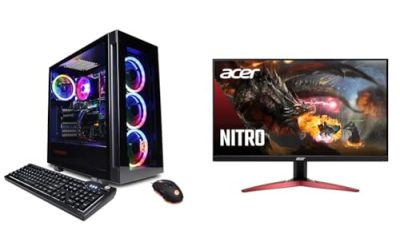
No prebuilt maker is reliable in every product line, but on published warranty terms, parts choices and service reputation, Corsair, NZXT and the premium Alienware Area-51 line come out as the safest bets in 2026, with Lenovo Legion, HP Omen and MSI close behind. Smaller system integrators such as iBuyPower, CyberPowerPC and Skytech can be just as dependable, but the spread between their best and worst configurations is wider. Reliability here is judged from published specs, warranty pages and review coverage, not from personal testing, so treat the ranking as a shortlist to verify against each seller’s current terms.
If you searched for something like “best gaming PC Consumer Reports,” a caveat first: general consumer-survey organizations publish desktop reliability data, but as far as published coverage goes they do not maintain a dedicated, regularly updated gaming-PC brand ranking. Gaming-specific reliability evidence comes mostly from hardware reviewers who open the case, from warranty documents, and from the pattern of complaints that repeats across owner communities. That is the evidence used below.
What “reliable” actually means for a gaming prebuilt
A reliable prebuilt is one that arrives working, keeps working for the warranty period, and gets fixed quickly when it does not. Four things drive that, and the brand logo on the case matters less than any of them.
- Power supply quality. The PSU is the part most likely to take other components with it when it fails. Look for a named model from a known manufacturer with an 80 Plus Gold or better rating and a wattage that leaves headroom above the GPU’s rated board power.
- Motherboard and memory configuration. A standard-size ATX or micro-ATX board with a normal memory kit is a good sign. Proprietary boards and unlabeled “DDR5 memory” listings make later repairs harder.
- Cooling that matches the chip. Case airflow and cooler capacity must match the CPU and GPU. Many early failures and throttling complaints trace back to thin airflow in compact cases.
- Warranty and support path. Length is only half of it. Ask who pays for shipping, whether parts are swapped from stock or repaired, and whether technical support is phone-based or ticket-only.
Quick comparison of the brands
| Brand and line | Reliability strength | Typical parts approach | Upgrade friendliness | Price tier |
|---|---|---|---|---|
| Corsair Vengeance | Own-brand PSU, cooler and memory; support known for good phone help | Corsair parts throughout, standard ATX layout | High | Mid to premium |
| NZXT Player / BLD | Clean builds, own-brand case, cooler and PSU options | NZXT case and cooling with standard board | High | Mid to premium |
| Alienware Area-51 | Large budget for validation, premium service tiers | Custom chassis, standard core parts on recent models | Medium to high | Premium |
| Lenovo Legion Tower | Large-vendor validation and service network | Mostly standard parts, some OEM boards | Medium | Entry to mid |
| HP Omen / Victus | Large-vendor service, broad availability | OEM boards and PSUs in smaller cases | Medium (Omen), low to medium (Victus) | Entry to premium |
| MSI Codex / MPG line | Board maker building around its own boards | MSI boards, graphics cards and cases | Medium to high | Entry to mid |
| iBuyPower | Wide choice, good when parts list is specific | Varies by configuration | Medium | Entry to premium |
| CyberPowerPC | Heavy retail presence, strong configurator | Varies, often budget-oriented | Medium | Entry to mid |
| Skytech | Aggressive configurations for the money | Mixed brands, check PSU and memory line | Medium | Entry to mid |
The brands, ranked on reliability signals
1. Corsair Vengeance
Why it ranks first: Corsair makes many of the parts inside its own desktops: power supplies, cases, coolers, fans and memory. That limits the number of vendors involved when something fails, and the company has long pushed its Vengeance desktops with multi-year coverage and technical support that review coverage tends to describe positively. Reviewers also point to tidy cable management and standard-form-factor parts, which makes later PSU, SSD or RAM swaps straightforward.
Best for: Buyers who want a fast, quiet, well-organized PC and plan to upgrade the GPU or storage later. Skip if: you want the cheapest possible configuration, since Corsair builds tend to cost more than comparable-spec value brands.
- Pro: Own-brand cooling, PSU and memory simplify support.
- Pro: Standard parts layout supports later upgrades.
- Pro: Build quality is consistently praised in reviews.
- Con: Price position is above entry-level competitors.
- Con: Fewer low-end configurations than the large integrators.
2. NZXT Player and BLD
Why it ranks here: NZXT builds its own cases and cooling, and the Player and BLD families are known for clean assembly and sensible airflow. The company’s service model has moved toward a retail-partner and configurator approach, so it matters which version you buy: confirm that the seller you use is the one handling returns and whether the warranty is with NZXT or with the retailer.
Best for: Buyers who value a tidy, upgrade-friendly build and a recognized case design. Skip if: you need the lowest price per frame, because NZXT’s premium for cases and cooling is real.
- Pro: Standard form factors and tidy builds.
- Pro: Cooling and case designed together.
- Pro: Clear configurator with named parts.
- Con: Premium over generic value builds.
- Con: Support route depends on how and where you buy.
3. Alienware (Area-51 and Aurora)
Why it ranks here: Dell’s Alienware brand has the largest validation and service infrastructure of any gaming-specific line, with onsite and extended service options sold as add-ons. The current Area-51 chassis was redesigned for airflow and for easier part access, which addresses the older criticism of proprietary, cramped internals. The Aurora line is the cheaper, more compact option and carries more of the older compromises.
Best for: Premium buyers who want a service contract and a high-end spec in a single supported package. Skip if: you want to replace every part with standard retail components, since some sub-assemblies remain Dell-specific.
- Pro: Extensive service and warranty extension options.
- Pro: Redesigned Area-51 airflow and access.
- Pro: Strong availability of top-tier GPUs in configurations.
- Con: Premium price position.
- Con: Some Dell-specific parts limit upgrade freedom.
4. Lenovo Legion Tower
Why it ranks here: Lenovo validates desktops at scale because it sells so many business machines, and the Legion Tower line benefits from that. The cases are plain but airflow is reasonable, and the configurations are conservative, which is often what reliability looks like. Check the PSU wattage on lower-tier models if you intend to upgrade the GPU.
Best for: Buyers who want a conservative, no-fuss machine from a large vendor. Skip if: you plan a major GPU upgrade on an entry configuration with a modest PSU.
- Pro: Large-vendor validation and service network.
- Pro: Sensible, conservative configurations.
- Pro: Frequent promotional pricing across retailers.
- Con: Limited PSU headroom on some tiers.
- Con: Fewer enthusiast touches than Corsair or NZXT.
5. HP Omen and Victus
Why it ranks here: HP’s Omen line (such as the Omen 35L, Omen 16L and Omen Max 45L) is aimed at enthusiasts with better cooling and more room, while the Victus line is the budget entry. Large-vendor service is a plus. The trade-off is that smaller chassis and OEM motherboards and power supplies can limit repairs and upgrades, so read the spec sheet for the PSU wattage and the memory arrangement before buying.
Best for: Buyers who want a mainstream brand with wide retail availability. Skip if: you intend to swap the motherboard or PSU later.
- Pro: Wide availability and frequent promotions.
- Pro: Omen cases have better airflow than Victus.
- Pro: Large-company service network.
- Con: OEM parts limit some upgrade paths.
- Con: Spec sheets can bury memory and PSU details.
6. MSI (Codex and MPG desktops)
Why it ranks here: MSI builds its desktops around its own motherboards, graphics cards and cases, which means fewer unknown parts. Current Codex-family models are positioned as value systems with a familiar-brand parts list, while MPG-branded systems sit higher. Warranty terms vary by region and model, so verify them on the product page.
Best for: Buyers who like a known board and graphics brand with a relatively standard internal layout. Skip if: you need a very premium chassis or onsite service.
- Pro: In-house boards and graphics cards reduce mixed-vendor risk.
- Pro: Competitive value positioning.
- Pro: Standard layouts in most models.
- Con: Lineup and naming change often, making comparisons tricky.
- Con: Support quality depends on region and channel.
7. iBuyPower, CyberPowerPC and Skytech
These three integrators deserve one shared section because they share the same trade-off: the best configurations are excellent and the worst cut corners. They build with a mix of third-party parts, so the reliability of a specific machine depends almost entirely on the parts list you pick. Prioritize listings that name the PSU make and model, the motherboard, and the exact memory kit and speed. Avoid listings that say only “750W power supply” or “16GB DDR5” with no further detail.
- Pro: Large choice and fast shipping from retail partners.
- Pro: Often strong GPU-for-the-money configurations.
- Pro: Configurators let you choose named parts.
- Con: Parts quality varies by listing.
- Con: Support experiences vary more between buyers than at the larger firms.
A scoring method you can apply to any brand
Rather than trusting a ranking, score the specific machine you are considering. Assign points on a ten-point scale, and treat anything below six as a pass.
| Criterion | Points | How to earn full points |
|---|---|---|
| PSU named and Gold-rated | 2 | Brand, model and 80 Plus rating listed |
| PSU headroom | 1 | Rated wattage at least 1.4 times GPU board power plus CPU power |
| Memory is dual-channel | 2 | Two matched modules, speed listed (for example DDR5-6000) |
| Cooler matched to CPU | 1 | Tower air or 240-360mm AIO for high-power chips |
| Warranty of at least 2 years on parts and labor | 2 | Confirmed on the seller’s page, shipping terms stated |
| Standard motherboard form factor | 1 | ATX or micro-ATX, not proprietary |
| Open SSD and RAM slots | 1 | At least one free M.2 slot and two free DIMM slots, or four-slot board with two used |
Worked example: a configuration with a 750W Gold PSU for a GPU rated around 300W and a CPU around 120W scores full points on PSU naming, and the headroom test works out as 750 divided by 420 (the combined draw), about 1.8 times, which passes. If the same machine used an unnamed 600W unit, the ratio would be about 1.4, only just passing, and the missing model name would lose two points. This arithmetic matters more than the brand name.
Warning signs that matter more than brand
- Single-channel memory. One 16GB stick instead of two 8GB sticks can reduce performance in some games and signals cost-cutting. Some builders have been criticized for this kind of shortfall when memory prices rose, so check the memory line.
- Vague PSU listings. “650W power supply” with no brand is the most common red flag.
- Locked or proprietary parts. If the listing says the motherboard or PSU is custom, assume repair means going back to the manufacturer.
- Swapped parts after the order. Check whether the seller can substitute equivalent parts without telling you, and keep the confirmation email.
- Warranty that excludes shipping. A three-year warranty that makes you pay both ways is weaker than a two-year warranty with prepaid shipping.
How to choose by situation
| Your situation | Brand shortlist | Why |
|---|---|---|
| Want the most upgrade-friendly standard parts | Corsair, NZXT, MSI | Standard form factors, named components |
| Want a service contract with onsite options | Alienware, Lenovo, HP | Large service networks |
| Want the most GPU for the money and will inspect the parts list | iBuyPower, CyberPowerPC, Skytech | Aggressive configurations, but verify PSU and memory |
| Want a compact, quiet desk machine | NZXT, HP Omen 16L class, Lenovo | Smaller cases with managed airflow |
| Want the top-end GPU in a supported box | Alienware Area-51, HP Omen Max 45L, Corsair | Large cases built for high power draw |
Reliability during a parts shortage
Memory and graphics card supply has been tight through 2026, and market coverage suggests manufacturers have changed some configurations to manage costs. That makes it more important to read the current listing rather than a review of an earlier configuration. A brand’s review from months ago may describe a different memory kit, a different PSU or a different GPU model. When in doubt, treat the reviewed model number as a starting point and verify each line on the live product page.
Frequently Asked Questions
Which prebuilt gaming PC brand is the most reliable?
Based on published warranty terms, in-house parts and review coverage, Corsair, NZXT and Alienware’s Area-51 line are the most consistently well-regarded. No brand is reliable on every model, so check the PSU, memory and warranty on the exact configuration.
Is a prebuilt from a big company safer than one from a small builder?
Big companies offer larger service networks and tighter validation, which helps when something fails. Smaller builders can offer better parts lists and more transparency. The deciding factor is whether the listing names the PSU, motherboard and memory.
How long should the warranty be?
Aim for at least two years on parts and labor, with clear shipping terms. Longer coverage helps only if the claims process is simple, so read the terms for who pays for shipping and how replacement parts are handled. Always confirm the current terms with the seller.
Do Consumer Reports-style ratings cover gaming PCs?
General consumer-survey groups publish desktop reliability data, but gaming-specific brand rankings are mostly produced by hardware reviewers. Use survey data as a rough guide to a company’s overall repair record and reviewer coverage for the specific model.
Are cheaper prebuilts less reliable?
Not automatically, but cheaper configurations are where cost-cutting appears: unnamed PSUs, single memory modules and thin cooling. A mid-priced build with named parts is usually safer than a low-priced one with vague specs.
Is it better to build my own for reliability?
Building lets you choose every part, but you take on diagnosis and support yourself. A prebuilt with a clear parts list and a real warranty gives you a single place to go when something fails, which many buyers value more than the small savings.
Related guides
- Where to Finance a Gaming PC: Cards, Payment Plans and Pay Later Compared
- 4 Best Gaming PCs for Beginners Buying Guide: Your First PC in 2026, Step by Step
- Best Websites to Buy a Gaming PC in 2026: 8 Sellers Ranked on Warranty and Parts
- 4 Best Gaming PCs for Teenagers in 2026: A Parent’s Guide to Six Desktops
More from Amazon
Programs that pair well with the guide above. Offers and eligibility are set by Amazon and may change.
Free shipping on eligible items, Prime Video and more. Eligible new members can start with a free trial.
Start a Prime free trialAd-free music streaming. Eligible new subscribers can start with a free trial.
Try Music Unlimited freeA Prime membership for ages 18-24 with a trial period. Eligibility is set by Amazon.
See Prime for Young AdultsAudiobooks and podcasts to listen to on the go. Eligible new members can start with a free trial.
Try Audible freeAs an Amazon Associate we earn from qualifying purchases.