Disclosure: As an Amazon Associate, we earn from qualifying purchases.
Our top pick: MSI GeForce GTX 1650 D6 Ventus XS OCV3. Runner-up: PowerColor Fighter Radeon RX 6500 XT.
A 4GB graphics card is the entry point to PC gaming, and it is also the class of card that still makes sense for small-form-factor builds, older PCs with modest power supplies, and secondary machines used for esports titles and lighter games. Four gigabytes of video memory is enough for 1080p play in many popular games at sensible settings, and the cards in this class tend to be short, cool-running and easy to power, which matters as much as raw speed when the PC is a compact living-room box or an upgraded office machine.
What separates the cards in this guide is not the memory capacity, because every model here carries exactly 4GB. The real differences are the GPU generation, the memory type, whether the card needs a power connector from the power supply, and the physical shape of the cooler. A low-profile card that runs entirely from the motherboard slot suits a slim prebuilt PC; a dual-fan card with a newer GPU suits a standard tower where there is room to spare. This guide covers five verified models, each checked against a real Amazon US listing with a verified ASIN, rather than padding the list with cards whose listings could not be confirmed.
Our Top Picks



Top 3 picks at a glance
Quick Picks
- MSI GeForce GTX 1650 D6 Ventus XS OCV3 — Best overall: a dual-fan GTX 1650 with 4GB of GDDR6 in a compact Ventus XS body.
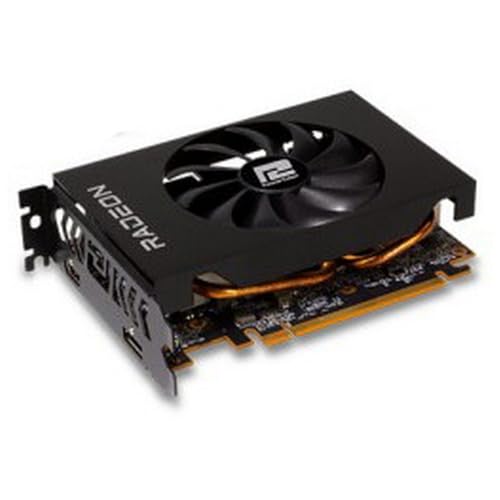
- PowerColor Fighter Radeon RX 6500 XT — Best for newer architecture: an RDNA 2 card with 1024 stream processors and 4GB of GDDR6.
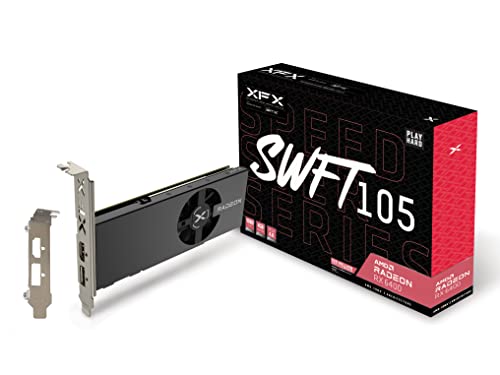
- XFX Speedster SWFT105 Radeon RX 6400 — Best for slim PCs: a low-profile, single-fan card that needs no power connector.
- PowerColor Radeon RX 6500 XT ITX — Best for very small cases: the RX 6500 XT GPU in a short ITX single-fan form factor.
- ASUS Phoenix GeForce GTX 1050 Ti 4GB — Best for older systems: a single-fan card with 4GB of GDDR5 that runs without a power connector.
MSI GeForce GTX 1650 D6 Ventus XS OCV3
OUR TOP PICK
The MSI GeForce GTX 1650 D6 Ventus XS OCV3 is the top pick because it balances a capable GPU, fast memory and a practical cooler in a card that fits most cases. As stated on the Amazon listing, it uses the NVIDIA GeForce GTX 1650 GPU with 4GB of GDDR6 memory, and the model number is V812-003R. The D6 in the name marks the GDDR6 version of the GTX 1650, which is the variant to look for: GDDR6 memory moves data faster than the older GDDR5 version of the same GPU, so two cards that both say GTX 1650 on the box are not equal, and this one is the better-specified version.
The Ventus XS cooler uses two fans, which gives the card more cooling headroom than the single-fan models in this guide, and that headroom matters in a case with limited airflow. The card is an OC edition, meaning MSI ships it with a factory overclock applied, and the Ventus XS body is shorter than a full-length gaming card, so it suits mid-tower and many compact cases. For a general-purpose gaming PC built around 1080p, this is the most rounded card here: a widely supported GPU, modern memory, and a cooler that does not ask the case to do all the work.
Specs
– Model: V812-003R
– GPU: NVIDIA GeForce GTX 1650, as stated on the listing
– Memory: 4GB GDDR6, as stated on the listing
– Cooler: Ventus XS dual-fan, as stated on the listing
– Edition: OC edition (factory overclocked), as stated on the listing
Pros
– GDDR6 version of the GTX 1650, the faster memory variant of this GPU
– Dual-fan Ventus XS cooler for better cooling headroom in warm cases
– Compact card length suits mid-tower and many smaller cases
Cons
– Larger than the low-profile and ITX cards in this guide, so it will not fit slim prebuilt cases
– The GTX 1650 is an entry-level GPU, so demanding games will need reduced settings at 1080p
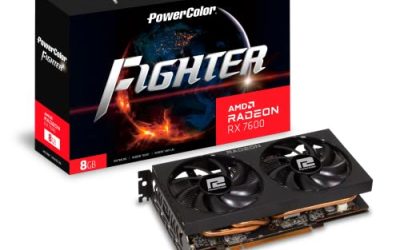
PowerColor Fighter Radeon RX 6500 XT
The PowerColor Fighter Radeon RX 6500 XT is the runner-up, and the pick for a buyer who wants the newer AMD architecture in this class. As stated on the Amazon listing, it uses the Radeon RX 6500 XT GPU with 1024 stream processors and 4GB of GDDR6 memory on a 64-bit bus, and the model number is AXRX 6500XT 4GBD6-DH/OC. The RX 6500 XT is built on AMD’s RDNA 2 architecture, the same generation used in far more expensive cards, so it brings modern driver support and features to a small card.
One specification deserves attention before buying: as stated on the listing, the card connects over PCIe 4.0 x4, meaning it uses four lanes of the PCIe slot rather than sixteen. In a PC with a PCIe 4.0 motherboard, that is how the card is designed to run. In an older PC with only PCIe 3.0, the narrower link has less bandwidth to work with, and the card gives up some of its performance. That makes this card a better match for a newer motherboard than for a very old system, and it is the main reason it sits behind the GTX 1650 as a general recommendation while remaining the stronger choice for a recent build. The Fighter cooler is a straightforward dual-fan design in a standard two-slot body, so case fit is rarely a problem outside very small enclosures.
Specs
– Model: AXRX 6500XT 4GBD6-DH/OC
– GPU: AMD Radeon RX 6500 XT, as stated on the listing
– Stream processors: 1024, as stated on the listing
– Memory: 4GB GDDR6, 64-bit bus, as stated on the listing
– Interface: PCIe 4.0 x4, as stated on the listing
Pros
– RDNA 2 architecture with current AMD driver support
– 1024 stream processors, the highest count in this guide
– Standard two-slot dual-fan body fits most tower cases
Cons
– PCIe 4.0 x4 interface loses ground in older PCIe 3.0 motherboards
– 64-bit memory bus is narrow, so memory bandwidth is limited
XFX Speedster SWFT105 Radeon RX 6400
The XFX Speedster SWFT105 Radeon RX 6400 is the card in this guide built for slim and small-form-factor PCs. As stated on the listing, it uses the Radeon RX 6400 GPU with 4GB of GDDR6 memory, 768 stream processors and a boost clock up to 2321 MHz, and the model number is RX-64XL4SFG2. It is a low-profile, single-fan card, and it needs no PCIe power connector, drawing its power from the motherboard slot alone.
Those three facts together define its job. Low-profile means it fits the slim desktop cases used by many prebuilt office PCs, which cannot take a full-height card. No power connector means it works with the modest power supplies those machines ship with, where there may be no spare cable for a graphics card at all. The RX 6400 is also an RDNA 2 GPU, so it carries modern driver support into a machine that may be several years old. The trade-off is performance: with 768 stream processors it is the least powerful GPU in this guide, suited to esports titles, older games and lighter 1080p play rather than demanding releases. For turning a slim office PC into a light gaming machine without changing the power supply or the case, it is the only card here shaped for exactly that task.
Specs
– Model: RX-64XL4SFG2
– GPU: AMD Radeon RX 6400, RDNA 2, as stated on the listing
– Stream processors: 768, as stated on the listing
– Boost clock: up to 2321 MHz, as stated on the listing
– Memory: 4GB GDDR6, as stated on the listing
– Form factor: low-profile, single fan, no PCIe power connector required, as stated on the listing
Pros
– Low-profile body fits slim prebuilt and small-form-factor cases
– No power connector needed, so it works with modest power supplies
– RDNA 2 GPU with 4GB of GDDR6 memory
Cons
– Least powerful GPU in this guide, aimed at lighter games and esports titles
– Single-fan cooler has less cooling headroom than the dual-fan cards here
PowerColor Radeon RX 6500 XT ITX
The PowerColor Radeon RX 6500 XT ITX puts the same GPU as the Fighter model above into a much shorter card. As stated on the listing, it uses the Radeon RX 6500 XT GPU with 4GB of GDDR6 memory in an ITX single-fan form factor, and the model number is AXRX 6500XT 4GBD6-DH. ITX-length cards are built for mini-ITX cases, where the limiting dimension is card length: a standard dual-fan card simply does not fit, no matter how good the rest of the build is.
Choosing between this card and the Fighter is therefore mostly a measuring exercise. The GPU, the memory capacity and the memory type are the same family of specification, so the decision comes down to the case. If the build is a standard tower, the Fighter’s larger cooler is the easier card to live with. If the build is a small cube or a console-style mini-ITX case with a short graphics card bay, this ITX version is the one that fits, and it brings a current-generation GPU with it rather than asking the builder to step down to an older, weaker card just to clear the case wall. Like the Fighter, it uses the PCIe x4 connection of the RX 6500 XT design, so it is happiest in a PCIe 4.0 motherboard, and a single fan means case airflow still matters even in a small build.
Specs
– Model: AXRX 6500XT 4GBD6-DH
– GPU: AMD Radeon RX 6500 XT, as stated on the listing
– Memory: 4GB GDDR6, as stated on the listing
– Form factor: ITX length, single fan, as stated on the listing
Pros
– Full RX 6500 XT GPU in a short ITX-length body
– Suits mini-ITX and other very small cases that cannot take a standard card
– 4GB of GDDR6 memory, matching the larger RX 6500 XT models
Cons
– Single-fan cooler, so it depends on decent case airflow
– Same PCIe x4 consideration as the Fighter in older PCIe 3.0 systems
ASUS Phoenix GeForce GTX 1050 Ti 4GB
The ASUS Phoenix GeForce GTX 1050 Ti 4GB is the oldest GPU in this guide, and it earns its place for one specific job: upgrading an older PC with the least possible fuss. As stated on the listing, it uses the NVIDIA GeForce GTX 1050 Ti GPU with 4GB of GDDR5 memory and a boost clock of 1392 MHz, and the model number is PH-GTX1050TI-4G. It is a single-fan Phoenix card, and it needs no PCIe power connector, running from the slot alone.
That combination made the GTX 1050 Ti a common upgrade for prebuilt PCs for years, and the reasoning still holds for a machine of that era: the card is short, the power supply does not need a spare connector, and 4GB of memory is enough for the older games and esports titles such a PC is likely to run. The limits are equally clear. GDDR5 is slower memory than the GDDR6 fitted to every other card in this guide, the GPU architecture is the oldest here, and driver support for this generation is in its later stages. For a recent build, the GTX 1650 and the RX 6500 XT cards above are better places to put money. For keeping an older tower useful, this is a simple, well-understood card that asks nothing of the rest of the system.
Specs
– Model: PH-GTX1050TI-4G
– GPU: NVIDIA GeForce GTX 1050 Ti, as stated on the listing
– Memory: 4GB GDDR5, as stated on the listing
– Boost clock: 1392 MHz, as stated on the listing
– Cooler: Phoenix single fan, no PCIe power connector required, as stated on the listing
Pros
– No power connector needed, so it suits older PCs and small power supplies
– Short single-fan body fits most cases, including many prebuilt towers
– Simple, widely supported card for older games and esports titles
Cons
– GDDR5 memory is slower than the GDDR6 in the other cards here
– Oldest GPU architecture in this guide, with the least headroom for newer games
How to Choose
Begin with the case, because it rules out more cards than any performance figure. Measure the length available for a graphics card and check whether the case takes full-height or only low-profile cards. A slim prebuilt points straight at the XFX RX 6400, a mini-ITX build points at the PowerColor RX 6500 XT ITX, and a standard tower leaves all five cards open.
Next, check the power supply. Two cards in this guide, the RX 6400 and the GTX 1050 Ti, run entirely from the motherboard slot and need no power connector, which makes them the safe picks for a PC with a small or basic power supply. For the other cards, confirm the power supply is adequate for a discrete gaming card and has whatever connection the specific model requires, using the listing for that model as the reference.
Then look at the motherboard generation, because it changes what the RX 6500 XT cards deliver. Both PowerColor models connect over PCIe 4.0 x4, so they perform as designed in a PCIe 4.0 system and give up ground in a PCIe 3.0 one. In an older PCIe 3.0 machine, the GTX 1650 avoids that issue entirely, which is one reason it is the top pick for a general recommendation.
After that, match the GPU to the games. All five cards carry 4GB of memory, which suits 1080p play in esports titles and older or lighter games, with settings adjusted in demanding releases. Within that shared limit, the RX 6500 XT has the most stream processors here, the GTX 1650 is the balanced all-rounder, and the RX 6400 and GTX 1050 Ti trade speed for easy installation in small or old systems.
Finally, check the memory type on the exact model, not just the GPU name. This guide includes a GDDR6 GTX 1650 and a GDDR5 GTX 1050 Ti, and across the wider market the same GPU name can appear with different memory. The listing for the specific card, with its model number, is the document that settles what is actually in the box.
FAQs
Is 4GB of video memory enough for gaming?
For 1080p play in esports titles, older games and many lighter releases, yes, with settings adjusted to suit. Demanding recent games at high settings can want more than 4GB for textures, and in those titles a 4GB card will need reduced texture and detail settings to run smoothly. The cards in this guide are best understood as entry-level and small-system cards, not as high-settings cards for the newest releases.
Does a 4GB graphics card need a power connector?
Some do and some do not, and it depends on the model rather than the memory size. In this guide, the XFX RX 6400 and the ASUS GTX 1050 Ti run from the motherboard slot with no connector, which suits PCs with modest power supplies. Before buying any card, check the listing for that exact model and confirm what your power supply can support.
Which of these cards fits a small or slim PC?
The XFX RX 6400 is the low-profile card here, made for slim cases, and it needs no power connector. The PowerColor RX 6500 XT ITX is the short card for mini-ITX cases where length is the limit. The other three cards are standard-height designs for tower cases, so measure the case and compare it with the card dimensions on the listing before choosing.
Conclusion
For most buyers, the MSI GeForce GTX 1650 D6 Ventus XS OCV3 is the top pick, pairing the GDDR6 version of the GTX 1650 with a dual-fan cooler in a compact body. The PowerColor Fighter Radeon RX 6500 XT is the runner-up for a newer PCIe 4.0 build, the XFX RX 6400 suits slim PCs with no spare power connector, the RX 6500 XT ITX fits mini-ITX cases, and the ASUS GTX 1050 Ti remains the simple upgrade for older systems. Before buying, measure the case, check the power supply, and confirm the motherboard’s PCIe generation.
Related guides
More from Amazon
Programs that pair well with the guide above. Offers and eligibility are set by Amazon and may change.
Free shipping on eligible items, Prime Video and more. Eligible new members can start with a free trial.
Start a Prime free trialAd-free music streaming. Eligible new subscribers can start with a free trial.
Try Music Unlimited freeA Prime membership for ages 18-24 with a trial period. Eligibility is set by Amazon.
See Prime for Young AdultsAudiobooks and podcasts to listen to on the go. Eligible new members can start with a free trial.
Try Audible freeAs an Amazon Associate we earn from qualifying purchases.