As an Amazon Associate we earn from qualifying purchases
A wireless gaming mouse only feels wireless if you can forget where the charging cable is. If you are plugging in every second night, the cable has not really left your desk — it has just become an appointment. The best gaming mouse with long battery life is therefore not simply the one with the biggest number on the box. It is the one whose manufacturer-rated runtime, at the polling rate and lighting settings you actually use, stretches across weeks of ordinary play instead of days, while still giving you a sensor, shape, and switch feel that suit your games.
Every battery figure in this guide is a manufacturer rating taken from the product listing or the maker’s specifications, and every rating comes with conditions. Runtime is usually quoted for constant motion at a standard polling rate, often with lighting off. Raise the polling rate, turn the lighting up, or switch connection modes, and the same mouse can last a fraction as long. Reading those conditions honestly is the difference between a mouse that genuinely goes a month between charges and one that disappoints you by the second weekend.
Our Top Picks
 Logitech G502 X Plus Wireless RGB Gaming MouseWireless7.1 x 4.6 x 2.7 inches0.84 poundsCheck on Amazon
 Logitech G Pro X Superlight 2 Lightspeed WirelessClassic1.57 x 2.5 x 4.92 inches0.1 poundsCheck on Amazon
 Razer DeathAdder V3 Pro Wireless Gaming Mouse1000 Hz5.01 x 2.65 x 1.69 inches0.1 poundsCheck on Amazon
Top 3 picks at a glance
What “long battery life” actually means in hours
It helps to translate hours into a routine. A rating of 90 hours sounds abstract until you divide it by your own schedule. At three hours of play a day, 90 hours of rated runtime is roughly a month of evenings before you need to think about power. At six hours a day, it is about two weeks. A 250-hour rating, by the same rough maths, covers many weeks of daily sessions. These are estimates based on the rated figures, not guarantees, because real use mixes active motion, idle time, sleep states, and short desktop sessions between games.
Three settings dominate how close you get to the headline number. Polling rate is the biggest lever on modern performance mice: a mouse rated for around 90 hours at 1,000 Hz can fall to well under 20 hours when an optional high-polling mode pushes it toward 8,000 Hz, because the radio and sensor are working far harder. Lighting is the second lever, and on RGB models it is dramatic — one pick below drops from 120 hours with lighting off to 37 hours with its lighting on. Connection mode is the third: Bluetooth almost always sips less power than a 2.4 GHz gaming connection, so dual-mode mice quote their longest figures over Bluetooth, at the cost of a slower report rate that most players would not choose for fast games.
Battery type matters too. Rechargeable models with a built-in cell are convenient and top up over USB-C, often while you keep playing wired. Models that run on a single AA cell cannot be recharged, but they offer a different kind of freedom: when the cell finally fades, you swap it in seconds and you are back to a full runtime immediately, with no cable session at all. Neither approach is automatically better. It depends on whether you would rather plug in occasionally or keep a spare battery in a drawer.
The picks
1. Logitech G305 LIGHTSPEED — the longest rated runtime here

The Logitech G305 LIGHTSPEED is the endurance outlier in this roundup, and it gets there with the simplest possible formula: an efficient sensor, no lighting to feed, and a single AA battery. Logitech rates it for up to 250 hours of continuous gameplay on that one cell in its performance mode, which is the highest gaming-mode figure among the mice in this article. There is also a lower-power endurance behaviour available through Logitech’s software for stretches when you value runtime over the fastest report rate, which suits a mouse that doubles for work and travel.
The rest of the specification explains why this mouse has stayed popular for so long. The HERO sensor reaches up to 12,000 DPI with tracking rated above 400 IPS, and the LIGHTSPEED connection reports at 1 millisecond, so the long runtime does not come with a sluggish connection. The body weighs 99 grams with the battery fitted, has six programmable buttons, onboard memory for your settings, and a compartment in the shell that stores the USB receiver — a small detail that matters a lot if the mouse travels in a laptop bag. The shape is a compact, safe, egg-like design that works for claw and fingertip grips and for smaller to medium hands.
The trade-offs are clear and honest. There is no Bluetooth, so the receiver is the only way to connect. There is no rechargeable cell, so your long-term running plan is a supply of AA batteries, and there is no lighting at all if that matters to your setup. The sensor, while accurate and proven, is an older generation than the flagship sensors below. For a player whose first priority is going as long as possible between battery changes — especially in shooters and everyday games where 12,000 DPI of clean tracking is plenty — the G305 remains the benchmark for runtime per battery.
2. Logitech G502 X Plus — 120 hours, if you keep the lights off
The Logitech G502 X Plus shows both sides of the battery story in a single product. Logitech rates it for up to 120 hours of constant-motion use, which is an excellent figure for a full-featured flagship — and for just 37 hours with its LIGHTSYNC RGB lighting switched on. That gap is the most useful lesson in this whole guide: on a feature-rich mouse, lighting is not a cosmetic extra, it is the main battery budget. Buy this mouse for its runtime and you should plan to run it dark, or accept a charging rhythm closer to once a week.
With the lighting question settled, what you get is a heavily equipped right-handed mouse. The HERO 25K sensor covers up to 25,600 DPI, the LIGHTFORCE switches are hybrid optical-mechanical designs intended to combine fast optical actuation with a mechanical click feel, and there are 13 programmable controls, including a removable and reversible DPI-shift button and a dual-mode scroll wheel that switches between free-spinning and ratcheted scrolling, with tilt inputs as well. It weighs around 106 grams, charges over USB-C, and is compatible with Logitech’s POWERPLAY wireless charging system, which is sold separately and removes the charging question entirely for desks that use it.
This is the pick for players who want long battery life without giving up a large, sculpted shape and a deep button layout — MMO, MOBA, and mixed work-and-play users who map a lot of commands. Fingertip players with small hands, and anyone chasing the lightest possible aim, will find it bulky. But judged on the keyword of this article, a 120-hour rating in a mouse this fully featured is genuinely strong, provided the RGB stays off or low.
3. Razer Basilisk V3 Pro — up to 110 hours over HyperSpeed, 150 over Bluetooth
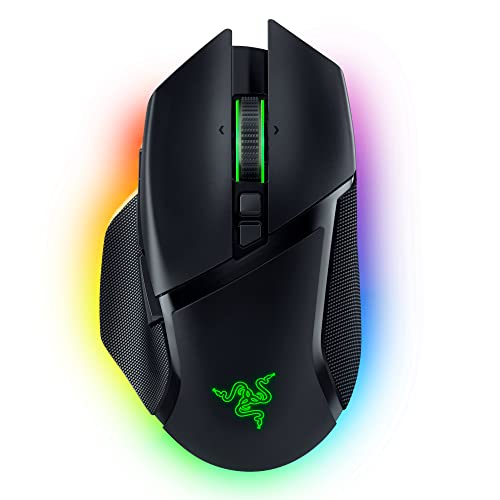
The Razer Basilisk V3 Pro is the other big, ergonomic, button-rich option here, and Razer’s current specifications give it up to 110 hours on its HyperSpeed wireless connection at a 1,000 Hz polling rate, rising to up to 150 hours over Bluetooth. As with the DeathAdder below, the very fast optional polling mode is the exception: with the separately sold HyperPolling equipment at 8,000 Hz, the rating falls to around 32 hours. In its standard gaming mode, though, this is one of the longest-lasting flagship mice available, and the Bluetooth figure makes it unusually flexible for a second machine or a work laptop during the day.
The hardware around that battery is extensive. The Focus Pro 30K optical sensor reaches 30,000 DPI, the HyperScroll wheel tilts and switches between tactile and free-spin modes, and there are 13 programmable controls when the tilt inputs are counted, along with Razer’s third-generation optical switches and Chroma RGB across multiple zones. It connects three ways — HyperSpeed wireless, Bluetooth, and wired USB-C — and it supports wireless charging through Razer’s dock system, which is sold separately and requires the charging puck setup. At around 112 grams it is a substantial mouse that fills the hand, aimed squarely at palm-grip players with medium to large hands.
Choose the Basilisk V3 Pro if you want the long-runtime flagship that also does everything else: lots of buttons, a versatile wheel, and a Bluetooth mode that stretches battery life even further on days when you are not playing competitively. Keep in mind that using its lighting and its fastest polling options will pull the real interval between charges well below the headline figures, as it will on every mouse here.
4. Logitech G PRO X Superlight 2 — 95 hours in a 60-gram esports mouse
The Logitech G PRO X Superlight 2 proves that long battery life does not require a heavy mouse with a huge cell. Logitech rates it for up to 95 hours of constant-motion use, and it achieves that while weighing only 60 grams — a combination that matters because competitive players used to assume endurance and low weight traded against each other. It charges over USB-C and is also compatible with the POWERPLAY wireless charging system, sold separately, for players who want to remove charging from their routine altogether.
The performance specification is aimed at esports. The HERO 2 sensor, five programmable buttons, LIGHTFORCE hybrid switches, and support for high polling rates through its LIGHTSPEED connection put it in the same conversation as wired tournament mice, and its symmetrical shape is one of the most widely used designs in competitive shooters, suiting claw and fingertip grips especially well. There is no lighting, which is both an aesthetic choice and part of how the runtime stays high, and there is no Bluetooth and no dedicated DPI button, so adjustments happen through software or a button assignment.
The Superlight 2 is the right answer for a competitive player who plays long scrim and ranked sessions and wants a mouse that can go a couple of weeks of heavy use between charges without ever feeling like an endurance product. Players who want buttons, lighting, or multi-device switching should look at the two feature-rich picks above instead.
5. Razer DeathAdder V3 Pro — up to 90 hours, ergonomic and 63 grams
The Razer DeathAdder V3 Pro rounds out the list with up to 90 hours of battery life on its HyperSpeed wireless connection at the standard 1,000 Hz polling rate, rechargeable over USB-C. Razer’s own guidance makes the polling trade-off explicit: with the separately sold HyperPolling Wireless Dongle running at 8,000 Hz, the rating drops to up to 17 hours. That is not a flaw unique to this mouse — it is the physics of high polling — but it means the long-battery version of this mouse is the one running at its default settings, which are already fast enough for the overwhelming majority of players.
What makes the DeathAdder distinctive is the shape. It is a right-handed ergonomic design, refined over many generations, in a shell that weighs approximately 63 grams for the black version. Inside are the Focus Pro 30K optical sensor, rated up to 30,000 DPI and 750 IPS, and Razer’s third-generation optical switches, with five programmable buttons keeping the layout clean and focused. There is no lighting and no tilt wheel; the design budget went into the shape, the weight, and the runtime.
Pick the DeathAdder V3 Pro if you are a palm or relaxed claw player with a medium to large hand who wants an ergonomic mouse that still weighs almost nothing and still runs for weeks of ordinary sessions per charge. Small-handed and fingertip players will usually be better served by the Superlight 2 above, which offers a similar runtime in a symmetrical shell.
How to make any of these mice last longer
Whatever you buy, a few habits will move your real runtime closer to the rated one. Turn lighting off, or set it to a low, static brightness, and treat animated effects as a feature you enable for an evening rather than a default. Leave the polling rate at 1,000 Hz unless you have a specific reason to raise it; the jump to very high polling is the single fastest way to drain a performance mouse, and most players will not feel a proportionate benefit. Use Bluetooth, where a mouse offers it, for desktop work and slower games, and save the 2.4 GHz connection for play that needs it. Set a sensible sleep timer in the software so the mouse powers down promptly between sessions instead of idling awake on your desk. Finally, top up little and often rather than running a rechargeable mouse completely flat before a long session — a short charge while you make coffee is easier than a cable tethered across your pad mid-game.
Which long-battery mouse should you buy?
Start with the runtime style you prefer. If you want the longest possible interval and the simplest routine, the G305’s 250-hour rating on a single AA battery is unmatched here, and swapping a cell takes seconds. If you want a rechargeable flagship with every feature and can live with the lights off, the G502 X Plus at 120 hours and the Basilisk V3 Pro at up to 110 hours over HyperSpeed are the two full-sized, button-rich choices, split mainly by shape, wheel, and software ecosystem. If you play competitive shooters and count grams as carefully as hours, the Superlight 2 pairs 95 hours with a 60-gram symmetrical shell, while the DeathAdder V3 Pro pairs 90 hours with a 63-gram ergonomic one.
Whichever direction you go, judge battery claims by their conditions, not just their size. A slightly lower rating quoted at the settings you will actually use is worth more than a headline figure that depends on a mode you will never select. Choose the mouse whose honest, everyday configuration still lasts for weeks — that is the best gaming mouse with long battery life for your desk.
Related guides
More from Amazon
Programs that pair well with the guide above. Offers and eligibility are set by Amazon and may change.
Free shipping on eligible items, Prime Video and more. Eligible new members can start with a free trial.
Start a Prime free trialAd-free music streaming. Eligible new subscribers can start with a free trial.
Try Music Unlimited freeA Prime membership for ages 18-24 with a trial period. Eligibility is set by Amazon.
See Prime for Young AdultsAudiobooks and podcasts to listen to on the go. Eligible new members can start with a free trial.
Try Audible freeAs an Amazon Associate we earn from qualifying purchases.