The best routers for att fiber are the ones that can actually keep up with a fiber line: a fast WAN port, modern WiFi, and enough processing power to move gigabit traffic without choking when the whole household is online at once. AT&T Fiber delivers symmetrical speeds, which means your upload speed matches your download speed, and that changes what matters in a router. A weak router becomes the bottleneck on a connection that should feel instant, while the right router lets a fiber plan do what it is built to do.
There is one setup detail that shapes every pick on this list. AT&T Fiber service runs through an AT&T gateway, such as the BGW320, which connects to the fiber terminal in your home. In most cases you cannot remove that gateway completely, so the standard approach is to connect your own router behind it and set the gateway to IP Passthrough mode, which hands the public connection to your router and lets your router handle WiFi, routing, and device management. You should also turn off the gateway WiFi so the two networks do not compete.
This guide covers five routers for different homes and AT&T Fiber plans, from a single gaming setup in an apartment to a large house that needs mesh coverage. Each pick is chosen for a specific strength: gaming latency, WiFi 6E coverage, mesh reach, or straightforward value for a gigabit plan.
Our Top Picks
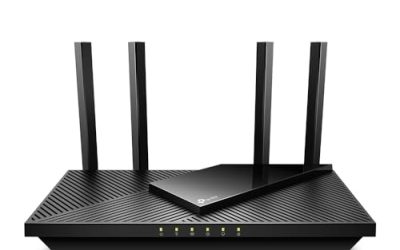
 TP-Link AXE5400 Tri-Band WiFi 6E RouterWiFi 6E, Tri-Band AXE540012.91 x 10.43 x 4.72 inches1.5 poundsCheck on Amazon
Top 3 picks at a glance

How to Choose
1. Match the WAN port to your fiber plan
The WAN port is the single most important specification for a fiber router, because it sets the ceiling on the speed your router can receive from the gateway. AT&T Fiber plans commonly run at 300 Mbps, 500 Mbps, 1 Gig, 2 Gig, and 5 Gig. A router with a gigabit WAN port can use plans up to 1 Gig, but it cannot pass more than a gigabit even if your plan is faster. If you subscribe to a 2 Gig or 5 Gig plan, look for a router with a 2.5 Gbps WAN port or faster, so the router does not cap your connection at the first hop.
2. Pick WiFi 6 or WiFi 6E for the wireless side
WiFi 6 is the baseline worth buying in this category, because it handles many connected devices far better than older WiFi 5 hardware. WiFi 6E adds a 6 GHz band on top of the familiar 2.4 GHz and 5 GHz bands, which gives newer phones, laptops, and consoles a clean lane with less interference from neighbors. The 6 GHz band has shorter range than 5 GHz, so it helps most in the same room as the router. If your devices are recent, WiFi 6E is a real upgrade; if most of your gear is older, a strong WiFi 6 router serves you just as well.
3. Plan for the gateway setup
Before you buy, confirm that you are comfortable setting the AT&T gateway to IP Passthrough mode and disabling its WiFi. The steps are straightforward: log in to the gateway settings, enable IP Passthrough, point it at your new router, and switch off the gateway wireless radios. A router with a clear mobile app makes this process easier, because you can run through its setup wizard from your phone while the gateway page is open on a laptop.
4. Count your devices and your square footage
A fiber connection invites more devices onto the network: phones, laptops, consoles, streaming boxes, smart speakers, cameras, and smart home gear. A router with a quad-core processor and OFDMA and MU-MIMO support will keep latency low when many devices are active at once, which matters for gaming and video calls. A single powerful router covers a typical apartment or a small house, but a larger or multi-story home usually needs a mesh system, where two or three units work together to cover every room without dead zones.
5. Look at the wired ports
Wireless speed gets the attention, but the wired ports decide how your gaming PC, console, and streaming box perform. A dedicated gaming port that prioritizes traffic from whatever is plugged into it is a genuine plus for competitive play. Link aggregation, which bonds two LAN ports together for a faster connection to a network storage device, is useful if you run a home server. Count the LAN ports too: four is standard, and if you have more wired devices than that, you will need a small switch.
6. Weigh security and parental controls
A router is the front door to your home network, so its built-in security features matter. Look for WPA3 encryption, automatic security updates, and a network protection suite that blocks malicious sites. Parental controls that let you set schedules and filter content per device are useful in a family home, and a VPN client or server lets you protect traffic or reach your home network remotely.
Top Picks
1. ASUS RT-AX86U Pro — Best Overall for AT&T Fiber

The ASUS RT-AX86U Pro is the strongest all-around pick for AT&T Fiber, and it is the router to choose when you want one device that handles gaming, streaming, and a busy household without fuss. It is a dual-band WiFi 6 router rated at AX5700, with a 2.5 Gbps port that pairs well with 1 Gig and 2 Gig AT&T Fiber plans, a dedicated gaming port, and three external antennas. Its quad-core processor keeps latency low when several people are online at once.
Setup behind an AT&T gateway is simple with this router. Connect its WAN port to a LAN port on the gateway, enable IP Passthrough on the gateway, and run the ASUS Router app setup wizard. The router supports AiMesh, so if coverage turns out to be short in a far room, you can add another ASUS router later and turn the two into a mesh network. AiProtection Pro provides network security with no subscription, and the router also supports VPN client and server modes, port forwarding, and a mobile game mode.
Who it is for: gamers and busy households on a 1 Gig or 2 Gig AT&T Fiber plan who want low latency, a 2.5 Gbps port, and room to expand coverage later.
Caveats: it is a WiFi 6 router rather than WiFi 6E, so it has no 6 GHz band for newer devices. The vertical design takes up more shelf space than a flat router, and the gaming features add settings that a non-gaming household may never touch.
2. TP-Link Archer AXE75 — Best WiFi 6E Router for AT&T Fiber
The TP-Link Archer AXE75 is the pick for anyone who wants WiFi 6E on an AT&T Fiber connection without stepping up to flagship hardware. It is a tri-band AXE5400 router with a dedicated 6 GHz band, a 2.5 Gbps WAN port, six external antennas, and a 1.7 GHz quad-core processor. The 6 GHz band gives newer phones, laptops, and consoles a low-interference lane for gaming and streaming, while the 2.5 Gbps WAN port keeps the router ready for 2 Gig fiber plans.
In an AT&T Fiber home, the AXE75 sits behind the gateway in IP Passthrough mode and takes over all WiFi duties. The Tether app walks through setup, and OneMesh support means you can add a compatible TP-Link extender later if a corner of the house needs help. HomeShield provides network security and parental controls, and the router supports VPN client and server modes plus WPA3 encryption.
Who it is for: households with newer WiFi 6E devices on a 1 Gig or 2 Gig AT&T Fiber plan, especially in apartments and townhouses where neighboring networks crowd the 5 GHz band.
Caveats: the 6 GHz band has shorter range than the 5 GHz band, so its advantage fades in far rooms. The router has gigabit LAN ports rather than multi-gig LAN, so a wired device cannot exceed gigabit speed even though the WAN port is faster.
3. NETGEAR Nighthawk RAX50 — Best Straightforward WiFi 6 Pick
The NETGEAR Nighthawk RAX50 is the simplest pick on this list, and it suits anyone who wants a capable WiFi 6 router for a 1 Gig AT&T Fiber plan without extra features to manage. It is a dual-band AX5400 router with six streams, four external antennas, and coverage rated for up to 2,500 square feet, which covers most apartments and single-story homes. The Nighthawk app handles setup, and the router supports WPA3 security, guest network access, and parental controls.
Behind an AT&T gateway, the RAX50 works like any standard router: one cable from the gateway to its WAN port, IP Passthrough enabled on the gateway, and the gateway WiFi switched off. Its four gigabit LAN ports and a USB 3.0 port cover the usual wired devices and a shared drive or printer. The six-stream design helps when many devices are connected at once, and the 5 GHz band carries the heavy traffic while the 2.4 GHz band serves smart home devices and gear at longer range.
Who it is for: households on a 300 Mbps, 500 Mbps, or 1 Gig AT&T Fiber plan who want a reliable WiFi 6 router with simple setup and no interest in mesh or WiFi 6E.
Caveats: the WAN port is gigabit only, so this router cannot use a 2 Gig or 5 Gig plan to its full speed. It has no 6 GHz band and no multi-gig port, which limits its headroom if you upgrade your plan later.
4. ASUS RT-AXE7800 — Best WiFi 6E Upgrade with Room to Grow

The ASUS RT-AXE7800 is the step up from the AX86U Pro for buyers who want WiFi 6E alongside a 2.5 Gbps port. It is a tri-band AXE7800 router with 2.4 GHz, 5 GHz, and 6 GHz bands, a 2.5 Gbps WAN and LAN port, link aggregation, and a 1.7 GHz quad-core processor. The higher throughput rating and the extra band give it more capacity for a household with many devices.
This router fits an AT&T Fiber home in the same way as the other ASUS pick: behind the gateway in IP Passthrough mode, with the gateway WiFi disabled. AiProtection Pro, Safe Browsing, parental controls, and Instant Guard VPN come built in, and AiMesh support lets you extend coverage with another ASUS router. The 2.5 Gbps port can serve as either the WAN or a LAN port, which is handy if you want a multi-gig wired link to a gaming PC or a network storage device.
Who it is for: households on a 1 Gig or 2 Gig AT&T Fiber plan that want WiFi 6E, strong security features, and the option to expand into a mesh network later.
Caveats: it costs more than the WiFi 6 picks on this list, and the 6 GHz advantage only applies to devices that support WiFi 6E. Its feature set is deep, so the settings pages take longer to learn than a simpler router.
5. TP-Link Deco XE75 (3-Pack) — Best Mesh System for Large AT&T Fiber Homes

The TP-Link Deco XE75 3-pack is the pick for a large or multi-story home where a single router leaves dead zones, and it is the only mesh system on this list. It is a tri-band WiFi 6E mesh system rated at AXE5400, with three units that work together to cover up to 7,200 square feet. The AI-driven mesh routing steers devices to the best unit as they move around the house, and the Deco app makes setup simple.
To use it with AT&T Fiber, connect the main Deco unit to the gateway, enable IP Passthrough on the gateway, and place the other two units where coverage is thin. The system supports WPA3, parental controls, and HomeShield security features, and it handles the handoff between units so a video call keeps running as you walk from one room to another.
Who it is for: large or multi-story homes on a 300 Mbps, 500 Mbps, or 1 Gig AT&T Fiber plan where whole-home coverage matters more than a single fast port.
Caveats: the standard XE75 units have gigabit Ethernet ports rather than multi-gig ports, so this system cannot pass more than a gigabit from the gateway to a wired device. Mesh nodes need a power outlet and a sensible placement, and putting a node too far from the main unit hurts the speed it can deliver.
Comparison Table
| Router | WiFi Standard | Speed Class | WAN Port | Bands | Mesh Support | Best For |
|---|---|---|---|---|---|---|
| ASUS RT-AX86U Pro | WiFi 6 | AX5700 | 2.5 Gbps | Dual-band | AiMesh | Gaming and all-around use |
| TP-Link Archer AXE75 | WiFi 6E | AXE5400 | 2.5 Gbps | Tri-band | OneMesh | WiFi 6E on a mid-range budget |
| NETGEAR Nighthawk RAX50 | WiFi 6 | AX5400 | Gigabit | Dual-band | No | Simple setup on a 1 Gig plan |
| ASUS RT-AXE7800 | WiFi 6E | AXE7800 | 2.5 Gbps | Tri-band | AiMesh | WiFi 6E with room to expand |
| TP-Link Deco XE75 (3-Pack) | WiFi 6E | AXE5400 | Gigabit | Tri-band | Built-in mesh | Large and multi-story homes |
Which One Is Right for You?
Start with your AT&T Fiber plan, because it sets the WAN port you need. On a 2 Gig plan, the ASUS RT-AX86U Pro, the TP-Link Archer AXE75, and the ASUS RT-AXE7800 are the picks that can use the full connection, thanks to their 2.5 Gbps WAN ports. On a 1 Gig plan or slower, any router on this list works, and the choice comes down to WiFi standard and coverage.
For a gaming household, the ASUS RT-AX86U Pro is the natural first choice: its dedicated gaming port, traffic prioritization, and 2.5 Gbps port are aimed squarely at low latency. If your gaming devices support WiFi 6E, the ASUS RT-AXE7800 adds the 6 GHz band to the same formula, while the TP-Link Archer AXE75 delivers WiFi 6E at a lower tier.
For a home where the 5 GHz band is crowded by neighboring networks, any of the three WiFi 6E picks helps, because the 6 GHz band is far less congested. For a large or multi-story home, skip the single-router picks and go straight to the TP-Link Deco XE75 3-pack, because no single router can cover a big house as evenly as three mesh units. And if you simply want a capable router that is easy to set up and easy to forget about, the NETGEAR Nighthawk RAX50 covers a 1 Gig plan with the least fuss.
Whatever you choose, remember the gateway step: enable IP Passthrough on the AT&T gateway, disable its WiFi, and let your new router run the network.
Frequently Asked Questions
Can I replace the AT&T gateway with my own router?
In most cases you cannot remove the AT&T gateway entirely, because it authenticates the fiber connection. The standard setup is to keep the gateway in place, enable IP Passthrough mode so it hands the public connection to your router, and connect your router to one of the gateway LAN ports. Your router then handles WiFi, routing, and device management. Disable the gateway WiFi so the two networks do not interfere with each other.
Do I need a 2.5 Gbps WAN port for AT&T Fiber?
It depends on your plan. A gigabit WAN port is enough for 300 Mbps, 500 Mbps, and 1 Gig plans. If you subscribe to a 2 Gig or 5 Gig plan, you need a router with a 2.5 Gbps WAN port or faster to use the full speed of the plan. If you plan to upgrade later, a 2.5 Gbps port is worth having now so the router does not need replacing when the plan changes.
Is WiFi 6E worth it on AT&T Fiber?
WiFi 6E is worth it if your phones, laptops, or consoles support the 6 GHz band, because that band is much less crowded than the 5 GHz band and delivers lower latency in the same room as the router. If most of your devices are older and only support WiFi 6 or WiFi 5, a strong WiFi 6 router gives you the same practical experience for less.
Why is my new router slower than the AT&T gateway WiFi?
The most common cause is double NAT, which happens when the gateway is still routing traffic and handing out addresses alongside your router. Enable IP Passthrough on the gateway and make sure your router is the only device managing the network. Other causes include a loose or damaged Ethernet cable between the gateway and the router, a WAN port that is slower than your plan, or a router placed in a cabinet or behind a television where its signal is blocked. Check the cable, the gateway settings, and the router placement in that order.
Disclosure: As an Amazon Associate, we may earn from qualifying purchases.
Related guides
More from Amazon
Programs that pair well with the guide above. Offers and eligibility are set by Amazon and may change.
Free shipping on eligible items, Prime Video and more. Eligible new members can start with a free trial.
Start a Prime free trialAd-free music streaming. Eligible new subscribers can start with a free trial.
Try Music Unlimited freeA Prime membership for ages 18-24 with a trial period. Eligibility is set by Amazon.
See Prime for Young AdultsAudiobooks and podcasts to listen to on the go. Eligible new members can start with a free trial.
Try Audible freeAs an Amazon Associate we earn from qualifying purchases.