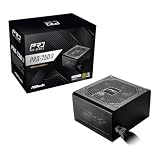
Building an ITX gaming rig means fighting for every cubic centimeter, and your power supply is one of the biggest space hogs you can shrink. A full ATX PSU can measure 150mm long or more and eat half a small case’s internal volume, blocking cable routing and airflow before you’ve even installed a graphics card. An SFX (or ITX-form-factor) unit drops that footprint to roughly 63.5mm wide and 100mm long in most cases, freeing room for a triple-slot GPU, better cooling, or simply a cleaner build in chassis like the Fractal Terra, NZXT H1 lineage, or Lian Li A4-H2O. The catch: SFX units cost more per watt, and the market is full of units that claim 80 Plus efficiency but cut corners on capacitors and fan quality.
Whether you’re powering an entry-level rig with integrated graphics or a Ryzen 7 and RTX 4070-class card, there’s a pick here that fits your case, your budget, and your noise tolerance.
As an Amazon Associate we earn from qualifying purchases at no extra cost to you.


Our Top Picks
 ASUS ROG Loki SFX-L 750W Platinum Power Supply750W|Black4.9 x 4.9 x 2.5 inches4 poundsCheck on Amazon


Top 3 picks at a glance
Quick Picks
| Product | Best for | Price |
|---|---|---|
| Apevia ITX-PFC500W | Varies | Check on Amazon |
| GOLDEN FIELD 550W SFX Platinum | Premium SFF builds wanting max efficiency | Check on Amazon |
| FSP SFX Pro 450W | Compact office/light gaming rigs | Check on Amazon |
| ASUS ROG Loki SFX-L 750W Platinum | High-end SFF with ARGB aesthetics | Check on Amazon |
| GAMEMAX SFX 850W Gold (GS-850G WT) | Power-hungry flagship GPU builds | Check on Amazon |
| GAMEMAX GS 650W Gold (GS-650G WT) | Mainstream mid-range gaming builds | Check on Amazon |
| Apevia ITX-PFC400W | Ultra-budget HTPC and APU builds | Check on Amazon |
How We Compared
We focused on four criteria: form factor compatibility with true ITX and SFX cases, certified efficiency ratings, wattage coverage across realistic build tiers, and warranty support. Every unit here is fully modular, because in a small-form-factor build, every unused cable is wasted space. We prioritized units with active PFC and universal 90-264V input where listed, PWM fan control for noise management, and modern PCIe connectivity for current graphics cards. We also weighed price-per-watt against brand reliability and warranty length, since a PSU failure in a tightly packed SFF case can take other components down with it.
The 7 Best Picks
1. Apevia ITX-PFC500W Fully Modular ITX 500W Power Supply
Active PFC with 90-264V universal input makes it safe for international use, and full modularity keeps the cable clutter manageable in tight cases.
- Fully modular design at a genuinely low price point
- Active PFC with universal 90-264V input for worldwide use
- No 80 Plus certification listed, so efficiency is unverified
Skip it if you’re running a high-end GPU or want certified efficiency figures for a power-sensitive build — the GOLDEN FIELD or GAMEMAX units below are safer long-term bets.
2. GOLDEN FIELD 550W SFX Power Supply
The 10-year warranty signals real confidence in the internals.
- 80 Plus Platinum with 100% Japanese capacitors — top-tier components at this price
- ATX 3.1 and PCIe 5.1 ready with a 10-year warranty
- 550W may be tight for flagship GPUs
Skip it if your build demands more than 550W of sustained draw; step up to the GAMEMAX 850W instead.
3. FSP SFX Pro 450W Power Supply
With 80 Plus Bronze certification, it’s a sensible match for APU builds, mini-ITX office rigs, and moderate gaming systems.
- Reputable OEM brand with proven PSU engineering
- 80 Plus Bronze certified efficiency in a compact footprint
- 450W limits GPU options to mid-range or lower cards
Skip it if you plan to upgrade to a power-hungry graphics card later — buy the wattage you’ll need tomorrow.
4. ASUS ROG Loki SFX-L 750W Platinum
It’s fully modular, ATX 3.0 compatible, and PCIe 5.0 ready, backed by a 10-year warranty.
- 80 Plus Platinum with Lambda A certified quiet operation
- 120mm ARGB PWM fan with Aura Sync for show builds
- SFX-L form factor and premium price don’t fit every case or budget
Skip it if your case only fits standard SFX depth or if RGB does nothing for you — the GOLDEN FIELD delivers similar efficiency cheaper.
5. GAMEMAX SFX Power Supply 850W Gold (GS-850G WT)
If you’re pairing a high-core-count CPU with a flagship GPU in an SFF chassis, this is the headroom you need.
- 850W of 80 Plus Gold power in an SFX footprint — exceptional capacity for the price
- Fully modular with headroom for flagship GPUs and overclocking
- Overkill wattage wastes money on modest builds
Skip it if your system draws under 400W at load; the 650W GS model suits you better.
6. GAMEMAX GS Series SFX Power Supply 650W Gold (GS-650G WT)
That’s enough juice for a modern six-to-eight-core CPU paired with something in the RTX 4060 Ti to 4070 class, with margin to spare.
- 80 Plus Gold efficiency at a very reasonable price
- 650W covers the majority of mainstream gaming builds
- Lacks the Platinum efficiency and long warranty of pricier rivals
Skip it if you’re chasing maximum efficiency per watt — the GOLDEN FIELD’s Platinum rating and 10-year coverage justify its small premium.
7. Apevia ITX-PFC400W Fully Modular ITX 400W Power Supply
Fully modular with active PFC and 90-264V universal input, it suits HTPC builds, APU-based gaming systems, and office machines where a discrete GPU isn’t in the cards.
- Cheapest fully modular option on the list
- Active PFC with universal input for flexible deployments
- 400W and no efficiency certification rule out serious gaming builds
Skip it for any build with a dedicated graphics card that draws over 150W — pair it with nothing more demanding than integrated graphics or a low-profile card.
Buying Guide
Wattage: Buy for Your Real Load
Total your components’ draw, then add 30-40% headroom. An APU build needs 400-450W; a mid-range gaming rig with a 150-220W GPU wants 550-650W; a flagship GPU build should look at 750-850W. Don’t buy more than you need — peak efficiency occurs at 40-60% load, so a 400W system running an 850W PSU wastes both money and efficiency.
Efficiency Ratings and Components
80 Plus Bronze, Gold, and Platinum tiers indicate how efficiently the unit converts AC to DC power at typical loads. Gold (roughly 90% at 50% load) is the sweet spot for most builders; Platinum is worth it for SFF builds where heat and fan noise matter. Look for 100% Japanese capacitors where possible — they handle heat and age better than mixed-origin caps, which matters more in a cramped, warm ITX chassis.
Form Factor, Modularity, and Warranty
Measure your case’s PSU bay before buying: SFX units run around 100mm long, while SFX-L units like the ROG Loki push closer to 130mm and may not fit shorter cases. Fully modular is non-negotiable in small builds. Finally, check the warranty — 10-year coverage (GOLDEN FIELD, ASUS) versus standard coverage tells you a lot about how long the manufacturer expects the unit to live.
Our Verdict
High-end showcase builds should splurge on the ASUS ROG Loki SFX-L 750W.
FAQ
Is an SFX power supply as reliable as an ATX unit?
Yes, provided you buy a quality unit. Modern SFX PSUs from reputable manufacturers use the same platform technology as ATX units, just in a smaller enclosure. The trade-offs are slightly higher cost per watt and sometimes shorter cable lengths, so verify your case’s cable routing needs.
Can I use an SFX PSU in a case that supports ATX?
Usually, yes — most ATX cases include an SFX bracket adapter, and many modern chassis natively support both. Check your case specifications. The reverse doesn’t work: an ATX PSU physically won’t fit in most SFX-only cases.
How much wattage do I actually need for an ITX gaming build?
Add your CPU’s maximum draw to your GPU’s maximum draw, add roughly 100W for the rest of the system, then add 30% headroom. A Ryzen 5 and RTX 4060 build lands around 450-550W; a Ryzen 7 with an RTX 4080-class card wants 750-850W.
Do I need a PCIe 5.0 or 5.1 power supply?
Only if your GPU uses the new 12V-2×6 (12VHPWR) connector natively. Units like the GOLDEN FIELD (PCIe 5.1) and ASUS ROG Loki (PCIe 5.0) handle it directly; for others, use the included adapter cables. A PCIe 5.x PSU is also a good hedge for future GPU upgrades through 2026 and beyond.