As an Amazon Associate we earn from qualifying purchases.
The best ultralight gaming mouse is the one that disappears in your hand. When a mouse weighs under 70 grams, flicks feel quicker, long sessions feel easier on the wrist, and small corrections become more natural. But weight is only the starting point. Shape, sensor quality, polling rate, and switch feel decide whether a featherweight mouse actually helps your aim or simply feels different for a week before you go back to your old mouse.
This guide explains what makes a gaming mouse truly ultralight, how to choose one for your hand size and grip style, and which five models stand out right now. Every pick below is a real, widely sold model from a major gaming brand, with specifications taken from manufacturer listings.
What Makes a Gaming Mouse Ultralight?
There is no single official definition, but most players and manufacturers draw the line at roughly 70 grams. A standard gaming mouse often weighs 80 to 100 grams, while an ultralight model usually lands between 49 and 68 grams. The lightest competitive mice now sit in the mid-50s, and a few specialized designs go even lower.
Weight matters because of inertia. Every time you flick to a target, stop on a head, or reset your mouse after a swipe, you are accelerating and decelerating mass. Less mass means less effort for the same movement, which shows up most clearly in fast-paced shooters where crosshair placement changes dozens of times per minute. Over a long session, the difference also adds up in wrist and forearm fatigue, especially for low-sensitivity players who move the mouse across a large pad.
That said, a lighter mouse is not automatically a better mouse. A 54-gram mouse with a shape that fights your grip will feel worse than a 65-gram mouse that fits your hand. Sensor performance, switch quality, glide, and wireless stability all matter as much as the number on the scale.
How to Choose the Best Ultralight Gaming Mouse
1. Start With Weight and Balance
Look for a total weight under 70 grams, and pay attention to where that weight sits. A mouse that is front-heavy or rear-heavy can feel awkward even at 55 grams, because the balance point changes how the mouse pivots under your palm. Symmetrical mice tend to balance near the middle, while ergonomic right-handed shells often carry slightly more weight toward the rear, where the palm rests.
If you are switching from a heavier mouse, give yourself time to adjust. A sudden drop of 30 grams changes muscle memory, and your aim may feel worse for the first few days while your hand recalibrates. That adjustment period is normal. Judge a new mouse after a week of regular play, not after a single evening.
2. Match the Shape to Your Grip and Hand Size
Shape is the most personal part of the decision, and it matters more than any specification. Three grip styles dominate:
- Palm grip: Your whole hand rests on the mouse. You need a longer, taller shell with a gentle hump that supports the palm, usually 120 millimeters or longer.
- Claw grip: Your palm rests on the rear while your fingers arch over the buttons. A medium shell with a defined hump works well, and a slightly narrower body gives the fingers room to curl.
- Fingertip grip: Only your fingertips touch the mouse. A short, light, symmetrical shell gives the most freedom, and low weight matters most here because the fingers do all the work.
Hand size matters too. Measure your hand from the base of the palm to the tip of the middle finger. Hands under 17 centimeters usually suit small or medium shells, hands between 17 and 19 centimeters suit medium shells, and hands over 19 centimeters usually need a large shell with a wider body. When a mouse is too small, your fingers crowd the buttons; when it is too large, you lose the fine control that makes an ultralight mouse worthwhile.
3. Check the Sensor
The sensor is the heart of a gaming mouse. Modern flagship sensors from the major brands all track cleanly at high speeds, with no smoothing, filtering, or acceleration when configured correctly. What separates them is the ceiling: maximum DPI, maximum tracking speed in inches per second, and maximum acceleration in G.
For practical play, any current flagship sensor is more than fast enough. A sensor rated for 30,000 DPI or higher, with tracking speeds above 650 inches per second, will not be the limiting factor in your aim. Focus instead on consistency: a sensor that holds its tracking on your mousepad surface, at your chosen lift-off distance, without spin-outs during fast flicks.
4. Understand Polling Rate
Polling rate is how often the mouse reports its position to the computer, measured in hertz. A 1,000 Hz polling rate reports every millisecond, which has been the standard for years. Newer mice offer 4,000 Hz or 8,000 Hz, reporting every 0.25 or 0.125 milliseconds.
Higher polling can make motion feel slightly smoother, especially on high-refresh-rate monitors, because the cursor position updates more often between frames. It also uses more CPU time, and the benefit is subtle at 60 or 144 Hz. As a rule, 1,000 Hz is enough for most players, and 8,000 Hz is for players who want the lowest possible input latency and have a modern CPU to handle it. Do not choose a mouse on polling rate alone; a well-tuned 1,000 Hz mouse beats a poorly shaped 8,000 Hz mouse every time.
5. Weigh Battery Life and Charging
Wireless ultralight mice need a battery, and battery life varies widely. Most current models run between 90 and 95 hours of continuous play at 1,000 Hz polling, which translates to weeks of normal use before a recharge. Higher polling rates drain the battery faster, so a mouse rated for 90 hours at 1,000 Hz may last far less at 8,000 Hz.
Charging should be painless. USB-C charging is now standard, and most mice can charge and play at the same time over the included cable. If you play daily, a simple habit of plugging in once a week removes battery anxiety entirely.
6. Consider Switches and Click Feel
Switches decide how the main buttons feel. Optical switches use a beam of light to register a click, which removes the metal contact that can wear out and cause double-clicking over time. Mechanical switches use a physical contact and often feel crisper, with a more defined tactile snap. Both types are fast enough for competitive play; the difference is feel and long-term durability.
Click weight matters for ultralight mice. A very light shell paired with very light clicks can lead to accidental clicks during tense moments, while stiff clicks cause fatigue. If you can, try the switches before buying, or choose a model whose click feel is widely described as medium weight with a clean, short travel.
Our Top Picks
1. Logitech G Pro X Superlight 2
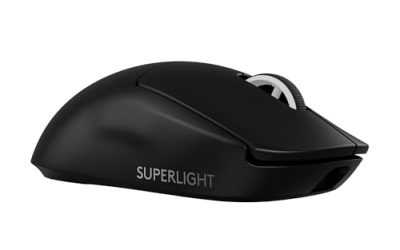
The Logitech G Pro X Superlight 2 is the benchmark that most ultralight mice are measured against. At 60 grams, it is light enough for fast flicks while keeping a solid, hole-free shell that feels clean and consistent in the hand. Its symmetrical shape suits claw and fingertip grips, and it has become a common sight in professional play because the shape works for a wide range of hand sizes.
- Weight: 60 grams
- Sensor: HERO 2, up to 44,000 DPI
- Polling rate: Up to 8,000 Hz
- Switches: LIGHTFORCE hybrid optical-mechanical switches
- Buttons: 5 programmable buttons
- Connectivity: LIGHTSPEED wireless with USB-C charging
- Battery life: Up to 95 hours
The HERO 2 sensor tracks cleanly at very high speeds, and the 8,000 Hz polling option makes motion feel smooth on high-refresh-rate displays. Battery life is generous for a mouse this light, and the USB-C port means you can charge it with the same cable as many other devices on your desk.
2. Razer Viper V3 Pro
The Razer Viper V3 Pro is one of the lightest wireless mice from a major brand, at 54 grams in black. It pairs a symmetrical shape with a top-tier sensor and true 8,000 Hz wireless polling, and it was developed with input from professional players. The result is a mouse built around competitive shooters, where every gram and every millisecond counts.
- Weight: 54 grams
- Sensor: Focus Pro 35K Optical Sensor Gen-2, up to 35,000 DPI
- Polling rate: True 8,000 Hz wireless
- Switches: Gen-3 optical switches
- Buttons: 8 programmable controls
- Connectivity: HyperSpeed wireless with USB-C charging
- Battery life: Up to 95 hours
The Viper V3 Pro feels almost weightless in a fingertip grip, and the optical switches give a crisp, consistent click with no debounce delay. The included 8,000 Hz receiver works without a separate purchase, which keeps setup simple.
Best for: Fingertip and claw players who want the lightest possible wireless mouse with full 8,000 Hz polling out of the box.
3. Razer DeathAdder V3 Pro
The Razer DeathAdder V3 Pro is the ergonomic pick in this roundup. At 63 grams, it is the heaviest mouse here, but it is also the most comfortable for palm and relaxed claw grips, thanks to a tall, sculpted right-handed shell that supports the hand through long sessions. If other ultralight mice feel too flat or too small, this is the one to try first.
- Weight: 63 grams
- Sensor: Focus Pro 30K Optical Sensor, up to 30,000 DPI
- Polling rate: Up to 8,000 Hz with the HyperPolling wireless dongle
- Switches: Gen-3 optical switches
- Buttons: 5 programmable buttons
- Connectivity: HyperSpeed wireless with USB-C charging
- Battery life: Up to 90 hours
- Dimensions: 128 x 68 x 44 millimeters
The Focus Pro 30K sensor tracks flawlessly on most surfaces, including glass, and the ergonomic shape reduces hand strain during long sessions. The shell is a refined version of a shape that has been popular for years, so it feels familiar from the first minute.
Best for: Palm-grip players and anyone with medium to large hands who wants ultralight weight without giving up ergonomic comfort.
4. Glorious Model O 2 Wireless
The Glorious Model O 2 Wireless is the versatile pick. At 68 grams, it is the heaviest mouse in this list, but it earns its place with dual wireless modes, a comfortable ambidextrous shape, and RGB lighting that the other picks skip. It connects over 2.4 GHz for gaming and Bluetooth for everyday use, so one mouse can serve a gaming PC and a laptop.
- Weight: 68 grams
- Sensor: BAMF 2.0 optical sensor, up to 26,000 DPI
- Polling rate: 1,000 Hz
- Switches: Optical switches rated for long life
- Buttons: 6 programmable buttons
- Connectivity: 2.4 GHz wireless and Bluetooth, with USB-C charging
- Feet: 100 percent PTFE feet
The ambidextrous shape suits both hands, and the six buttons give extra room for keybinds in games that reward them. The PTFE feet glide smoothly on cloth pads, and the solid shell keeps dust out of the interior.
Best for: Players who want one mouse for gaming and daily use, with Bluetooth, RGB lighting, and an ambidextrous shape.
5. Pulsar X2 V2
The Pulsar X2 V2 is the value-minded pick in this roundup, and it proves that a lighter mouse does not have to come from the biggest brands. At 53 grams, it is one of the lightest mice here, with a clean symmetrical shape, a proven PixArt sensor, and optical switches. It is a strong option for players who want flagship weight and tracking without paying for features they will not use.
- Weight: 53 grams
- Sensor: PixArt PAW3395, up to 26,000 DPI
- Polling rate: 1,000 Hz
- Switches: Optical switches
- Buttons: 5 programmable buttons
- Connectivity: 2.4 GHz wireless with 1 millisecond response, USB-C charging
- Shape: Symmetrical, medium size
The PAW3395 sensor is a well-established performer with no smoothing or acceleration, and the medium symmetrical shell suits claw and fingertip grips across a wide range of hand sizes.
Best for: Claw and fingertip players who want a very light, straightforward wireless mouse with a proven sensor.
Comparison Table
| Mouse | Weight | Sensor and Max DPI | Polling Rate | Buttons | Battery Life |
|---|---|---|---|---|---|
| Logitech G Pro X Superlight 2 | 60 g | HERO 2, 44,000 DPI | Up to 8,000 Hz | 5 | Up to 95 hours |
| Razer Viper V3 Pro | 54 g | Focus Pro 35K, 35,000 DPI | Up to 8,000 Hz | 8 | Up to 95 hours |
| Razer DeathAdder V3 Pro | 63 g | Focus Pro 30K, 30,000 DPI | Up to 8,000 Hz | 5 | Up to 90 hours |
| Glorious Model O 2 Wireless | 68 g | BAMF 2.0, 26,000 DPI | 1,000 Hz | 6 | Extended sessions |
| Pulsar X2 V2 | 53 g | PAW3395, 26,000 DPI | 1,000 Hz | 5 | Extended sessions |
Which One Is Right for You?
For fingertip grip and small to medium hands: The Razer Viper V3 Pro and the Pulsar X2 V2 are the natural choices. Both are under 55 grams with symmetrical shells that leave the fingers free to control the mouse. The Viper V3 Pro adds 8,000 Hz polling, while the Pulsar X2 V2 keeps things simpler and lighter on features.
For claw grip and medium hands: The Logitech G Pro X Superlight 2 is the safest all-round pick. Its 60-gram weight, proven sensor, and long battery life make it easy to recommend, and its shape works for the widest range of claw players.
For palm grip and larger hands: The Razer DeathAdder V3 Pro is the clear answer. Its tall ergonomic shell supports the palm, and 63 grams is still firmly ultralight. If you have ever found symmetrical mice too flat, start here.
For one mouse that does everything: The Glorious Model O 2 Wireless covers gaming and daily use with Bluetooth, RGB lighting, and an ambidextrous shape. It is the heaviest pick here, but 68 grams is still light by any reasonable measure.
For the lightest possible wireless mouse: The Pulsar X2 V2 at 53 grams and the Razer Viper V3 Pro at 54 grams lead the list. Between them, choose the Viper V3 Pro for maximum polling rate and the Pulsar X2 V2 for a simpler, lighter feature set.
Once you narrow the list to one shape, remember that settings matter as much as hardware. A well-matched mouse with the wrong sensitivity will still feel off, so pair your pick with a sensible DPI and in-game sensitivity. Our guide to the best mouse settings for gaming walks through DPI, polling rate, and sensitivity step by step.
Frequently Asked Questions
How light should an ultralight gaming mouse be?
Most players consider anything under 70 grams ultralight, and the competitive picks in this guide range from 53 to 68 grams. Below 60 grams, the differences become subtle, and shape matters more than the last few grams. Choose the lightest mouse that still fits your grip comfortably rather than chasing the lowest number.
Are wireless ultralight mice as responsive as wired mice?
Modern wireless mice using 2.4 GHz connections are effectively as responsive as wired mice for gaming. At 1,000 Hz polling, the connection adds about one millisecond of latency, and at 8,000 Hz it adds far less. Keep the receiver close to the mousepad, keep the battery charged, and the connection will not be the limiting factor in your aim.
Does a lighter mouse actually improve aim?
A lighter mouse can improve aim by reducing the effort of flicks and quick corrections, and by cutting fatigue over long sessions. It does not replace practice, good settings, or a consistent mousepad. Think of weight as removing friction from your movement, not as adding skill. The biggest gains come from pairing a comfortable ultralight mouse with a sensitivity you can control.
What DPI should I use with an ultralight mouse?
Most competitive players use between 400 and 1,600 DPI, with 800 DPI as a common starting point. Higher DPI is not better on its own; what matters is the combination of DPI and in-game sensitivity, which sets your effective sensitivity. Start at 800 DPI, set your in-game sensitivity so a full swipe across the pad turns you roughly 180 degrees, and adjust in small steps from there.
Related guides
More from Amazon
Programs that pair well with the guide above. Offers and eligibility are set by Amazon and may change.
Free shipping on eligible items, Prime Video and more. Eligible new members can start with a free trial.
Start a Prime free trialAd-free music streaming. Eligible new subscribers can start with a free trial.
Try Music Unlimited freeA Prime membership for ages 18-24 with a trial period. Eligibility is set by Amazon.
See Prime for Young AdultsAudiobooks and podcasts to listen to on the go. Eligible new members can start with a free trial.
Try Audible freeAs an Amazon Associate we earn from qualifying purchases.