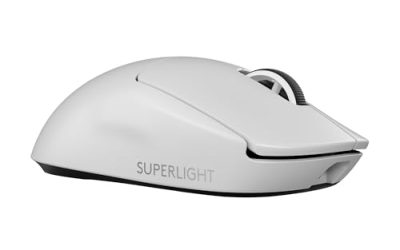
A gaming mouse with weights lets you change how heavy the mouse feels and where that weight sits, instead of accepting whatever the factory shipped. For players who flick between targets in a shooter, hold long angles in a tactical game, or grind long sessions in an MMO, a few grams in the right spot can steady aim or speed up resets. The trick is buying a mouse whose weight system is genuinely adjustable, with removable inserts you can add, remove, or move, rather than a fixed-weight shell with a marketing label. This guide covers five mice with real tunable weight systems and explains how to set them up.
As an Amazon Associate, we earn from qualifying purchases.
Our Top Picks
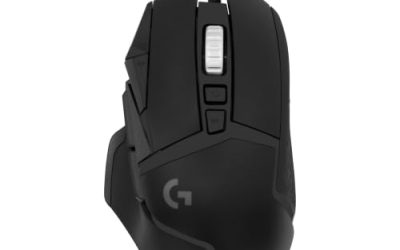
 Logitech G502 LIGHTSPEED Wireless Gaming MouseWireless5.19 x 2.95 x 1.57 inches0.81 poundsCheck on Amazon

Top 3 picks at a glance

Quick Answer
Buy the Logitech G502 HERO if you want the classic tunable-weight mouse at a friendly entry point, or the G502 LIGHTSPEED if you want the same idea without a cable. Corsair fans should look at the M65 RGB Ultra for FPS play or the Nightsword RGB for deep balance tuning.
How to Choose
Start with the weight range, because that is the whole point of this category. A good tunable mouse lists a base weight and a maximum weight with all inserts fitted, and the gap between the two tells you how much room you have to experiment. A range of around 15 to 25 grams is enough for most players to feel a real difference. If the range is only a few grams, the system is closer to a token feature than a tuning tool. Also check how the weights are split: several small inserts give finer control than one large insert, and inserts that sit in different slots let you shift the balance forward or backward, not just add mass.
Balance matters as much as total weight. A mouse that is heavy at the rear feels planted during slow, deliberate aiming but can drag during fast flicks, while a front-heavy mouse can feel eager to move but harder to stop precisely. The best systems let you place weights near the front, the middle, or the rear, so you can match the balance to your grip. Palm-grip players often prefer a slightly rear-biased balance, while claw-grip players tend to like a centered or slightly forward balance. Expect to spend a session or two moving inserts around before you settle.
Sensor quality still decides how the mouse tracks, and weight tuning cannot rescue a weak sensor. Look for a modern optical sensor with a wide DPI range, adjustable in small steps, and a high polling rate. All five mice in this guide use proven optical sensors with high maximum DPI, so the differences between them come down to feel and features rather than raw tracking.
Shape and grip come next. Tunable-weight mice tend to be larger and heavier than ultralight esports mice, because the weight system itself adds bulk. If you have small hands, a wide ergonomic shell may force your fingers into an awkward spread, and no amount of weight tuning fixes a bad fit. Right-handed ergonomic shapes dominate this category, so left-handed players should check the layout carefully before buying. The G903 LIGHTSPEED is the exception here, with an ambidextrous body and configurable side buttons.
Wired versus wireless is a real fork in the road. Wired mice never need charging and usually cost less, while wireless models remove cable drag and suit players who lift and reposition the mouse often. Modern wireless connections are fast enough for competitive play, but wireless mice carry a battery, so their base weight is higher and their weight range is narrower. If you go wireless, check the battery life and whether the mouse supports a charging dock or wireless charging pad.
Software is the quiet deciding factor. Weight tuning on some mice is purely physical, with inserts you place by hand, while others pair the hardware with software that shows the center of gravity and suggests layouts. Both approaches work, but software-driven tuning is easier to repeat: you can save a layout and return to it after cleaning the mouse or swapping desks. Make sure the companion software runs on your operating system.
Finally, count the buttons and think about your games. A shooter player may only need a sniper button and a DPI switch, while an MMO player may want more side buttons. Extra buttons add weight and complexity, so buy for the games you actually play.
Logitech G502 HERO

The Logitech G502 HERO is the mouse that made tunable weights mainstream, and it remains the reference point for the whole category. Five removable 3.6-gram weights sit in a compartment under the mouse, and you can add none, some, or all of them to shift both total mass and balance. The base weight is 121 grams, so this is a substantial mouse even before you add inserts, and that heft is exactly what some players want for steady, deliberate aiming. The HERO 25K sensor tracks from 100 to 25,600 DPI with no smoothing, filtering, or acceleration in its published specifications, and the eleven programmable buttons cover shooters, MMOs, and productivity work alike. A dual-mode hyper-fast scroll wheel switches between click scrolling and free spinning. LIGHTSYNC RGB lighting syncs with other Logitech G gear, and onboard memory stores up to five profiles on the mouse itself, so your settings travel with you. The right-handed ergonomic shape suits palm and claw grips, though small hands may find the shell wide. If you want the classic adjustable-weight experience with zero charging chores, this is the natural starting point.
Specs
| Spec | Detail |
|---|---|
| Sensor | HERO 25K optical, 100 to 25,600 DPI |
| Weight system | Five removable 3.6-gram weights, 121 grams base |
| Buttons | 11 programmable buttons |
| Scroll wheel | Dual-mode hyper-fast scroll wheel |
| Lighting | LIGHTSYNC RGB |
| Connection | Wired |
| Onboard memory | Five profiles |
| Model number | 910-005469 |
Logitech G502 LIGHTSPEED
The Logitech G502 LIGHTSPEED takes the HERO formula and cuts the cable, keeping the same shape and the same tuning idea. Six adjustable weights are included, four at 2 grams and two at 4 grams, for up to 16 grams of extra mass arranged across two compartments on the underside. That finer split lets you tune in smaller steps and shift balance between the two compartments. The base weight is 114 grams, lighter than the wired model despite the battery inside, and the LIGHTSPEED wireless connection runs at a 1 ms report rate. The HERO 25K sensor matches the wired version at up to 25,600 DPI. Eleven programmable buttons and the dual-mode scroll wheel carry over, and the mouse works with the POWERPLAY wireless charging system for players who want to skip charging cables entirely. Onboard memory stores your profiles, and LIGHTSYNC RGB rounds out the feature set. The trade-off is the usual wireless one: you gain freedom from cable drag and pay for it with charging chores and a higher entry point.
Specs
| Spec | Detail |
|---|---|
| Sensor | HERO 25K optical, 100 to 25,600 DPI |
| Weight system | Six adjustable weights, four at 2 grams and two at 4 grams, 114 grams base |
| Buttons | 11 programmable buttons |
| Scroll wheel | Dual-mode hyper-fast scroll wheel |
| Lighting | LIGHTSYNC RGB |
| Connection | LIGHTSPEED wireless, 1 ms report rate |
| Battery life | Up to 60 hours |
| Charging | POWERPLAY compatible |
| Model number | 910-005565 |
Logitech G903 LIGHTSPEED
The Logitech G903 LIGHTSPEED is the pick for players who want weight tuning in an ambidextrous body. It ships with a single removable 10-gram weight, so the tuning range is narrower than the G502 models, but the idea is the same: add the weight for a planted, deliberate feel at 117 grams total, or leave it out for a lighter 107-gram mouse. The ambidextrous design is the real draw, with configurable side buttons that snap on for left-handed or right-handed use and a symmetrical shell that suits palm, claw, and fingertip grips. The HERO 25K sensor tracks up to 25,600 DPI, and the LIGHTSPEED wireless connection holds a 1 ms report rate. Battery life runs to 140 hours or more in the listing specifications, which is far longer than most wireless gaming mice, and the mouse supports POWERPLAY wireless charging. Eleven programmable buttons, LIGHTSYNC RGB, and onboard memory complete a feature list that matches the G502 family. The single-weight system will not satisfy players who want to fine-tune balance across multiple slots. But for left-handed players, or anyone who switches grips between games, it is the only mouse here that adapts its shape as well as its weight.
Specs
| Spec | Detail |
|---|---|
| Sensor | HERO 25K optical, 100 to 25,600 DPI |
| Weight system | One removable 10-gram weight, 107 grams base |
| Buttons | 11 programmable buttons, configurable side buttons |
| Design | Ambidextrous, left or right handed |
| Lighting | LIGHTSYNC RGB |
| Connection | LIGHTSPEED wireless, 1 ms report rate |
| Battery life | 140 hours or more |
| Charging | POWERPLAY compatible |
| Model number | 910-005670 |
Corsair M65 RGB Ultra

The Corsair M65 RGB Ultra is the FPS-first pick in this guide, built around a tunable weight system that adjusts the mouse from 97 grams to 115 grams using up to six included weights. That range starts lighter than any other mouse here, which suits fast flick aiming, and the six mounting points let you tune the center of gravity rather than just adding bulk. The MARKSMAN optical sensor is native at 26,000 DPI, and the AXON hyper-processing pipeline pushes polling up to 8,000Hz for responsive input. Optical switches remove debounce delay, and Sensor Fusion pairs the optical sensor with gyro and accelerometer data to steady tracking during fast lifts. Eight programmable buttons include a dedicated sniper button for temporary DPI drops, a classic M65 feature that FPS players rely on for long-range shots. An aluminum frame gives the mouse a rigid feel, and iCUE software handles macros, lighting, and sensitivity settings. At 97 grams with no weights fitted, this is the lightest starting point in the guide, and the wired connection means no battery to charge. If your games are mostly shooters and you want a tunable mouse that can still play light, start here.
Specs
| Spec | Detail |
|---|---|
| Sensor | MARKSMAN optical, native 26,000 DPI |
| Weight system | Up to six weights, 97 to 115 grams |
| Buttons | 8 programmable buttons, dedicated sniper button |
| Switches | Optical switches |
| Polling rate | Up to 8,000Hz via AXON hyper-processing |
| Frame | Aluminum frame |
| Lighting | RGB, iCUE compatible |
| Connection | Wired |
| Model number | CH-9309411-NA2 |
Corsair NIGHTSWORD RGB
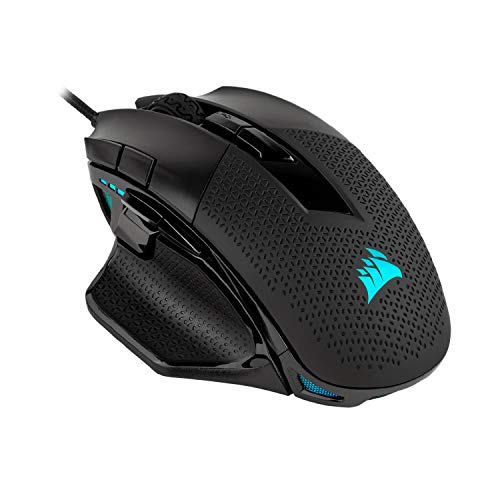
The Corsair NIGHTSWORD RGB offers the deepest weight tuning in this guide, and it is the pick for players who treat balance as a science. Two sets of weights and six mounting locations produce 120 different weight and balance configurations, with total weight adjustable between 119 grams and 141 grams. Corsair iCUE software detects the center of gravity in real time, so you can see how each layout shifts the balance and repeat a setup that works. The custom PixArt PMW3391 optical sensor is native at 18,000 DPI and adjustable in 1 DPI steps, giving fine control over sensitivity. Ten programmable buttons cover shooters and MOBAs, with Omron switches rated for long service, and four-zone RGB lighting runs through iCUE alongside macros and surface calibration. Onboard profile storage carries your settings between computers. The Nightsword is heavy even at its lightest setting, so it will never suit players chasing an ultralight mouse, and expect to try several layouts before the balance feels right. For players who want the most control over how a mouse feels in the hand, nothing else in this guide comes close.
Specs
| Spec | Detail |
|---|---|
| Sensor | Custom PixArt PMW3391 optical, native 18,000 DPI |
| Weight system | Two sets of weights, six mounting locations, 120 configurations, 119 to 141 grams |
| Buttons | 10 programmable buttons |
| Switches | Omron switches |
| Lighting | Four-zone RGB, iCUE compatible |
| Connection | Wired |
| Onboard memory | Onboard profile storage |
| Model number | CH-9306011-NA |
Who Should Skip It
Skip a tunable-weight mouse if you play fast competitive shooters and want the lightest mouse possible. Modern ultralight mice weigh far less than any mouse here, and their advantage is raw speed, not tuning. If your hand is small, the wide ergonomic shells here may cause strain during long sessions, and a narrower mouse will serve you better. Left-handed players should skip every pick except the G903 LIGHTSPEED, since the rest are shaped for right-handed use. Players on a tight budget should also think twice, because weight tuning adds cost over a basic gaming mouse. Finally, if you never adjust settings and just want a mouse that works out of the box, the tuning system becomes dead weight. In each of these cases, a lighter fixed-weight mouse is the better buy.
FAQ
Do gaming mice with weights actually improve aim?
Weights do not improve the sensor or make the mouse more accurate on their own. They change how the mouse feels in your hand, and a better feel can help you aim more steadily. A heavier mouse resists small tremors during slow aiming, while a lighter mouse moves faster during flicks. The benefit comes from matching the weight and balance to your grip and your games, not from adding weight for its own sake.
How many weights should I start with?
Start with no weights fitted and play for a few sessions to learn the base feel. Then add weights in small steps, one or two at a time, and test each layout in the same game or aim routine. Give each change at least a full session before judging it. Most players settle on a middle layout rather than the heaviest or lightest extreme.
Can I use a weighted mouse for work as well as gaming?
Yes, and many players do. The same weight that steadies aim can steady cursor control in design work, spreadsheets, and long documents, and the extra programmable buttons map well to shortcuts. The trade-off is size and mass: a heavy mouse can tire your wrist during a long workday, so try a lighter layout for office use and save the heavier setup for gaming.
Do wireless gaming mice with weights exist?
Yes. The G502 LIGHTSPEED and the G903 LIGHTSPEED in this guide both carry removable weights, with the G502 offering six inserts and the G903 offering a single 10-gram insert. Wireless models tend to start heavier because of the battery, and their tuning range is narrower than wired equivalents. If wireless freedom matters more than maximum tuning range, either one is a strong choice.
Final Verdict
The Logitech G502 HERO is the best gaming mouse with weights for most players: its five-weight system is simple and proven, and the wired connection keeps things uncomplicated. Players who want the same tuning without a cable should step up to the G502 LIGHTSPEED, which adds finer weight splits and wireless freedom. The G903 LIGHTSPEED is the call for left-handed players and grip switchers, while the Corsair M65 RGB Ultra suits FPS players who want a lighter starting point. The Corsair NIGHTSWORD RGB is the specialist pick, with 120 configurations and real-time balance detection for players who enjoy tuning as much as playing. Pick the mouse whose base weight and tuning range match your hand and your games, then give yourself a few sessions to dial in the balance.
Product and ASIN Reference
| Product | ASIN |
|---|---|
| Logitech G502 HERO | B07GBZ4Q68 |
| Logitech G502 LIGHTSPEED | B07L4BM851 |
| Logitech G903 LIGHTSPEED | B07NSVMT22 |
| Corsair M65 RGB Ultra | B09CXQZMHG |
| Corsair NIGHTSWORD RGB | B07QX9C9WH |
Related guides
More from Amazon
Programs that pair well with the guide above. Offers and eligibility are set by Amazon and may change.
Free shipping on eligible items, Prime Video and more. Eligible new members can start with a free trial.
Start a Prime free trialAd-free music streaming. Eligible new subscribers can start with a free trial.
Try Music Unlimited freeA Prime membership for ages 18-24 with a trial period. Eligibility is set by Amazon.
See Prime for Young AdultsAudiobooks and podcasts to listen to on the go. Eligible new members can start with a free trial.
Try Audible freeAs an Amazon Associate we earn from qualifying purchases.