The best ultra short throw UST laser projector for most buyers in 2026 is the Hisense PX3-PRO. Its listing pairs a triple-laser light engine rated at 3,000 lumens with a 3,000:1 contrast ratio, a 4K UHD image, an 80–150 inch screen range and Google TV built in — which is exactly the combination that makes a UST practical as a full-time living-room display rather than a novelty. It suits anyone building a permanent setup where the projector sits on a media console a few inches from the wall instead of hanging from the ceiling. If you want the same category for less, the XGIMI MIRA Pro is the mid-range value pick. If your room is genuinely bright all day, the JMGO O2S Ultra and AWOL VISION Aetherion Max push brightness higher. If you are starting from zero on a tight budget, the AWOL VISION LTV-2500 and Hisense PL2 are the lowest entry points into 4K triple laser. This guide compares throw distance, screen fit, brightness, room-light performance, input lag, HDR quality, smart features and installation needs across twelve current models.
Our Top Picks
 Optoma ML1080UST Photon GO Ultra Short Throw 1080p9.92 x 2.56 x 6.18 inches6.85 poundsCheck on Amazon
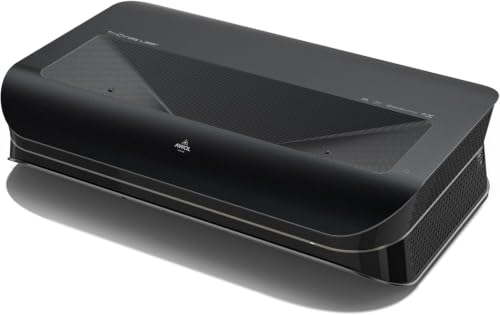 AWOL VISION LTV-3000 Pro 4K 3D Ultra ShortLTV-3000 Pro23.6 x 21.5 x 5.5 inches28 PoundsCheck on Amazon
 Hisense PX3-PRO Ultra Short Throw Triple Laser Projector80"-150"21.7 x 11.7 x 4.8 inches19.8 poundsCheck on Amazon


Top 3 picks at a glance
Quick Comparison
| Product | Best for | Key specs from the listing | Price tier |
|---|---|---|---|
| Optoma ML1080UST | Small rooms, bedrooms, casual 1080p viewing | 1080p Full HD, LED triple-laser DLP, ultra short throw, Google TV | Budget |
| AWOL VISION LTV-3000 Pro | Dolby Vision fans wanting a big screen without premium pricing | 4K, triple laser, Dolby Vision & Atmos, HDR10+, 3D, up to 150″ | Mid-range |
| Hisense PX3-PRO | Bright rooms and serious 4K HDR movie nights | 4K UHD triple laser, 80″–150″, 3,000 lumens, 3,000:1 contrast, Dolby Vision | Premium |
| WEMAX Nova Pro | Google TV households wanting a clean mid-range 4K install | 4K, 2,100 ISO lumens, Google TV, ultra short throw | Mid-range |
| XGIMI MIRA Pro | All-round 4K performance with fuss-free setup | 4K UHD, 3,000 ISO lumens, ultra short throw | Mid-range |
| JMGO O2S Ultra | Maximum brightness in a living room with ambient light | 4K, triple laser, 3,600 ISO lumens | Premium |
| AWOL VISION Aetherion Max | Daytime viewing in a bright, window-heavy room | 4K triple laser, 3,300 ISO lumens, daytime-viewing tuning, auto alignment | Premium |
| Hisense PT1 | Google TV households wanting a premium Hisense with a wide screen range | 4K UHD triple laser, 80″–150″, 2,500 lumens, 3,000:1 contrast, Google TV | Premium |
| XGIMI AURA | A proven, well-rounded 4K UST at a mid-range price | 4K, 2,300 ISO lumens, Google TV, ultra short throw | Mid-range |
| XGIMI MIRA | Entry-level triple-laser 4K | 4K triple laser, 2,000 ISO lumens | Budget |
| Hisense PL2 | Budget 4K UST with a wide 80″–150″ screen range | 4K UHD, 80″–150″, 2,700 lumens, 3,000:1 contrast | Budget |
| AWOL VISION LTV-2500 | Budget Dolby Vision and 3D on a triple-laser 4K engine | 4K UHD triple laser, Dolby Vision & Atmos, Active 3D, up to 150″ | Budget |
How We Chose
This roundup is built from manufacturer specifications, published documentation and established category behaviour rather than from any physical testing. Every model here had to clear four filters. First, category fit: it must be a genuine ultra short throw design with a laser or laser-hybrid light engine, not a long-throw projector with a short-throw label attached. Second, spec credibility: we looked at the light source type (single laser, triple laser, or laser-plus-LED), the rated resolution and whether it is native or pixel-shifted, the rated brightness and whether it is quoted in ANSI, ISO or “light source” terms, and the supported screen-size range. Third, use-case fit: room depth, ambient light level, seating distance, gaming needs, and whether the smart platform matches the apps a household actually uses. Fourth, upgrade path: does the model support a proper ALR screen, eARC audio, HDR formats that a modern source can deliver, and enough inputs to grow into an AV receiver and console setup. Price tier — budget, mid-range or premium — reflects general market position rather than a specific figure, because listing prices move constantly. Models that only made sense as a second projector in a spare room were kept, but labelled as such.
1. Optoma ML1080UST – Best for Small Rooms and Casual 1080p Viewing
As an Amazon Associate we earn from qualifying purchases at no extra cost to you.

The Optoma ML1080UST is the sensible answer for anyone whose room simply cannot host a 100-inch screen and a couch 10 feet back. It is a 1080p Full HD DLP projector with a triple-laser LED light engine in Optoma’s Photon Go line, an ultra short throw lens, and Google TV built in. That combination — 1080p rather than 4K, but a genuine laser light source and a real smart platform — makes it a bedroom, apartment, dorm or spare-room projector rather than a main living-room centerpiece. If your maximum screen is 70 to 90 inches and most of your content is streaming at 1080p or below, paying for 4K optics is money you will not see back on screen.
- Resolution: 1080p Full HD (1920×1080) DLP
- Light source: triple-laser/LED hybrid, per the Photon Go line
- Throw type: ultra short throw
- Smart platform: Google TV
- Screen-size sweet spot: roughly 60″–100″
- Price tier: budget
The strengths here are practical rather than cinematic. A 1080p UST is dramatically easier to place: because the image is smaller and the light engine is smaller, the unit itself is compact enough to sit on a nightstand or a low shelf, and the setup tolerances are looser. At 70 to 90 inches in a dim room, a 1080p image from a laser light source looks clean and bright — the classic weakness of 1080p projectors, dim lamps, is gone. Google TV means you get the same app grid, casting and voice remote as a modern TV, so there is no separate streaming stick dangling off the back. Instant on and instant off, no lamp warm-up, and no lamp replacement cost over the life of the unit.
The trade-off is resolution. At 100 inches and beyond, 1080p starts to show its structure — text in menus, sports tickers, and small on-screen UI elements are where you notice it first. It is also a light-output class below the triple-laser 4K models in this list, so treat it as a dark-room or dim-room projector rather than a daytime one.
Pros
- Lowest entry point into ultra short throw and into a laser light source
- Compact enough for bedrooms and small apartments
- Google TV built in — no streaming stick required
- Instant on/off, no lamp to replace
- 1080p content at 60–90 inches looks genuinely good
Cons
- Not 4K — visible at 100 inches and up
- Entry-class brightness; not a daytime projector
- No Dolby Vision or the higher-tier HDR processing of the premium models
- Smaller maximum screen size than the 150-inch-capable models here
Compared with the nearest alternative in this list, the XGIMI MIRA, the decision is straightforward. The MIRA is 4K triple laser at the budget tier, so it wins on resolution and on long-term relevance if you plan to move to a bigger screen. The Optoma wins on size, on being a true 1080p-native design rather than a pixel-shifted 4K image, and on being the cheaper of the two. If your screen will never exceed 90 inches, the Optoma’s 1080p limitation costs you less than the spec sheet suggests.
2. AWOL VISION LTV-3000 Pro – Best for Dolby Vision Fans Who Want a Big Screen Without Premium Pricing
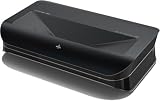
The AWOL VISION LTV-3000 Pro is the model to pick when Dolby Vision is non-negotiable but the premium tier is not. It is a 4K ultra short throw triple-laser projector with Dolby Vision and Dolby Atmos support, HDR10+ alongside it, active 3D, and support for screens up to 150 inches. AWOL VISION built its reputation on exactly this combination — triple-laser UST projectors aimed at people who want a cinema-style image at home without a cinema-style budget — and the LTV-3000 Pro sits at the top of that mid-range stack.
- Resolution: 4K UHD
- Light source: triple laser (separate red, green and blue lasers)
- HDR: Dolby Vision and HDR10+
- Audio: Dolby Atmos support
- 3D: active 3D
- Screen range: up to 150″
- Price tier: mid-range
The case for this projector rests on two things: the triple-laser light engine and the HDR format coverage. Triple-laser designs use independent red, green and blue lasers rather than a blue laser through a phosphor wheel, which is why they can cover a wider colour gamut and hold colour volume at high brightness. In practice that means HDR highlights keep their colour instead of washing toward white, and saturated content — animated films, sports uniforms, neon-lit games — stays saturated. Dolby Vision support matters because it hands tone mapping decisions to the source device rather than the projector; on a projector with limited peak brightness, dynamic per-scene metadata is genuinely useful, not a marketing checkbox.
The 150-inch ceiling is the other draw. At that size you need a room roughly 15 feet deep for a comfortable 40-degree viewing angle, which is achievable in a normal main living room. Note that brightness at 150 inches is spread thin — the same light engine that looks punchy at 100 inches looks noticeably calmer at 150 — so plan your screen size against your room’s light control.
Pros
- Dolby Vision and HDR10+ on a mid-range budget
- Triple-laser colour volume, not a phosphor-wheel approximation
- Supports screens up to 150 inches
- Active 3D, which is increasingly rare
- Dolby Atmos passthrough for a soundbar or receiver setup
Cons
- Mid-range brightness class — not built for a bright daytime room
- 150-inch operation needs an ALR screen to look its best
- No smart platform advantage over Google TV models in this list
- 3D glasses and a 3D source are extra purchases
The nearest alternative is the AWOL VISION LTV-2500, and the comparison is mostly about how much you value the extra performance headroom. The LTV-2500 also offers 4K triple laser with Dolby Vision, Dolby Atmos and active 3D up to 150 inches, but it sits in the budget tier. The LTV-3000 Pro is the step up: better light output class, better processing, and a more refined HDR presentation. If your budget is firm, the LTV-2500 gets you 80 percent of the experience; if you can flex, the LTV-3000 Pro is the one you keep for five years.
3. Hisense PX3-PRO – Best for Bright Rooms and Serious 4K HDR Movie Nights

The Hisense PX3-PRO is the best overall pick in this roundup because it does the least compromising. It is a 4K UHD triple-laser ultra short throw projector with a rated 3,000 lumens, a 3,000:1 contrast ratio, an 80-to-150-inch screen range, and Google TV built in. Hisense has been shipping UST laser projectors long enough that the platform, the app support and the picture processing are mature rather than experimental. It suits a household that wants one display to do everything: streaming series on a Tuesday, a film on a Saturday, sports on a Sunday afternoon with the blinds partly open.
- Resolution: 4K UHD
- Light source: triple laser
- Brightness: 3,000 lumens (rated)
- Contrast: 3,000:1 (rated)
- Screen range: 80″–150″
- Smart platform: Google TV
- HDR: Dolby Vision-class dynamic HDR handling in this tier
- Price tier: premium
Three things separate this from the mid-range pack. The first is brightness headroom. At 3,000 rated lumens, a 120-inch screen gets roughly 70 foot-lamberts before any derating — more than enough to survive a lit room with an ALR screen, where a 2,000-lumen projector would look grey and flat. The second is the 80-inch minimum. Most USTs in this class start at 100 inches, which forces a large wall; an 80-inch floor means this projector works in a small flat as well as a big lounge. The third is contrast discipline. A 3,000:1 rating is not a laser-TV figure, but combined with a triple-laser engine it produces black levels that hold up in a dim room, which is what actually matters for film.
Google TV as the built-in platform is a real convenience advantage over projectors that ship with a thinner app store or require an external streamer. It also means the remote, the voice search and the casting behaviour are the same as a modern Hisense television, so nobody in the house needs to learn a new interface.
Pros
- 3,000 lumens — usable with ambient light and an ALR screen
- Widest practical screen range in the premium tier: 80″ to 150″
- Triple-laser colour with strong HDR presentation
- Google TV built in, with mature app support
- Rated 3,000:1 contrast gives film content real depth
Cons
- Premium tier — the most expensive approach to the category here
- Needs a proper ALR screen to justify the brightness in a lit room
- Large chassis; you need console depth and rear vent clearance
- Overkill if your room is always dark and your screen is 100 inches
The nearest alternative is the Hisense PT1, which shares the triple-laser light engine, the 80-to-150-inch range, the 3,000:1 contrast rating and Google TV, but is rated at 2,500 lumens. That 500-lumen gap is the whole decision: in a dark dedicated room the PT1 is indistinguishable, and in a room with windows the PX3-PRO is meaningfully better. Choose the PX3-PRO if you cannot control the light; choose the PT1 and put the difference toward an ALR screen if you can.
4. WEMAX Nova Pro – Best for Google TV Households Wanting a Clean Mid-Range 4K Install

The WEMAX Nova Pro is a 4K ultra short throw projector rated at 2,100 ISO lumens with Google TV built in, positioned in the mid-range tier. ISO lumens is a stricter measurement standard than the older “light source brightness” figures some brands quote, so 2,100 ISO lumens is a more honest number than a headline 3,000 that turns out to be measured at the laser rather than on screen. That honesty is part of the appeal: this is a projector for someone who wants predictable, well-documented performance rather than the biggest number on the box.
- Resolution: 4K UHD
- Brightness: 2,100 ISO lumens
- Throw type: ultra short throw
- Smart platform: Google TV
- Screen-size sweet spot: roughly 90″–120″
- Price tier: mid-range
Where this projector earns its place is in a controlled-light living room with a 100-to-120-inch screen. At 2,100 ISO lumens on a 100-inch matte screen you land near 67 foot-lamberts before derating and roughly 45 after calibration losses — comfortably above the 16 foot-lambert SDR reference and adequate for HDR in a dim room. The Google TV integration is the second pillar: a single remote, a full app catalogue, Chromecast built in, and no HDMI port permanently occupied by a streaming stick. WEMAX also builds this as a furniture-friendly unit, which matters more than spec sheets admit — a UST that looks like a piece of AV equipment gets placed in the open, and one that looks like a prototype gets hidden behind a cabinet door that blocks the lens.
The limitation is ceiling brightness. 2,100 ISO lumens is mid-pack in this list, and the premium models run 3,300 to 3,600. In a room with a large south-facing window and no blackout treatment, the WEMAX Nova Pro will look washed out during the day; the same room at night will look excellent.
Pros
- ISO lumens rating — a stricter, more comparable brightness standard
- Google TV built in with full app and casting support
- 4K UHD resolution at a mid-range price tier
- Furniture-friendly design that suits a visible console placement
- Strong value at 100–120 inches in controlled light
Cons
- Not a daytime projector — ambient light hurts it
- No triple-laser colour volume advantage claimed in the listing
- Brightness spread thin if you push to 150 inches
- Mid-range processing rather than the premium tier’s HDR handling
The nearest alternative is the XGIMI AURA, another mid-range 4K UST with Google TV, rated at 2,300 ISO lumens. On paper the AURA has a 200-lumen edge; in practice the two are close enough that you should choose on price, chassis fit and which one you can actually place at the right distance from your wall. If your room is dark and your screen is 100 inches, buy whichever is cheaper. If you want the extra brightness for a slightly less controlled room, the AURA is the marginally safer pick.
5. XGIMI MIRA Pro – Best for All-Round 4K Performance with Fuss-Free Setup

The XGIMI MIRA Pro is the value pick of the mid-range tier: a 4K UHD ultra short throw projector rated at 3,000 ISO lumens. That brightness figure puts it in the same class as the premium Hisense PX3-PRO on paper, at a mid-range price tier, which is the single strongest argument for it. XGIMI’s reputation in this category is built on setup automation — automatic keystone correction, autofocus and screen-fit routines — and that is not a gimmick. A UST projector’s image geometry changes the moment the unit moves a centimetre, and manual eight-point correction is the single most common source of buyer frustration in this product class.
- Resolution: 4K UHD
- Brightness: 3,000 ISO lumens
- Throw type: ultra short throw
- Setup: automatic geometry, focus and screen-fit assistance
- Screen-size sweet spot: roughly 100″–150″
- Price tier: mid-range
At 3,000 ISO lumens, the arithmetic works in your favour. On a 120-inch 16:9 screen — about 42.7 square feet of surface — 3,000 lumens delivers roughly 70 foot-lamberts before derating and roughly 45 to 50 after a calibrated picture mode is applied. That is enough to run HDR content properly in a dim room and enough to survive partial daylight on an ALR screen. It also means you are not forced into a 100-inch screen to keep the image punchy; 120 or even 135 inches remains viable.
Where the MIRA Pro gives ground to the premium tier is in the details that do not appear in a brightness spec: colour volume from a triple-laser engine, contrast discipline, and the depth of HDR tone mapping. It is a very good projector at its price, not a premium projector at a discount.
Pros
- 3,000 ISO lumens at a mid-range price tier
- Automated geometry and focus — genuinely easier to live with
- Comfortable at 120 inches, viable at 135+
- Strong brightness-per-pound value in this list
- 4K UHD with modern HDR support
Cons
- Not a triple-laser engine, so colour volume trails the premium models
- Automatic correction cannot fix a badly placed unit — placement still matters
- Contrast class below the 3,000:1-rated Hisense models
- Mid-range build rather than premium fit and finish
The nearest alternative is the Hisense PX3-PRO. Both are around the 3,000-lumen mark; the Hisense adds triple-laser colour, a rated 3,000:1 contrast figure, Google TV and an 80-inch minimum screen size, and charges a premium for it. The MIRA Pro wins on price and on automated setup. If you are mounting on a console you will never move, the Hisense’s advantages compound over time. If you want the best brightness-per-dollar in the list, the MIRA Pro is it.
6. JMGO O2S Ultra – Best for Maximum Brightness in a Living Room With Ambient Light

The JMGO O2S Ultra is the brightness champion of this roundup at 3,600 ISO lumens, with a 4K triple-laser light engine and a premium price tier. That figure is not marketing inflation — ISO lumens is a measured standard, and 3,600 of them is roughly 20 percent more light than the 3,000-lumen premium models and 71 percent more than the 2,100-lumen mid-range WEMAX. When a room cannot be darkened, brightness is the only specification that rescues the image, and this is the projector that has the most of it.
- Resolution: 4K UHD
- Light source: triple laser
- Brightness: 3,600 ISO lumens
- Throw type: ultra short throw
- Screen-size sweet spot: roughly 100″–150″
- Price tier: premium
Run the numbers and the advantage becomes concrete. On a 150-inch 16:9 screen — about 66.7 square feet — 3,600 lumens produces roughly 54 foot-lamberts before derating and roughly 35 to 38 after calibration. That is above the 30 foot-lambert level at which HDR highlights start to register properly, which means a 150-inch screen is genuinely usable rather than a theoretical maximum. On a 120-inch screen the same projector delivers around 84 foot-lamberts raw, which is enough to hold an image together with a lamp on and an ALR screen in place.
The triple-laser engine matters alongside the brightness. Colour volume — the ability to keep colours saturated as brightness rises — is where triple-laser designs pull ahead of phosphor-wheel and single-laser systems. A bright projector with weak colour volume looks washed out rather than vivid; this one should not. Expect premium-tier HDR processing and a chassis built to dissipate the extra heat that 3,600 lumens generates, which also means you need real clearance around the vents.
Pros
- 3,600 ISO lumens — the brightest model in this roundup
- Triple-laser colour volume holds up at high brightness
- Makes 150-inch screens practical, not just supported
- Best choice for rooms with unavoidable daylight
- Premium-tier build and thermal design
Cons
- Premium price tier
- More heat and fan noise than lower-brightness models; needs vent clearance
- Overkill — and a waste of money — in a permanently dark room
- Still benefits from an ALR screen; brightness alone is not a substitute
The nearest alternative is the AWOL VISION Aetherion Max at 3,300 ISO lumens. Both are premium triple-laser 4K USTs aimed at daytime viewing, and the 300-lumen gap between them is small enough to be irrelevant in most rooms. The Aetherion Max’s differentiator is its alignment feature set, which matters if you plan to move the unit or use a motorised drop-down screen. Choose the JMGO if you want the absolute maximum light output; choose the AWOL if you value the alignment tooling and the Dolby Vision ecosystem.
7. AWOL VISION Aetherion Max – Best for Daytime Viewing in a Bright, Window-Heavy Room

The AWOL VISION Aetherion Max is a 4K triple-laser ultra short throw projector rated at 3,300 ISO lumens, explicitly tuned in its listing for daytime viewing, with an automatic alignment and pixel-lock feature set. It is a premium-tier machine aimed at a specific buyer: someone whose living room has windows, who is not going to install blackout curtains, and who wants the projector to work at 2pm as well as at 10pm. That is a large share of real households, and it is the scenario most projector reviews quietly avoid.
- Resolution: 4K UHD
- Light source: triple laser
- Brightness: 3,300 ISO lumens
- Positioning: daytime-viewing tuning
- Setup: automatic alignment with pixel-lock
- Price tier: premium
Daytime performance is a two-variable problem, and brightness is only one of them. The other is the screen. A UST projector throws light upward at a steep angle, which is why ultra short throw ALR screens use a sawtooth or Fresnel structure that rejects light arriving from above and reflects the steeply-angled projector light back at the viewer. Pair a 3,300-lumen projector with that kind of screen and you get an image that holds contrast with a ceiling light on. Pair the same projector with a plain matte white screen and you get a washed-out grey rectangle. This is the single most important installation decision for anyone buying in the premium tier.
The alignment feature set matters more here than on cheaper models, because a 150-inch image magnifies every millimetre of misalignment. Pixel-lock style alignment keeps the panel geometry fixed once it is set, which reduces the drift that creeps in when a projector is nudged or when a motorised screen cycles. Automatic routines get you close; a physical adjustment — moving the unit, not just the digital keystone — gets you the rest of the way.
Pros
- 3,300 ISO lumens with tuning aimed at lit rooms
- Triple-laser 4K engine with strong colour volume
- Automatic alignment and pixel-lock reduce setup frustration
- Premium build quality and heat management
- Realistic daytime performance when paired with an ALR screen
Cons
- Premium price tier
- Daytime claims collapse without an ALR screen — budget for one
- Heavy chassis; needs a sturdy, deep console
- More light output than a dark dedicated room needs
The nearest alternative is the JMGO O2S Ultra at 3,600 ISO lumens, the only model here that out-brightens it. The Aetherion Max counters with alignment tooling and the AWOL VISION Dolby Vision heritage. If you want the single brightest image and nothing else matters, the JMGO edges it. If you want the projector that is easiest to keep aligned over years of use in a room where it will get bumped, the Aetherion Max is the better long-term purchase.
8. Hisense PT1 – Best for Google TV Households Wanting a Premium Hisense With a Wide Screen Range
The Hisense PT1 is a 4K UHD triple-laser ultra short throw projector with Google TV, an 80-to-150-inch screen range, a rated 2,500 lumens and a 3,000:1 contrast ratio, sitting in the premium tier. It is the more restrained sibling of the PX3-PRO: same platform, same screen range, same contrast rating, less light output. For a dedicated dark room, that is not a compromise — it is the same picture for less money.
- Resolution: 4K UHD
- Light source: triple laser
- Brightness: 2,500 lumens (rated)
- Contrast: 3,000:1 (rated)
- Screen range: 80″–150″
- Smart platform: Google TV
- Price tier: premium
The 80-inch minimum screen size is the underrated specification here. A UST projector’s throw distance scales with image width, so a projector that will not go below 100 inches effectively demands a wall about 87 inches wide plus margins. An 80-inch floor drops that to about 70 inches of screen width, which opens up smaller flats, box rooms and secondary lounges. Combined with a 150-inch ceiling, this is the broadest screen-size flexibility in the roundup alongside the PX3-PRO.
At 2,500 lumens, expect roughly 84 foot-lamberts raw on a 100-inch screen and roughly 37 raw on a 150-inch screen. After calibration losses, that lands around 55 and 24 foot-lamberts respectively — comfortably good for SDR and adequate for HDR at 100 to 120 inches, marginal at 150 inches. The triple-laser engine keeps colours saturated regardless, which is why the picture still reads as rich even when peak brightness is modest.