The best trailer jacks match the trailer’s loaded tongue weight with enough lift capacity, provide adequate travel for your hitch height, and use a wheel or swivel mechanism suited to how often you move and store the trailer.
As an Amazon Associate we earn from qualifying purchases at no extra cost to you.



Our Top Picks
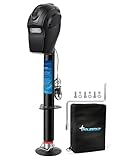
 VEVOR 5000 lbs A-Frame Trailer Jack5000 lbs (15 inch Stroke)25 x 6 x 6 Inches11 poundsCheck on Amazon


Top 3 picks at a glance
Best trailer jacks at a glance
For a light utility trailer, a 1,000–2,000-pound sidewind jack is usually sufficient. A boat trailer or enclosed cargo trailer generally benefits from a 2,000–5,000-pound jack, while heavy equipment trailers may require a 5,000–12,000-pound model or a pair of jacks. The capacity figure is the jack’s lifting rating, not the trailer’s total permissible weight.
| Trailer situation | Recommended jack class | Useful travel | Best design | Typical market range |
|---|---|---|---|---|
| Small utility trailer, under about 3,500 lb loaded | 1,000–2,000 lb | 10–15 in | Fixed sidewind jack; caster wheel optional | Varies |
| Boat or cargo trailer, about 3,500–7,000 lb loaded | 2,000–5,000 lb | 12–15 in | Swivel jack with 5–6 in wheel | Varies |
| Heavy equipment trailer, about 7,000–14,000 lb loaded | 5,000–12,000 lb | 12–15 in | Drop-leg or heavy swivel jack | Varies |
| Frequent commercial use or very heavy tongue load | 12,000 lb or higher, often in pairs | 15 in or more | Direct-weld or heavy-duty bolt-on jack | Varies |
How much lifting capacity do you need?
Choose capacity from the trailer’s actual tongue weight, not simply its gross vehicle weight rating. A common loaded tongue-weight range is approximately 10–15% of a conventional trailer’s total loaded weight. For example, a 6,000-pound trailer may place roughly 600–900 pounds on the coupler.
That does not mean a 1,000-pound jack is automatically the right choice. Uneven ground, cargo shifting, a steep driveway, and side loads can raise the force required to lift the coupler. A practical selection is a jack rated at least twice the expected tongue weight when the trailer is frequently moved or loaded near its limit.
Worked example: if your loaded trailer weighs 7,000 pounds and you estimate 12% tongue weight, the static coupler load is 840 pounds. Doubling that gives a 1,680-pound target, so a 2,000-pound jack is the minimum sensible class. If the trailer is used on rough ground, carries concentrated equipment, or has a tongue-mounted spare tire and battery, moving up to a 3,000–5,000-pound jack provides more margin.
Lift travel: the measurement that prevents installation problems
Travel is the distance between the jack’s retracted and extended positions. More travel is not always better: a long jack can sit too low, drag on ramps, or interfere with the trailer frame. Measure three points before buying:
- Retracted clearance: Leave room above the jack for the coupler, frame, spare tire, and tow vehicle when turning.
- Coupling height: The extended jack must raise the coupler high enough to clear the hitch ball and safety-chain connection.
- Storage height: A swivel jack should fold upward without contacting the trailer body or tailgate.
For many utility and cargo trailers, 10–15 inches of travel is adequate. A drop-leg jack can cover large height changes quickly with a removable pin, then use the screw mechanism for final adjustment. This is especially useful on heavy trailers because it reduces the number of cranks needed under load.
Wheel, foot, and swivel designs compared
Swivel jacks
A swivel jack pivots horizontally into a storage position, making it a strong choice when the trailer must travel over uneven driveways or when ground clearance matters. Look for a locking pin that is easy to inspect and a bracket with multiple mounting holes. The pivot hardware should not be the only part carrying the trailer load; the mounting bracket and frame attachment must be rated for it.
Fixed jacks
Fixed jacks are simple, compact, and often stronger for permanent commercial use. They are a good choice when the jack never needs to fold and the trailer has adequate clearance. A fixed jack may be welded directly to the frame or attached with bolts through a clamp bracket.
Wheel jacks
A wheel helps reposition an unloaded or lightly loaded trailer on smooth, hard ground. A larger pneumatic or solid rubber wheel rolls more easily over cracks, while a small caster keeps the jack compact. Do not treat a caster as a substitute for proper trailer support: small wheels can sink into gravel, grass, or soft soil and can introduce side loads while the trailer is being moved.
Footpad and drop-leg jacks
A footpad is more stable than a wheel when the trailer is parked. It is usually the safer choice for heavy cargo, long-term storage, or uneven ground. Drop-leg versions are particularly efficient for heavy trailers because the leg takes up most of the extension before the screw mechanism is used for precise leveling.
Mounting requirements matter as much as the jack rating
A high-capacity jack cannot compensate for a weak mounting point. Before installation, check the trailer tongue for rust, cracks, thin-wall tubing, and previous damage. Clamp-on brackets are convenient and avoid welding, but they need full contact with the frame and properly tightened hardware. Recheck the bolts after the first few trips.
Weld-on jacks offer a clean, rigid installation, but welding should be performed by someone familiar with trailer frames. Avoid drilling through a structural member unless the jack manufacturer’s instructions allow it. The jack must remain vertical through its working range; a leaning jack can bind and transfer damaging side loads to the screw and frame.
Also check the handle sweep. A jack may fit physically but be unusable if the handle strikes the coupler, tongue rails, battery box, or propane tanks. Sidewind handles are usually easier to operate where vertical clearance is restricted, while top-wind handles can be more comfortable when the tongue is open and accessible.
Corrosion resistance for rain, salt, and boat trailers
For freshwater utility use, a zinc-plated steel jack can offer good value if its coating remains intact. Galvanized construction is preferable for boat trailers and wet storage because it provides broader protection against moisture. Stainless-steel hardware is helpful around salt water, but hardware alone does not make a jack corrosion-proof if the tube, welds, and internal screw are ordinary steel.
- Choose hot-dip galvanized or marine-oriented construction for repeated salt-water exposure.
- Inspect weld seams and the bottom of the outer tube, where water and road salt collect.
- Keep the screw lubricated with the lubricant specified by the manufacturer.
- Use a protective cap when stored outdoors, but allow the jack to dry before covering it.
- Replace a jack if corrosion has reduced tube wall thickness, damaged the pivot, or caused binding under load.
Decision matrix: which jack fits your trailer?
| Your priority | Choose | Avoid | Reason |
|---|---|---|---|
| Lowest cost on a small utility trailer | 1,000–2,000 lb fixed sidewind jack | Oversized commercial drop-leg model | Less weight and cost without sacrificing needed capacity |
| Frequent hand repositioning on pavement | Swivel jack with a robust 5–6 in wheel | Tiny caster on rough ground | Better rolling and faster storage |
| Stable parking on gravel or soil | Footpad or drop-leg jack | Small wheel left carrying the load | A broad foot resists sinking and movement |
| Salt-water boat use | Galvanized or marine-grade jack | Basic uncoated steel | Improved resistance at tubes, welds, and fittings |
| Heavy tongue weight and frequent loading | 5,000 lb or higher drop-leg jack, possibly paired | Light-duty utility jack | More load margin and fewer cranks |
Frequently asked questions
Can a trailer jack be used to move a loaded trailer?
A trailer jack wheel is intended for repositioning an unloaded or lightly loaded trailer on smooth, hard ground. Small wheels may sink into gravel, grass, or soft soil and can introduce side loads while the trailer is moved. For stable parking, especially with heavy cargo or on uneven ground, a footpad is generally the safer choice than leaving the load on a wheel.
How do I estimate my trailer’s tongue weight?
Estimate tongue weight as approximately 10–15% of the trailer’s total loaded weight. For example, a 6,000-pound trailer may place roughly 600–900 pounds on the coupler. Cargo placement, a tongue-mounted spare tire, a battery, uneven ground, and a steep driveway can affect the force required, so select a jack with additional capacity rather than matching the estimate exactly.
Should I choose a bolt-on or weld-on trailer jack?
Choose a bolt-on jack when you want convenient installation without welding, provided the clamp-on bracket has full contact with the frame and the hardware is properly tightened. Choose a weld-on jack for a clean, rigid permanent installation when the trailer has adequate clearance. Welding should be done by someone familiar with trailer frames, and structural members should not be drilled unless the instructions allow it.
Why does a trailer jack need to remain vertical?
A trailer jack needs to remain vertical because a leaning jack can bind and transfer damaging side loads to the screw and frame. Check its alignment throughout the working range during installation. Also inspect handle clearance: the handle should not strike the coupler, tongue rails, battery box, or propane tanks, even if the jack appears to fit physically.
How should I maintain a trailer jack stored outdoors?
Maintain an outdoor trailer jack by keeping its screw lubricated with the lubricant specified by the manufacturer and using a protective cap after the jack has dried. Inspect weld seams and the bottom of the outer tube, where water and road salt collect. Replace the jack if corrosion has reduced tube wall thickness, damaged the pivot, or caused binding under load.
Final buying checklist
- Estimate loaded tongue weight and select a realistic safety margin.
- Confirm the jack’s retracted and extended dimensions against the trailer and tow vehicle.
- Choose a wheel for smooth repositioning or a footpad for stable parking.
- Verify that the swivel bracket, bolts, weld area, and trailer frame can carry the load.
- Match the finish to the environment, especially for boat trailers and salted roads.
- Check whether the handle direction and crank clearance allow comfortable operation.
For most owners, the best trailer jacks are not the largest models available. A properly mounted 2,000–5,000-pound swivel jack with 12–15 inches of travel suits many utility, boat, and cargo trailers; heavier equipment trailers should move to a drop-leg or commercial jack with a footpad and substantially higher capacity.