The best competition kettlebells for serious training are the Rogue Competition Kettlebells for demanding general use, Kettlebell Kings Competition Kettlebells for a polished all-round option, and competition-style bells from Bells of Steel or REP Fitness when price and availability matter most.
As an Amazon Associate we earn from qualifying purchases at no extra cost to you.


Our Top Picks



Top 3 picks at a glance
What makes a competition kettlebell different?
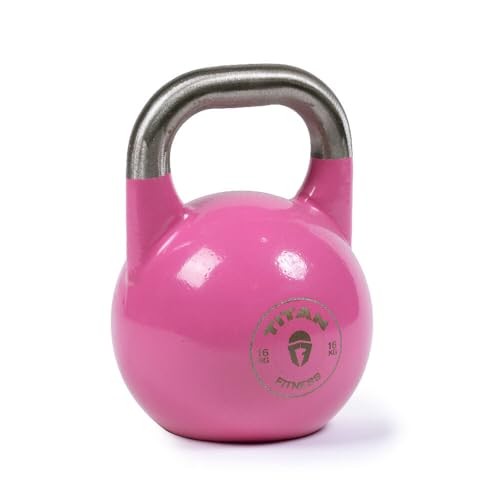
A competition kettlebell uses a consistent external shell size across its weight range. A 12 kg bell and a 32 kg bell are intended to occupy roughly the same space, unlike cast-iron kettlebells that grow larger as they become heavier. That fixed geometry changes the movement: the hand meets the handle at nearly the same position, the bell follows a predictable path, and a heavier snatch does not require adapting to a much wider or taller body.
Competition bells are particularly useful for snatches, cleans, jerks, long-cycle work, and competition-style technique. They can also handle swings, although many people prefer a cast-iron or powder-coated bell for high-volume two-handed swings because its wider handle and textured finish may feel more secure.
Best competition kettlebells compared
| Product or range | Typical shell geometry | Handle character | Best suited to | Typical market position |
|---|---|---|---|---|
| Rogue Competition Kettlebell | Competition-style fixed shell; approximately 210 mm high and 145 mm wide on common sizes | Machined steel handle with a relatively grippy, competition-oriented surface | Frequent snatches, cleans, jerks, and competition practice | Usually mid-range to premium |
| Kettlebell Kings Competition Kettlebell | Uniform competition shell across weights; dimensions vary slightly by production run | Smooth-to-fine-textured handle designed to balance grip and hand comfort | Mixed training, technique work, and home gyms buying a full set | Usually mid-range to premium |
| Bells of Steel Competition Kettlebell | Standardized competition profile with a flat base | Typically smooth steel with enough texture for chalked training | Value-focused athletes and structured progression | Usually budget to mid-range |
| REP Fitness Competition Kettlebell | Competition-style dimensions intended to remain consistent between weights | Steel handle with a moderate finish; check the current specification for exact coating | General strength training and technique practice | Usually budget to mid-range |
Exact dimensions, paint formulas, and handle finishes can change between manufacturing batches. Before buying a complete set, compare the manufacturer’s current measurements rather than assuming that every “competition” bell is identical.
Head-to-head buying criteria
1. Standardized dimensions
For competition practice, the most important dimensional targets are a consistent body diameter, body height, handle height, and handle opening. Many competition-style kettlebells cluster around a 145 mm body diameter, approximately 210 mm overall height, and a handle diameter near 33 mm. These are useful reference points, not a universal certification standard.
Dimensional consistency matters most when you change weights during a workout. If your 16 kg bell and 24 kg bell have the same handle relationship to the body, you can concentrate on timing and rack position rather than relearning the movement.
For swings, a longer handle opening is often more comfortable because both hands fit without crowding. For snatches, a competition handle’s fixed, relatively narrow geometry gives a more repeatable turnover. If you primarily perform two-handed swings, compare handle width in addition to the product label.
2. Handle texture
A good competition handle should provide friction without feeling abrasive. Excessively smooth steel can become slippery as chalk wears away. Excessively rough paint can tear calluses during high-repetition snatches.
- Fine-textured or lightly machined steel: a strong choice for chalked snatches and cleans.
- Smooth painted steel: comfortable for moderate volume, but potentially slick with sweat.
- Rough powder coat: secure for swings, though it may create more friction during the hand rotation of a snatch.
Do not judge grip solely by how rough the handle feels in a dry showroom. Competition training involves repeated turnover, so a surface that feels secure for a deadlift may be too abrasive for 100 snatches.
3. Weight consistency
Weight tolerance is more important when you train by competition standards or compare left- and right-side performance. A small difference is rarely meaningful for general fitness, but it can affect pacing and total workload in high-volume practice.
As a practical check, place each new bell on a calibrated bathroom or luggage scale and record the result. A 24 kg bell that measures 23.6 kg is 400 g lighter, or 1.67% below the marked weight:
(24.0 − 23.6) ÷ 24.0 × 100 = 1.67%
That does not automatically make the bell unusable, but record the actual mass in your training log. When building a matched pair, choose two bells from the same range and compare their measured weights rather than relying only on paint color.
4. Coating durability
Competition kettlebells commonly use painted or powder-coated steel bodies. The coating protects against corrosion and reduces floor damage, but no finish is immune to chips from dropping a bell on concrete.
- Use rubber flooring or a platform at least 10–12 mm thick for repeated work.
- Do not drag the bell across abrasive flooring.
- Wipe sweat from the handle and body after training.
- Touch up exposed steel promptly if your training area is humid.
A flat base is useful for storage, push-up variations, and stable rack drills. Inspect the base for casting or coating irregularities: a small wobble can become distracting during renegade rows or floor-based exercises.
Which bell fits your training?
| Your situation | Priority | Best choice | Why |
|---|---|---|---|
| Preparing for a kettlebell sport event | Repeatable geometry and handle feel | Rogue Competition or Kettlebell Kings Competition | Choose the range whose dimensions and finish most closely match your event equipment. |
| Mostly two-handed swings | Comfortable opening and secure grip | Competition bell with a moderate or slightly textured handle | Handle comfort matters more than perfect competition geometry for high-repetition swings. |
| Snatches and cleans cause hand irritation | Fine surface texture and smooth transitions | A lightly textured steel competition handle | Avoid aggressively rough coating; improve technique before adding volume. |
| Buying several weights on a budget | Consistent sizing at a reasonable cost | Bells of Steel or REP Fitness competition ranges | They provide the competition-style format without requiring a premium-priced complete set. |
| Training in a small home gym | Compact storage and predictable movement | One standardized competition range | Identical shell dimensions make storage and movement patterns easier to manage. |
Choosing the right weight for swings, snatches, and competition practice
For swings, select a weight that allows crisp hip extension without pulling you forward. A common starting range is 12–16 kg for many beginners, 16–24 kg for intermediate recreational lifters, and 24 kg or more for stronger trained athletes, but body size and coaching matter more than a fixed chart.
Snatches usually require a lighter bell than swings because the weight travels overhead and demands more grip endurance. A useful progression is to perform 5 sets of 10 reps per arm with consistent lockout and no painful impact on the forearm before increasing weight.
For competition practice, match the event’s prescribed weight and rules. If you are preparing for long-cycle work, prioritize a bell that stays comfortable in the rack and does not force excessive wrist extension. If you are learning the snatch, prioritize handle comfort and a controlled turnover over maximum load.
A simple volume calculation before you buy pairs
Suppose your session contains 10 rounds of 10 snatches per arm using a 20 kg bell. That is 200 total repetitions and 4,000 kg of nominal lifted load:
10 rounds × 10 reps × 2 arms × 20 kg = 4,000 kg
If you use two bells for a double-kettlebell exercise, the same 10-repetition set at 20 kg per bell represents 400 kg per round rather than 200 kg. This is why a durable coating, comfortable handle, and accurately matched pair become more important as training volume rises. The cheapest bell is not necessarily the lowest-cost choice if rough handles reduce your usable volume or mismatched weights disrupt your progression.
Frequently asked questions
Are competition kettlebells suitable for two-handed swings?
Yes, competition kettlebells can handle two-handed swings, but handle comfort should guide your choice. Many people prefer a cast-iron or powder-coated kettlebell for high-volume swings because its wider handle and textured finish may feel more secure. If you choose a competition bell, compare handle width and texture, since a longer opening can be more comfortable when both hands share the handle.
How can I check whether a kettlebell has the marked weight?
Weigh the kettlebell on a calibrated bathroom or luggage scale and record the result. A 24 kg bell measuring 23.6 kg is 400 g lighter, or 1.67% below the marked weight. That difference does not automatically make it unusable, but recording the actual mass helps you track training accurately and compare matched pairs.
Should I buy matching kettlebells from the same range?
Yes, choosing two bells from the same range can make matching their measured weights easier. Do not rely only on paint color when building a pair; compare the actual weights. Matched bells become more important during double-kettlebell exercises and higher training volumes, where mismatched loads can disrupt progression and make the total workload less predictable.
What surface should I use under a competition kettlebell?
Use rubber flooring or a platform at least 10–12 mm thick for repeated work. This helps reduce floor damage and provides a more suitable surface than concrete, which can chip the coating when a bell is dropped. You should also avoid dragging the bell across abrasive flooring and wipe sweat from the handle and body after training.
Why is a flat base useful on a competition kettlebell?
A flat base is useful for storage, push-up variations, and stable rack drills. It also deserves inspection because casting or coating irregularities can create a small wobble. That wobble may become distracting during renegade rows or other floor-based exercises, even when the bell’s dimensions, handle finish, and marked weight otherwise suit your training.
Bottom line
The best competition kettlebells combine repeatable dimensions, a handle that is secure without being abrasive, reliable weight marking, and a coating that survives regular contact with proper flooring. Choose Rogue or Kettlebell Kings when competition-style consistency and finish are the main priorities; consider Bells of Steel or REP Fitness when building a broader set at a lower market range. Whichever range you choose, verify current dimensions, weigh matched bells, and select the handle surface for your main movement—not merely for how it feels when dry.