This review analyzes published product information. We have not performed detailed research of this unit.
As an Amazon Associate, we earn from qualifying purchases.
A 750W PSU with a specific GPU connection limit
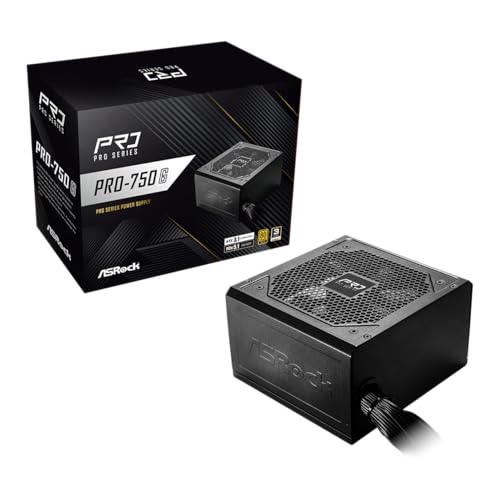
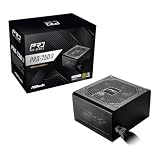
The ASRock PRO 750G is a 750W ATX power supply whose listing emphasizes ATX 3.1 and PCIe 5.1 compliance, 80 PLUS Gold certification, and a native 12V-2×6 graphics-card connector. Those specifications make it worth considering for a gaming-PC build, but the most consequential detail is more specific: the supplied connector is listed for up to 450W. That figure deserves as much attention as the PSU’s total capacity when planning a graphics-card upgrade.
This review evaluates the exact 750W PRO 750G using the supplied retailer specifications, not detailed research. The evidence establishes basic dimensions, a cooling-fan size and warranty coverage, but leaves several installation and electrical details unresolved. The buying question is therefore whether its documented capacity and connections match your intended system—not simply whether it carries a current standards label.
Documented specifications
| Item | Listed specification |
|---|---|
| Model and capacity | ASRock PRO 750G, 750W |
| Form factor | Standard ATX |
| Power standards | ATX 3.1 and PCIe 5.1 compliance claimed |
| Efficiency | 80 PLUS Gold; up to 90% efficiency claimed |
| Native GPU connector | Dual-color 12V-2×6, listed for up to 450W |
| Cooling | 120mm fan, described as optimized for low noise |
| Dimensions | 5.51 × 5.91 × 3.39 inches |
| Weight | 4.78 pounds |
| Warranty | 3 years |
Match the GPU requirement before planning the upgrade
The native 12V-2×6 connector is the PRO 750G’s clearest compatibility feature. For a graphics card designed to accept that connection, it offers a direct connector match rather than making an adapter the starting point of the installation plan. However, neither the native connection nor the PCIe 5.1 claim establishes compatibility with every graphics card.
Treat the listed 450W connector capability and the 750W total PSU capacity as separate constraints. The former describes the stated capability of that GPU connection; the latter must serve the complete system. Do not interpret 750W on the product name as power reserved for the graphics card, or assume that the standards label overrides the connector’s stated limit.
Before buying, check the intended GPU’s connection requirements and recommended system power supply, then consider the CPU and the rest of the build. If a future upgrade requires more than the documented connection can support, this PSU should not be treated as a confirmed match. The listing does not provide rail-current details, a full output-label breakdown or independent electrical test results, so those cannot be used here to justify extra headroom.
Case fit requires more than an ATX label
ASRock’s listing describes a standard ATX enclosure and gives dimensions of 5.51 × 5.91 × 3.39 inches. These are useful starting points for checking a case’s PSU compartment, but the supplied specification does not label the three measurement axes. Confirm the enclosure orientation against the case documentation instead of assigning a depth from the order of the numbers alone.
Space for the metal enclosure is only part of the installation. As a practical planning step, allow room for cable exits, routing and access to the graphics-card power socket. A drive cage or confined PSU compartment can complicate those routes even when the enclosure itself fits. That is an installation consideration, not evidence of a defect in this model.
The listing does not establish whether the PRO 750G has fixed, semi-modular or fully modular cables. It also omits cable lengths and a complete connector inventory. Before committing to a build, confirm the motherboard and CPU power connections, any required conventional PCIe connectors, and the number of storage-device power plugs. This is especially important when replacing a PSU in an existing system, where every currently powered device needs a documented connection plan.
Efficiency and cooling: useful claims, limited conclusions
The retailer lists 80 PLUS Gold certification and claims efficiency of up to 90%. That supports treating efficiency as a stated selling point, but the supplied evidence does not include a load-by-load efficiency curve or the conditions behind the maximum figure. It would therefore be misleading to present 90% as the efficiency your PC will achieve throughout its operating range.
Cooling is specified as a 120mm fan, with low-noise operation promoted in the listing. There are no acoustic measurements, fan-speed curves or details of a fan-stop mode. Buyers building a quiet gaming PC should regard the noise language as a seller claim, not proof of inaudibility at idle or restrained sound under gaming loads. The evidence also does not establish fan bearing type.
The three-year warranty is a concrete ownership detail. It does not, by itself, establish internal component quality or long-term reliability. Likewise, the standards-compliance claims are relevant to selection, but they are not substitutes for independently documented voltage regulation, ripple or protection testing.
Frequently asked questions
Does the ASRock PRO 750G include the cables needed for every build?
The article does not establish that because the listing omits a complete connector inventory and cable lengths. It also does not identify whether the cables are fixed, semi-modular or fully modular. Before buying, confirm the motherboard and CPU power connections, conventional PCIe connectors, and storage-device power plugs required by the intended system.
Can this PSU be used with a graphics card that does not use 12V-2×6?
The article does not confirm compatibility with every graphics card. The native 12V-2×6 connector is a direct match for a graphics card designed to accept that connection, but the listing does not provide a complete connector inventory. Check the intended GPU’s connection requirements and the available PSU connectors before planning the installation.
Will the listed dimensions tell me whether this PSU fits my case?
They provide a useful starting point, but not a complete fit confirmation. The listing describes a standard ATX enclosure and gives dimensions of 5.51 × 5.91 × 3.39 inches, without labeling the measurement axes. Check the case documentation, and allow additional room for cable exits, routing, and access to the graphics-card power socket.
Is the PRO 750G suitable for a quiet gaming PC?
The article cannot confirm that. The listing describes a 120mm fan and promotes low-noise operation, but it provides no acoustic measurements, fan-speed curves, or details of a fan-stop mode. Treat the noise language as a seller claim rather than proof of inaudibility at idle or restrained sound during gaming loads.
What does the three-year warranty tell me about this power supply?
It provides a concrete ownership detail, but it does not establish internal component quality or long-term reliability. The article also notes that the supplied evidence lacks independent electrical testing, including documented voltage regulation, ripple, or protection results. Therefore, the warranty should be considered alongside the unresolved cabling details and absent measured performance evidence.
Verdict: a conditional fit, not a blanket recommendation
The ASRock PRO 750G 750W is most straightforward to consider for an ATX build whose verified total power needs fit its capacity and whose graphics card matches the documented 12V-2×6 connection. Its Gold certification claim, native GPU connector and stated warranty provide a useful specification baseline.
The main reservations are unresolved cabling details and the absence of measured electrical or acoustic evidence. Confirm the full cable inventory, cable lengths, enclosure orientation and GPU power requirements before selecting it. For broader selection context, see our gaming PC power supply guide.
Sources: Product specifications and seller claims are drawn from the supplied ASRock PRO 750G retailer listing.
Check the exact product and current offer on Amazon