The ethernet cable best for gaming is a shielded Cat 8 or Cat 6a cable in the shortest length that reaches your router, because a wired link removes the jitter and packet loss that Wi-Fi adds during online play. For most gaming setups, a certified Cat 8 cable gives you the most headroom, while a Cat 6a cable covers every current home network speed. The cable itself will not raise your internet plan speed, but it keeps the connection between your PC or console and your router as steady as possible.
That stability is what matters in a match. Online games send small packets back and forth many times per second, and a single delayed packet can show up as a rubber-banding player or a shot that lands late. A wired cable gives those packets a clean, direct path with almost no variation in timing. This guide explains what to check before you buy, then compares four cables that fit different gaming setups, from a short desk run to a long run across the house.
Top 3 picks at a glance


How to Choose an Ethernet Cable for Gaming
Match the category to your network, not to the marketing
Ethernet cable categories describe the fastest link the cable is built to carry. Cat 6a handles 10 Gbps up to 100 meters, which covers every home internet plan and every current gaming PC or console port. Cat 8 handles 25 Gbps and 40 Gbps up to 30 meters, with 2000 MHz of bandwidth, and it exists for home labs and multi-gigabit switches rather than for ordinary gaming.
The practical rule is simple. If your router, switch, and PC all use gigabit or 2.5-gigabit ports, a Cat 6a cable is all you need. If you already run a 10-gigabit home network, or you want the most future-proof run you can install once, a Cat 8 cable is the right pick. Buying a faster category than your hardware supports does not make games run faster, but it does mean the cable will not be the weak link when you upgrade your network later.
Shielding matters near power cables and consoles
Shielding is the foil or braid wrapped around the wire pairs inside the cable, and it blocks interference from nearby power cables, monitors, and console power bricks. Unshielded cable, labeled UTP, works fine on a clean run with some distance from power lines. Foiled cable, labeled F/FTP, wraps each pair in foil and suits a crowded desk. Fully shielded cable, labeled S/FTP, adds a braid around the whole bundle and suits runs that pass through walls or alongside power cables.
For gaming, shielding is worth having because a gaming desk is one of the noisiest places in a house for interference: a PC power supply, two monitors, a console, a phone charger, and a power strip all sit within arm’s reach. A shielded cable keeps that noise out of the signal, which keeps latency steady instead of letting it spike when a nearby device draws power.
Buy the shortest length that reaches with slack
Length affects convenience far more than speed at home distances. A Cat 6a cable holds its full 10 Gbps speed to 100 meters, and a Cat 8 cable holds its 25 and 40 Gbps speeds to 30 meters, so any run inside a normal house is well within spec. The real reason to keep the cable short is cable management: a 50-foot cable coiled behind a desk is a tangle that collects dust and gets pinched by chair wheels, while a 10-foot cable lies flat and stays out of the way.
Measure the path the cable will actually take, not the straight-line distance. Go around the desk, down to the floor, along the wall, and up to the router, then add a foot or two of slack so the plugs are never under tension.
Check the conductor material and the plugs
Inside every ethernet cable are eight copper wires. The best cables use solid or stranded bare copper, which carries a clean signal and survives being plugged and unplugged many times. Cheaper cables sometimes use copper-clad aluminum, which is lighter and stiffer, breaks more easily at the plug, and can run hot under Power over Ethernet loads. The product listing usually states the conductor material, and bare copper is the detail to look for.
The plugs matter too. Gold-plated RJ45 contacts resist corrosion, which keeps the connection stable over years of use. A snagless boot, the small rubber sleeve where the cable meets the plug, stops the locking tab from catching on other cables and snapping off when you pull the cable through a desk grommet. A broken tab means a plug that slides out of the port at the worst moment, so this small detail is worth checking.
What a cable cannot fix
A new cable will not raise your internet plan speed or make up for a router that reboots under load. If your connection drops on Wi-Fi and on a wired cable alike, the problem is upstream: the modem, the router, or the line coming into the house. A cable solves the link between your device and your router, and it solves it well, but it is one link in a longer chain, so check the rest of the chain before blaming the cable.
The Picks
Cable Matters Cat 8 Ethernet Cable, 9.8 Feet
View the Cable Matters Cat 8 Ethernet Cable on Amazon
The Cable Matters Cat 8 cable is the most thoroughly specified pick in this guide. It carries GHMT Cat 8 channel verification, which means an independent lab confirmed the cable meets the Cat 8 standard rather than the maker simply printing the label on the jacket. It supports 10GBASE-T, 25GBASE-T, and 40GBASE-T links up to 30 meters, with 2000 MHz of bandwidth and full S/FTP shielding: every pair wrapped in foil, plus a braid around the whole bundle. The RJ45 plugs are gold-plated with metal shells, and the cable supports PoE Plus, so it can carry power to an access point or a camera on the same run.
This is the cable to buy for a short run between a gaming PC and a switch or router when you want the most headroom available in a copper cable. It suits a home lab, a 10-gigabit network, or a desk where the cable passes close to power bricks and monitor cables. It is also fully backward compatible with Cat 5e, Cat 6, and Cat 6a equipment, so it works with the gigabit ports on a console or a motherboard today and stays ready for a faster switch later.
The trade-offs are the ones that come with heavy shielding. The cable is thicker and stiffer than a plain Cat 6 cable, so it needs gentle curves around desk legs rather than sharp bends. At 9.8 feet it is a short-run cable, so measure before ordering if your router sits across the room.
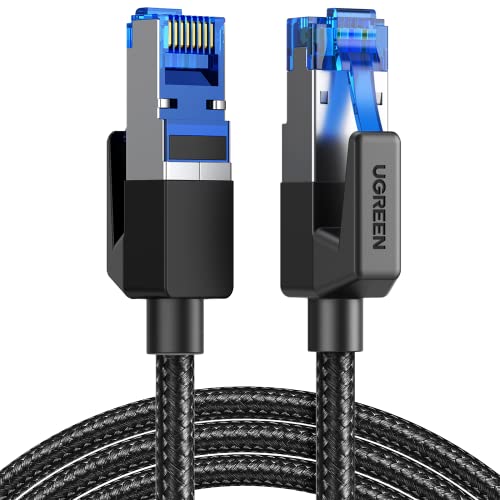
UGREEN Cat 8 Ethernet Cable, Braided, 10 Feet
View the UGREEN Cat 8 Ethernet Cable on Amazon
The UGREEN Cat 8 cable takes the same 40 Gbps and 2000 MHz specification and wraps it in a cotton braided jacket. The braid makes the cable flexible, tangle-resistant, and able to survive more than ten thousand bends according to the maker, which is the kind of durability that matters when a cable gets plugged in, unplugged, and moved between a desk, a console, and a laptop. Inside the braid are shielded foiled twisted pairs with a pure copper core and gold-plated RJ45 connectors, and the cable supports PoE on every length except the longest one.
This is the cable to buy when the cable itself gets handled a lot. It suits a shared desk where the cable moves between a gaming PC and a work laptop, a living room where the cable gets coiled up when guests come over, or a setup where a pet or a chair wheel threatens a plain PVC jacket.
The trade-offs are size and reach. The braid adds bulk, so the cable is thicker than a standard Cat 8 patch cord and needs a wider path through a desk grommet. Ten feet is enough for a desk-to-router run in the same room, but it will not reach a router in the next room, so longer runs need the longer lengths in the same line.
DbillionDa Cat 8 Ethernet Cable, 6 Feet
View the DbillionDa Cat 8 Ethernet Cable on Amazon
The DbillionDa Cat 8 cable is built for runs that leave the comfort of a desk. It uses 26 AWG wire with S/FTP shielding, gold-plated RJ45 connectors, and a weatherproof, UV-resistant jacket, so the same cable works indoors and outdoors. The listing rates it at 40 Gbps and 2000 MHz, and it comes in lengths from 3 feet to 150 feet, which covers everything from a console beside a router to a run out to a garage or a garden office.
This is the cable to buy when the run goes somewhere a normal indoor cable should not. It suits a gaming setup in a garage, a cable that passes through an exterior wall to another building, or a run along a sunny window where a plain jacket would stiffen and crack over time. The weatherproof jacket also makes it a good pick for a temporary run to a LAN party or an event, where the cable may cross a doorway and sit in direct sun for a day.
The trade-offs begin with the length in this listing: six feet is short, so check the length you need before ordering, since the same product line sells many lengths under the same name. The jacket is heavier than a standard indoor cable, so it is less flexible around tight corners. And one crawl of the listing showed the category field reading Cat 7 while the title reads Cat 8, so the listing itself is not perfectly consistent, which is one more reason to confirm the exact length and specification on the product page before ordering.
Cable Matters Cat 6a Ethernet Cable, 50 Feet, White

View the Cable Matters Cat 6a Ethernet Cable on Amazon
The Cable Matters Cat 6a cable is the long-run pick in this guide. It is a 10 Gbps shielded Cat 6a patch cable with S/FTP shielding, 26 AWG bare copper conductors, 550 MHz of bandwidth, and snagless gold-plated RJ45 plugs. At 50 feet it reaches from a router in one corner of a house to a gaming setup in another room, and because Cat 6a holds its full 10 Gbps speed to 100 meters, this length gives up nothing in speed. The white jacket blends in against light walls and baseboards, which makes the run less visible than a black cable on a pale wall.
This is the cable to buy when distance is the problem. It suits a PC in a bedroom with the router in the living room, a console on the far side of a large room, or a run that follows a baseboard through a doorway. It is also the right pick for anyone whose network tops out at gigabit or 2.5 gigabit, because a Cat 6a cable already exceeds those speeds with room to spare.
The trade-offs are about headroom. Cat 6a tops out at 10 Gbps, so it will not carry a 25 or 40 Gbps link if you build a multi-gigabit home lab later. Fifty feet is a lot of cable for a desk-side run, so the extra length needs a coil or a cable clip to stay tidy.
Ethernet Cables for Gaming Compared
| Cable | Category | Max data rate | Bandwidth | Shielding | Length | Best for |
|---|---|---|---|---|---|---|
| Cable Matters Cat 8 | Cat 8 | 40 Gbps | 2000 MHz | S/FTP | 9.8 ft | Short runs, 10-gigabit networks, home labs |
| UGREEN Cat 8 Braided | Cat 8 | 40 Gbps | 2000 MHz | F/FTP | 10 ft | Desk setups, cables that get moved often |
| DbillionDa Cat 8 | Cat 8 | 40 Gbps | 2000 MHz | S/FTP | 6 ft | Indoor and outdoor runs, garage setups |
| Cable Matters Cat 6a | Cat 6a | 10 Gbps | 550 MHz | S/FTP | 50 ft | Long runs across rooms, gigabit networks |
The table shows the real split in this guide: three Cat 8 cables for maximum headroom and one Cat 6a cable for long runs on ordinary networks. The Cat 8 picks differ in jacket and length rather than in speed, so choose between them by where the cable will live.
Frequently Asked Questions
Does an ethernet cable make gaming faster?
An ethernet cable does not raise your internet plan speed, but it does make the connection steadier, and steadiness is what online games feel. Wi-Fi adds variation in timing as the signal passes through walls and competes with other devices, while a wired cable delivers packets with almost no variation. The result is lower and more consistent latency, fewer spikes during busy moments, and fewer disconnects in the middle of a match.
Is Cat 8 better than Cat 6a for gaming?
Cat 8 is better on paper, with four times the data rate and nearly four times the bandwidth of Cat 6a, but no current game or console can use that extra capacity. A gigabit or 2.5-gigabit port is the fastest connection on almost every gaming PC and console, and Cat 6a already exceeds both. Cat 8 earns its place when you run a 10-gigabit or faster home network, when you want a cable that stays relevant through the next network upgrade, or when you value the heavier shielding that usually comes with Cat 8 construction. For everyone else, Cat 6a delivers the same gaming experience.
What length of ethernet cable should I buy for gaming?
Buy the shortest cable that reaches from your device to your router or switch with a foot or two of slack. Measure along the actual path: around the desk, down to the floor, along the wall, and up to the router. A cable that is too short puts tension on the plugs and can cause intermittent drops, while a cable that is far too long becomes a coil that collects dust and gets caught under chair wheels. For a desk beside a router, 6 to 10 feet is usually right. For a setup across a room, 25 to 50 feet is the common range.
Do I need a shielded ethernet cable for gaming?
A shielded cable helps most when the run passes near sources of interference, and a gaming desk is full of them: a PC power supply, monitors, a console, and a power strip all sit close together. Shielding blocks that noise from reaching the signal, which keeps latency steady. On a short, clean run with distance from power cables, an unshielded cable performs just as well. Shielding is cheap insurance rather than a requirement, and it is worth choosing when the cable will run alongside power cables or through a wall.
Can I use a flat ethernet cable for gaming?
A flat cable works for gaming on a short run, and its main advantage is that it slides under a rug or a door where a round cable would not fit. The trade-off is that the wire pairs sit side by side in a flat ribbon, which makes the cable more sensitive to sharp bends and to being stepped on. For a permanent run, or for any run longer than a few meters, a round shielded cable is the safer pick because it holds its shape, tolerates coiling, and keeps its shielding intact.
Conclusion
The best ethernet cable for gaming is the one that fits your room, your network, and your hardware without becoming the weak link. A shielded Cat 8 cable is the right choice when you want maximum headroom and heavy shielding for a short run, and the Cable Matters 9.8-foot model leads this guide because its Cat 8 performance is independently verified. The UGREEN braided Cat 8 suits a cable that gets moved and bent, the DbillionDa Cat 8 suits runs that go outdoors or into a garage, and the Cable Matters Cat 6a covers long runs on gigabit and 2.5-gigabit networks.
Whichever cable you choose, measure the run first, pick the shortest length that reaches with slack, and plug it in directly rather than through a chain of adapters. A wired connection is the simplest upgrade a gaming setup can get, and a good cable keeps it that way for years.
Disclosure: As an Amazon Associate, we may earn from qualifying purchases.
Related guides
More from Amazon
Programs that pair well with the guide above. Offers and eligibility are set by Amazon and may change.
Free shipping on eligible items, Prime Video and more. Eligible new members can start with a free trial.
Start a Prime free trialAd-free music streaming. Eligible new subscribers can start with a free trial.
Try Music Unlimited freeA Prime membership for ages 18-24 with a trial period. Eligibility is set by Amazon.
See Prime for Young AdultsAudiobooks and podcasts to listen to on the go. Eligible new members can start with a free trial.
Try Audible freeAs an Amazon Associate we earn from qualifying purchases.