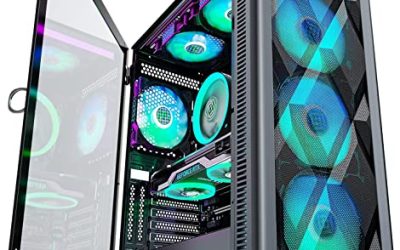
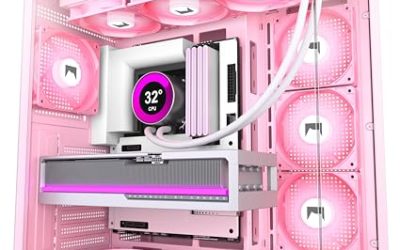
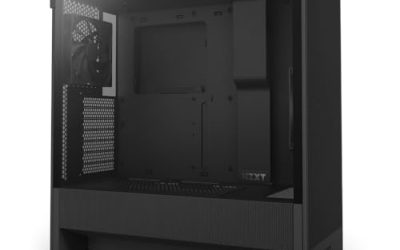
For a standard ATX build, the Cooler Master TD500 Mesh is the safest starting point on this list: it lists four ARGB fans, 360mm radiator support and RTX 5090 compatibility in its title. The darkFlash LAND451 and TH285 are the roomier, glass-heavy alternatives, the Elite 502 family is the airflow-first value route, and the Micro-ATX and Mini-ITX cases serve smaller builds. If you are comparing against ordinary ATX towers, our ATX mid-tower comparison covers fans and glass in more depth. All details here come from listing titles and published specifications.
Our Top Picks
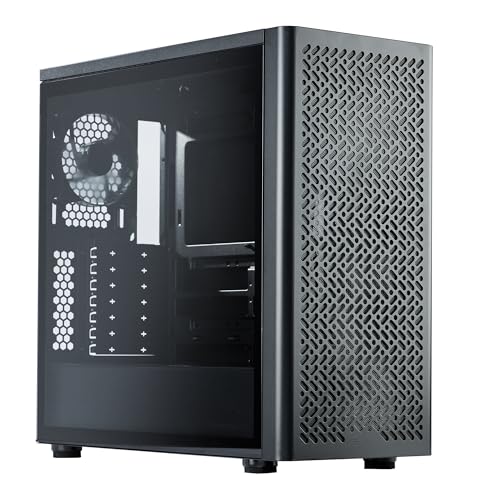 Cooler Master Elite 502 Lite ATX High AirflowMid Tower18.66 x 18.94 x 9.06 inches17.42 poundsCheck on Amazon
Top 3 picks at a glance
Picks by build type
As an Amazon Associate we earn from qualifying purchases at no extra cost to you.
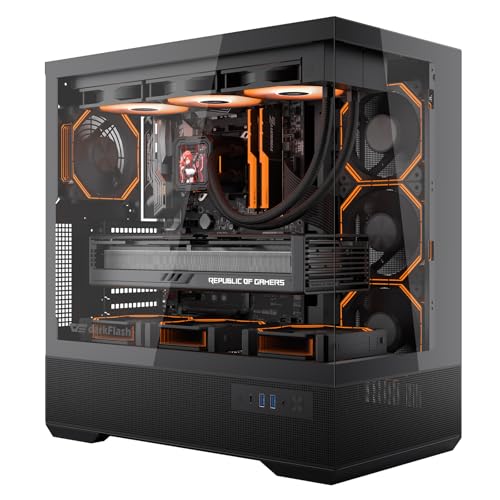


- Standard ATX with plenty of fans: Cooler Master TD500 Mesh
- Showcase build with vertical GPU: darkFlash LAND451
- Glass on three sides: darkFlash TH285
- Simple, airflow-first ATX: Cooler Master Elite 502, Elite 502 Lite or Elite 502 White
- Smaller Micro-ATX: darkFlash DB460M or FLOATRON F1
- Mini-ITX: Cooler Master NR200P V2 or SSUPD Meshroom S V2
Side-by-side table
| Model | Key point from title | Best for |
|---|---|---|
| darkFlash LAND451 | ATX, vertical GPU, up to 420mm card, dual 360mm AIO | Showcase builds |
| Cooler Master Elite 502 Lite | 410mm GPU max, 360mm AIO, one 120mm fan | Budget airflow |
| Cooler Master TD500 Mesh | 4 ARGB fans, 360mm radiator | All-rounder ATX |
| Cooler Master Elite 502 | 410mm GPU max, triple 120mm aRGB fans | Fans included |
| SSUPD Meshroom S V2 | Mini-ITX, PCIe 5.0 riser, 280mm AIO | Compact, mesh panel |
| Cooler Master Elite 502 White | White version of the Elite 502 | White builds |
| darkFlash DB460M | Micro-ATX, up to 420mm card, 360mm top radiator | Compact airflow |
| darkFlash TH285 | ATX, 4 ARGB PWM fans, up to 415mm card | Glass lovers |
| Cooler Master NR200P V2 | Mini-ITX, 357mm vertical GPU mount, SFX PSU | Small form factor |
| darkFlash FLOATRON F1 | Micro-ATX, up to 425mm card, back-connect, 360mm AIO | Clean-look builds |
Full-size ATX cases
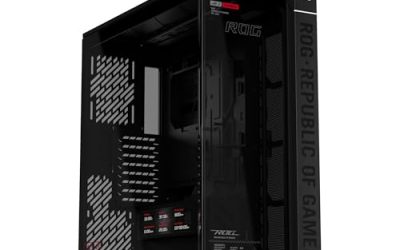
darkFlash LAND451 ATX
The title packs in a lot: ATX, vertical graphics card mounting, BTF motherboard support, a full-view mid-tower layout, Type-C, dual 360mm AIO room and an RTX 5090 allowance of up to 420mm. It is one of the larger clearance figures here. Vertical mounting needs a PCIe riser, and the listing does not say whether it is included, so check.
Pros
- 420mm card limit in the title
- Room for two 360mm radiators
Cons
- Vertical mounts can restrict card airflow
- Riser details not in the title
Who it’s for: Builders who want a display piece and have a BTF or standard board.
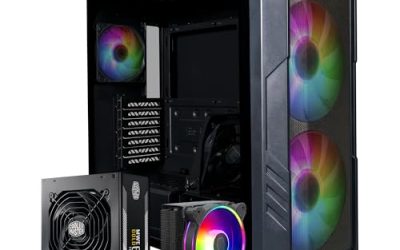
Cooler Master TD500 Mesh
The listing names four CF120 ARGB fans, a polygonal mesh front, tempered glass, 360mm radiator support and compatibility with RTX 5090 and RX 9070 XT cards. It does not give a millimetre limit for the GPU, so look up the figure on the Cooler Master page. Four fans included is a real saving over cases that ship with one. Because the title pairs the RTX 5090 with the RX 9070 XT, it is evidently aimed at current high-end cards, but only the manual can confirm the exact length and the radiator depth.
Pros
- Four fans in the box
- Mesh front for intake
Cons
- No GPU length figure in the title
- ARGB lighting is not for everyone
Who it’s for: A first 5090 build in a normal ATX case.
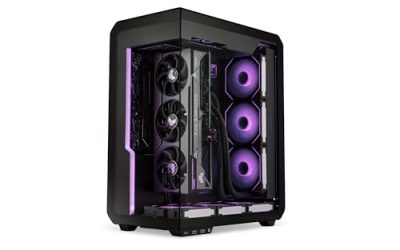
darkFlash TH285
An ATX mid-tower with full-view tempered glass on the front, top and side, 4 ARGB PWM fans (the title has a garbled character where the quantity should be), a 415mm RTX 5090 limit and 360mm radiator support. Glass on the top panel limits airflow, so expect fan choice to matter. The listing also says the front is full-view glass, which means intake air has to enter from the sides or the base, so check the manual for where the vents are before you commit.
Pros
- PWM fans included
- 415mm card limit stated
Cons
- Glass front and top restrict air
- Fan quantity unclear in the title
Who it’s for: Showpiece builders who accept a small airflow compromise.
Cooler Master Elite 502 (triple fan)
Described as a high airflow, minimalist ATX case with 410mm GPU maximum, 360mm AIO maximum, Type-C, tempered glass, triple 120mm aRGB fans and an intake grill. The title names an RX 7090 XT, which looks like a typo, so rely on the 410mm figure instead.
Pros
- Three fans included
- 410mm limit is stated
Cons
- Typo in the compatibility text
- Minimalist style, not much flair
Who it’s for: Budget-minded ATX builders who prioritise airflow.
Cooler Master Elite 502 Lite
The same 410mm GPU and 360mm AIO limits as the standard Elite 502, but with a single 120mm fan. Plan to buy extra fans if you want serious intake. Pick this version only if the price gap versus the triple-fan model is meaningful.
Pros
- Same clearance as the fuller model
- Likely the cheapest of the trio
Cons
- One 120mm fan only
- Same typo in the title
Who it’s for: Shoppers who will add their own fans.
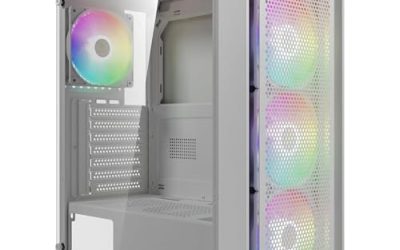
Cooler Master Elite 502 White
The white colourway of the triple-fan Elite 502, with the same 410mm clearance and 360mm AIO listing. The only reason to pick it over the black one is the paint. Check that white parts match the rest of your build.
Pros
- White finish for themed builds
- Triple fans included
Cons
- May cost more than black
- Same RX 7090 XT wording problem
Who it’s for: White-themed ATX builds.
Micro-ATX cases
darkFlash DB460M Micro-ATX
A micro-ATX case with a full-mesh front, a tool-free clamshell side panel, 420mm RTX 5090 support and a 360mm top radiator. Smaller boards mean fewer expansion slots, so confirm that your motherboard and card thickness suit it. A top 360mm radiator also leaves the front free for intake fans, which is a layout that works well when a hot graphics card sits near the front.
Pros
- Full-mesh front for intake
- 420mm card limit in the title
Cons
- Fewer slots on Micro-ATX boards
- Fan count not in the title
Who it’s for: A compact airflow-focused build.
darkFlash FLOATRON F1 Micro-ATX
A 270-degree panoramic glass design with a fan-free base, back-connect support, a high-airflow mesh front, 425mm RTX 5090 support, 360mm AIO room and USB-C. It lists the longest card limit here. The panoramic style suits tidy desks, but there are fewer places to hide cables.
Pros
- 425mm card limit, the longest listed
- Back-connect support for tidy cabling
Cons
- Glass panels can look messy if cables show
- Fan count not in the title
Who it’s for: Desk-top setups where looks count.
Mini-ITX cases
SSUPD Meshroom S V2 Mini-ITX
Listed as an SFF case with a full mesh panel, PCIe 5.0 riser cable, USB Type-C and 280mm AIO support. The title also says compatible with an ATX motherboard, which seems inconsistent with a Mini-ITX case, so verify the board size. RTX 5090 fit is named, though the exact card length limit is not.
Pros
- PCIe 5.0 riser included
- Mesh panel for airflow
Cons
- Board compatibility wording is unclear
- Length limit not stated
Who it’s for: SFF fans willing to read the manual.
Cooler Master NR200P V2 White Mini-ITX
The title mentions SFX PSU fitment (check whether a PSU is actually included), 280mm AIO support, a 357mm vertical GPU mount and design readiness for the RTX 5090 and RX 9070 XT. 357mm is the lowest limit here. Many flagship cards may not fit, so confirm your card first. Vertical mounting also means the card faces the side panel, so look at how far the glass sits from the fans before you buy.
Pros
- Small footprint
- Takes an SFX power supply
Cons
- 357mm limit rules out longer cards
- Tight to build in
Who it’s for: Small-form-factor builders who have already checked their card’s dimensions.
How we picked these
We searched Amazon US for PC cases whose titles name RTX 5090 support, then kept every result that fit a recognisable form factor. We compared the titles against published manufacturer documentation and buyer reviews. Nobody on the team used or measured these units. A clearance figure is only used where the title states it; otherwise it is marked as something to check.
What decides whether a 5090 really fits
The maximum GPU length is only the start
A case’s limit is usually measured with nothing in front of the card. Add a front fan or radiator and the real space drops. Get the exact card length from the product page of the card you plan to buy, as board partners vary.
Radiators, fans and cable room
A front 360mm radiator with fans can eat 50mm or more of length. Side room also matters: power connectors on flagship cards need space to bend. Many cable makers advise leaving a few centimetres before any sharp turn, so a thin case with a tight glass panel is a hazard.
Airflow versus glass
Mesh fronts, as on the TD500, Elite 502 and DB460M, feed fans directly. If noise is also a priority, see our list of quiet PC cases, which trade some of that mesh for foam and solid panels. Cases with full-view glass fronts look better but make the front fans work harder. A card producing a lot of heat benefits most from a mesh intake.
Weight, support and handling
Large cards are heavy, and a desk-friendly horizontal case changes how the weight is supported. A support bracket helps in a case without one, and the card needs to be installed with both hands. Always power the PC off and unplug it before touching the card or its connector.
A worked clearance example
Say a card is 340mm long and you want a 360mm radiator with fans at the front, which might take 55mm. In the Elite 502, with a 410mm limit, that leaves 15mm of margin. In the NR200P V2, with its 357mm vertical limit, you would be inside the limit but without a front radiator. These figures are only an example, so substitute your own.
Mistakes buyers make
Trusting the compatibility sentence is the first mistake, since two Cooler Master titles here mention an RX 7090 XT, and typos like that are common. Second, ignoring the front radiator. Third, choosing a Mini-ITX case without checking card thickness. And fourth, buying glass-heavy designs and then running out of airflow. Always compare the number in millimetres, not the marketing line.
Verdict
The Cooler Master TD500 Mesh is the safest all-round choice, and the Elite 502 family gives similar airflow for less. The darkFlash LAND451 and FLOATRON F1 give the roomiest clearance figures for builders after a statement piece. Choose the Mini-ITX cases only when you have the card’s exact dimensions, and read each manual before purchase.
Related guides
- Sustainable Gaming Pc Power Supply Efficiency Guide
- Noctua Nh-D15 Vs Thermalright Peerless Assassin 120
- Thermal Paste Application Method For Lga1851
Frequently asked questions
How much GPU clearance does an RTX 5090 need?
It depends on the exact card, because board partners make different lengths. The cases here state limits from 357mm for the vertical-mount NR200P V2 up to 425mm for the FLOATRON F1. Take the length from your card’s product page, add room for the front fan or radiator and the power cable, and only then compare it with the case figure. Never rely on the RTX 5090 name alone.
Can a Mini-ITX case take an RTX 5090?
Some can, but your choice of card narrows sharply. The NR200P V2 lists a 357mm vertical GPU mount and the SSUPD Meshroom S V2 names a PCIe 5.0 riser cable, but triple-slot flagship cards are often larger than that. Check the card’s length and thickness against the case’s limits and expect tight cable routing. If the dimensions are not both confirmed, choose a larger case instead.
Is a 360mm radiator or an air cooler better in these cases?
Either works if it fits. Cases such as the TD500 Mesh, TH285 and Elite 502 list 360mm radiator support, which frees the CPU area from tall air coolers. Large radiators at the front can cost GPU clearance, though, so read the case manual. Micro-ATX and Mini-ITX options may support smaller radiators or only low-profile coolers, so check the listed limits first.
Why do some Cooler Master titles mention an RX 7090 XT?
The Elite 502 family listings name an RX 7090 XT, which is not a card we can confirm exists, and it looks like a listing typo. The RTX 5090 mention is the part that matters here. Treat the AMD wording as unreliable, and confirm the actual clearance number, listed as 410mm, rather than trusting the compatibility sentence on its own.
Is a vertical GPU mount a good idea with an RTX 5090?
It can look striking, but it adds risks. The LAND451 and NR200P V2 list vertical mounts, which can push the card closer to the side glass and restrict its intake air. A riser cable also has to support PCIe 5.0 if you want full bandwidth. If cooling matters more than looks, a standard horizontal mount in a mesh-front case is the simpler option.