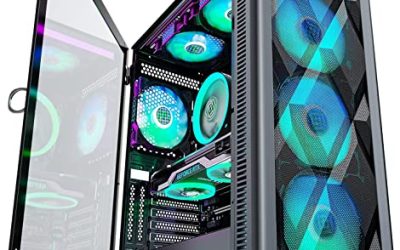
The Lian Li A4-H2O X5 in black is the best small form factor case for most RTX graphics cards in this group: it holds a card up to roughly 322 mm long and three slots thick inside an 11-liter sandwich layout, ships with a PCIe 5.0 riser, and still leaves room for a 240 mm radiator. “Small form factor” here means a Mini-ITX chassis under about 15 liters, where the graphics card, power supply and cooler all compete for the same few centimeters. If you own a compact two-slot RTX model, the SGPC K49 and Metalfish T40 shrink the footprint even further, while the micro ATX option trades size for easier building.
Our Top Picks
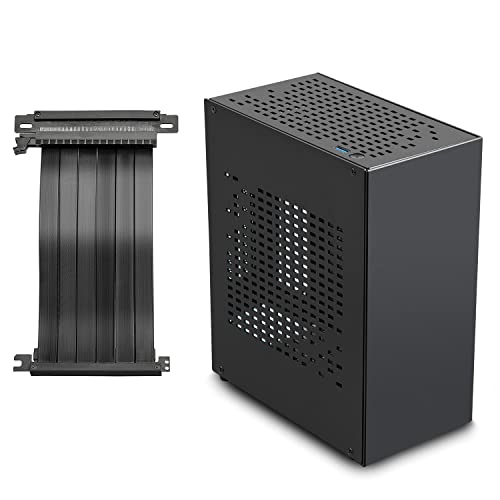
 Lian Li A4-H2OX5 Mini-ITX Case-SFX Layout-PCIe 5.0 Riser-Black-A4H2OX53.7012.83 x 5.51 x 9.61 inches7.56 poundsCheck on Amazon


Top 3 picks at a glance
Quick List
- JOYJOM TX aluminum Mini ITX – best for ultra-compact builds with a low-profile card (runner-up for full-size RTX cards)
- Lian Li A4-H2O X5 (black) – best overall for large RTX cards in a sandwich layout
- Metalfish T40 – best for a tiny vertical build around a short two-slot card
- Lian Li A4-H2O A5 (silver) – best for the same A4-H2O layout in a lighter finish
- Micro ATX case with 90 mm RGB fans – best for builders who want a standard ATX power supply and easy cable routing
- SGPC K49BL – best for a portable 8.3-liter build with a 300 mm card
Which One Is Right for You?
| If you… | Choose |
|---|---|
| Own a thick, long RTX card and want the most clearance in a small box | Lian Li A4-H2O X5 (black) |
| Prefer a silver exterior but need the same internal layout | Lian Li A4-H2O A5 (silver) |
| Want a carry-handle case and your card is about 300 mm or shorter | SGPC K49BL |
| Have a compact two-slot card under about 206 mm | Metalfish T40 |
| Already own an ATX power supply and want to keep it | Micro ATX case with 90 mm RGB fans |
| Are building around a single-slot or low-profile card and a Flex-style power supply | JOYJOM TX aluminum Mini ITX |
The deciding numbers are card length, card thickness and power supply format. Measure the card first, add a few millimeters of margin for power connectors, and then match it to a case. If the card is a triple-slot model, only the two Lian Li units and the micro ATX case are realistic here.
All 6 Picks in Detail
1. JOYJOM TX Aluminum Mini ITX Case – Best for Ultra-Compact, Low-Profile Builds
As an Amazon Associate we earn from qualifying purchases at no extra cost to you.

This is a 4.3-liter aluminum Mini-ITX case with a PCIe 3.0 riser, and it is the smallest option here. It also clearly does not fit the usual full-size RTX card, so treat it as a runner-up for this topic. Retailer specification fields list a graphics card envelope of about 17 x 10 x 4 cm, which points to a low-profile, single-slot-class card. It suits someone building a living-room or desk-side mini PC who accepts a very limited GPU choice in exchange for size.
- Volume of about 4.3 liters in roughly 2 mm aluminum alloy
- PCIe 3.0 riser cable included; length is listed differently by retailers, so confirm on the listing
- Graphics card limit of roughly 17 cm long and 4 cm thick
- Power supply listed as a Flex or 1U style unit, not a standard SFX unit
- CPU cooler height limited to roughly 36 mm
- Room for two thin 2.5-inch SSDs
Build notes: with such a limited envelope, plan the whole system around the case rather than the other way around. A low-power Mini-ITX board, a very short cooler and a modest, thin SSD are the realistic pairing, and the power supply is the part most likely to surprise you because Flex-style units are less common than SFX models. Anyone who wants a current mainstream RTX gaming card should look at the other five cases instead.
Pros:
- Extremely small footprint and clean aluminum look
- Riser included in the box
Cons:
- Does not accommodate mainstream full-size RTX cards
- Flex power supplies limit wattage and are harder to source
- Very tight cooler clearance
Compared with the Metalfish T40, which at least accepts a two-slot card around 206 mm, this case is for a different, much smaller class of graphics card entirely.
2. Lian Li A4-H2O X5 (Black) – Best Overall for Large RTX Cards

The A4-H2O is an 11-liter Mini-ITX case in a sandwich layout, with the motherboard on one side, the graphics card on the other, and a PCIe 5.0 riser connecting them. The X5 designation is the black version with the PCIe 5.0 riser. It suits builders who want a big RTX card, a short but capable CPU cooler or all-in-one liquid cooler, and a footprint about the size of a shoebox.
- Mini-ITX only, about 11 liters (roughly 326 x 140 x 244 mm)
- Graphics card up to about 322 mm long and triple-slot thickness
- SFX and SFX-L power supplies via a removable bracket, with an extension cord
- Top mount for a 240 mm radiator with two 120 mm fans
- CPU air cooler clearance of about 55 mm
- One 2.5-inch SSD mount; aluminum exterior and steel interior
Build notes: the sandwich design means the card sits on the far side of the board from the CPU cooler, so the two heat sources breathe separately. That helps sustained gaming loads because neither part is exhausting directly into the other. Builders who want to fit a large RTX card with an all-in-one cooler should read the radiator thickness limit closely, since 120 mm fans plus a thick radiator can exceed the stated clearance. Cable management is the learning curve, and the included power extension helps.
Pros:
- Best card clearance in the group, including thick triple-slot designs
- PCIe 5.0 riser matches current RTX 50-series interface speeds
Cons:
- Requires an SFX or SFX-L power supply, not ATX
- Only one 2.5-inch drive mount
Choose it over the SGPC K49BL if your card is thicker than two slots or longer than 300 mm; choose the K49BL if portability matters more.
3. Metalfish T40 – Best for a Tiny Vertical Build Around a Short Card

The Metalfish T40 is a roughly 7-liter vertical Mini-ITX case with a built-in carry handle. It is aimed at builders who have a compact RTX model and want the smallest practical footprint with a standard SFX supply. The listing states support for a 206 mm graphics card and a 70 mm CPU cooler, which means card choice is the main constraint.
- Mini-ITX only, around 7 liters
- Graphics card limit of about 206 mm long, with roughly 46 mm of thickness, so dual-slot at most
- SFX and SFX-L power supply support, mounted at the bottom
- CPU cooler height limit of 70 mm
- Steel and acrylic construction with a carry handle; fans not included
- PCIe riser cable required to connect the card
Build notes: the vertical layout and small volume mean the card, riser and power supply need to be chosen together. Measure the card including the backplate and any rear power connector, and confirm the riser length reaches both the board and the card without a sharp bend. With no fans included, budget for at least one or two slim intake fans and check the dust filter positions listed on the product page.
Pros:
- Very small and easy to carry
- Accepts SFX-L as well as SFX power supplies
Cons:
- Only compact RTX models fit; many mainstream partner cards are too long or thick
- Airflow depends on the fans and panel you add
Next to the SGPC K49BL, it is smaller but allows about 100 mm less card length, so check your card dimensions twice.
4. Lian Li A4-H2O A5 (Silver) – Best for the Same Layout in a Lighter Finish

This is the silver edition of the same A4-H2O platform, with the same PCIe 5.0 riser and sandwich layout as the black X5. Pick it when your desk or build theme calls for a silver aluminum exterior rather than black. Internal limits should match the black version, but confirm the exact SKU details on the listing before ordering.
- Mini-ITX, about 11 liters, aluminum exterior with SPCC steel interior
- Triple-slot graphics card support, up to roughly 322 mm
- SFX and SFX-L power supply layout
- Top mount for a 240 mm radiator (up to about 55 mm thickness including fans)
- CPU air cooler height of about 55 mm
- PCIe 5.0 riser cable included in the A5 version
Build notes: if you are weighing black against silver, the decision is mostly cosmetic and logistical. Silver aluminum can look cleaner next to a white motherboard or light desk, but darker finishes tend to hide dust and handling marks. Whichever you choose, treat the stated clearances as the manufacturer’s numbers and leave a little margin for thick power connectors on the card.
Pros:
- Identical clearances to the black version
- Light finish pairs well with white or silver builds
Cons:
- Light aluminum shows fingerprints more readily
- Same SFX-only power supply limitation
It sits one step behind the black X5 in this guide only because the black version came first in the list; on specs they are effectively equal.
5. Micro ATX Case with 90 mm RGB Fans – Best for Standard ATX Power Supplies

At 14.6 liters, this is the largest case in the guide and not truly “small form factor” in the strict sense, but it takes Micro ATX and Mini-ITX boards and removes the biggest SFF headaches: no riser, no SFX premium and no cooler height limit below 135 mm. It suits first-time builders pairing a long RTX card with a normal ATX power supply.
- Micro ATX and Mini-ITX motherboard support
- Graphics card up to about 310 mm long
- CPU cooler up to about 135 mm tall
- Standard ATX power supply support
- Two 90 mm RGB fans pre-installed; additional fan positions available
- 0.8 mm SPCC steel with USB 3.0 and Type-C front I/O
Build notes: this case is the most forgiving first build in the set. A standard ATX power supply, a tall tower cooler and a long RTX card all fit without special parts, and the two pre-installed 90 mm fans give a basic airflow path out of the box. The compromise is volume: at 14.6 liters it is closer to a compact mid-tower than a true SFF machine, and the thin steel panels are less rigid than aluminum.
Pros:
- No riser cable or SFX power supply needed
- Room for larger air coolers and extra storage
Cons:
- Noticeably larger than every other case here
- Thin steel can flex more than aluminum designs
Compared with the A4-H2O units, it gives up about three liters of volume savings for a much simpler build.
6. SGPC K49BL – Best for Portable 8.3-Liter Builds with a 300 mm Card

The SGPC K49 is an 8.3-liter Mini-ITX case with a carry handle and a vertical GPU position fed by a riser. The listing for this black Standard Edition calls out a 300 mm card limit. It suits someone who takes a gaming PC to LAN events and wants one of the shorter cases that still accepts a long-ish RTX card.
- Mini-ITX board support, about 8.3 liters (roughly 151 x 306 x 179 mm)
- Graphics card up to about 300 mm long
- SFX power supply only; SFX-L does not fit
- CPU air cooler up to about 69 mm tall
- One 2.5-inch drive mount; USB 3.0 and Type-C front I/O
- 1.5 mm steel panels; a riser cable may be sold separately, so confirm on the listing
Build notes: the K49 family is shared across several colors and bundles, some with a riser and some without, so read the contents line on the exact listing you are buying. The vertical card position pulls air through a ventilated panel, and the 69 mm cooler limit calls for a low-profile tower or a compact cooler. Because only SFX supplies fit, check cable lengths before ordering a high-wattage unit.
Pros:
- Strong balance of size and card length
- Included carry handle
Cons:
- SFX-only power supply support
- Riser may not be included in this edition
The Metalfish T40 is smaller still, but the K49BL accepts roughly 100 mm longer cards.
Specs Compared
| Case | Volume | Max GPU length | PSU format | CPU cooler height | Riser |
|---|---|---|---|---|---|
| JOYJOM TX aluminum | About 4.3 L | About 170 mm (low-profile class) | Flex / 1U | About 36 mm | PCIe 3.0, included |
| Lian Li A4-H2O X5 (black) | About 11 L | About 322 mm, triple-slot | SFX / SFX-L | About 55 mm | PCIe 5.0, included |
| Metalfish T40 | About 7 L | About 206 mm, dual-slot | SFX / SFX-L | 70 mm | Required; confirm on listing |
| Lian Li A4-H2O A5 (silver) | About 11 L | About 322 mm, triple-slot | SFX / SFX-L | About 55 mm | PCIe 5.0, included |
| Micro ATX case, 90 mm fans | 14.6 L | About 310 mm | Standard ATX | About 135 mm | Not needed |
| SGPC K49BL | About 8.3 L | About 300 mm | SFX | About 69 mm | Confirm on listing |
How We Chose These
This guide is built from published specifications, not from personal use of the cases. We started from the six cases in the current catalog set and compared each against the same questions: how long and thick a graphics card it accepts, which power supply formats it takes, how much CPU cooler height it allows, and whether a riser is included. We cross-checked listing titles against manufacturer pages where they exist and flagged anywhere sources disagree. Cases that cannot take a mainstream RTX card are labeled as runner-ups rather than ranked on equal terms, and anything the listing does not state is marked “confirm on listing.”
What to Look For
Card Length, Thickness and Slot Count
RTX partner cards vary enormously. Compact two-slot models can be under 220 mm, mainstream dual-fan designs often land between 260 and 320 mm, and flagship triple-slot coolers can exceed 330 mm and 60 mm of thickness. Always compare the card maker’s stated length, height and thickness with the case’s limits, and leave at least 5 to 10 mm for power connectors and cables. As a rule of thumb, a case that lists a “triple-slot” or “65 mm” thickness limit is the safe pick for a large card; a case that lists only a length may still reject a thick one.
Power Supply Format and Wattage
Most SFF cases accept SFX or SFX-L units rather than full ATX. SFX supplies are widely available up to 1000 W, but they usually cost more per watt and have smaller fans. NVIDIA’s published system requirements for current RTX cards typically call for an 850 W supply on a high-end 80-class model, so do not assume a 450 W Flex supply is enough. Also verify the supply has a native 12V-2×6 connector or a quality adapter, and confirm the cable length reaches the card in a sandwich layout.
Airflow, Panels and Cooler Height
Small cases rely on mesh panels and fan placement. Sandwich layouts such as the A4-H2O feed the graphics card from its own side panel, which helps cards that run hot. A 55 to 70 mm air-cooler limit means low-profile or compact tower coolers; a 240 mm all-in-one radiator on the top is often a better thermal answer. Example: a CPU with a 120 W power limit usually needs a compact cooler rated for at least that figure, so check the cooler’s height against the case before buying either part.
Riser Cables and PCIe Generation
Vertical GPU cases need a riser. A PCIe 5.0 riser keeps current RTX 50-series cards at full link speed, while a PCIe 3.0 or 4.0 riser can limit link speed on a card that supports a newer standard. In practice most games lose little from a one-generation drop, but a longer, poorly shielded riser can cause instability, so prefer cases that ship with a rated riser.
Noise and Fan Behavior in Tight Spaces
Compact cases concentrate heat, so fans spin faster for the same temperature. Look for dust-filtered intake on the side that feeds the card, and avoid blocking exhaust paths with cable bundles. A graphics card with a modest power limit and a fan curve set to ramp gradually usually sounds better in a 7 to 11 liter case than the same card at stock settings, so plan a few minutes in the card’s software to adjust the curve once the build is finished.
Build Difficulty and Assembly Order
Smaller cases mean tighter tolerances. Plan the order: install the CPU, memory and storage on the board, mount the cooler, route the power supply cables, then slide in the card last. Use shorter custom or sleeved cables where the manufacturer offers them.
Questions
Will an RTX 50-series card fit in a small form factor case?
It depends on the specific model. Founders-style and compact partner cards can fit cases with a 300 mm limit, while large triple-slot coolers need a case rated for around 320 mm and 60 mm or more of thickness. Compare the card’s published dimensions to the case table before buying.
Do I need an SFX power supply?
For most Mini-ITX cases in this list, yes. The micro ATX option is the exception because it accepts a standard ATX unit. SFX supplies are available at wattages high enough for high-end RTX cards.
Is a PCIe 5.0 riser necessary?
Not strictly, but it matches the interface of current cards and avoids link-speed limits. Cases that ship with one remove a compatibility question.
Can I use a 240 mm radiator in these cases?
The A4-H2O models list top support for a 240 mm radiator with limited total thickness. Verify the thickness of your radiator and fans against the case, since the stated clearance includes the fans.
Is the JOYJOM TX suitable for a gaming RTX card?
Only for low-profile, single-slot-class cards. Its listed GPU envelope is far smaller than mainstream RTX gaming cards, so it is best viewed as a compact mini PC chassis.
Why does the silver A4-H2O appear separately from the black one?
They are separate finish options on the same platform, each with its own listing. Internal dimensions should match, but confirm on the product page.
Update History
- October 21, 2026 – Initial publication; product set drawn from current catalog listings.
- Check the product page for current specifications and availability before buying.
Sources
- Manufacturer product and specification pages for Lian Li, SGPC and Metalfish
- Retailer listing titles and specification fields for each case
- NVIDIA published power supply recommendations for RTX graphics cards