Our Top Picks
 TempPro TempSwift 1 Sec Digital Food Thermometer forDigital8.6 x 1.2 x 1.2 Inches0.05 PoundsCheck on Amazon


Top 3 picks at a glance
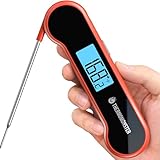
Best Meat Thermometers for Perfect Cooking
The ThermoWorks Thermapen ONE is the best meat thermometer for perfect cooking when accuracy, near-instant readings, waterproofing, and easy cleanup matter more than wireless monitoring; choose the MEATER Pro for wireless cooking, the ThermoWorks Signals for several probes, and the Combustion Inc. Predictive Thermometer for the most detailed temperature picture inside a large roast.
Best Meat Thermometers at a Glance
| Rank | Model | Accuracy and speed | Wireless range | Waterproofing | Best for | Typical price |
|---|---|---|---|---|---|---|
| 1 | ThermoWorks Thermapen ONE | Approximately ±0.5°F; about 1-second readings | None | IP67 | Fast, precise everyday cooking | Varies |
| 2 | MEATER Pro | Multi-sensor probe; readings update in seconds | Bluetooth and Wi-Fi through its charger | Probe is waterproof; charger is not | Wireless roasting and grilling | Varies |
| 3 | Combustion Inc. Predictive Thermometer | Eight internal sensors; predictive cooking estimates | Bluetooth, typically extended by a display or booster | Probe is water-resistant; check the charger limits | Large roasts and edge-to-center monitoring | Varies |
| 4 | ThermoWorks Signals | Four wired probes; approximately ±1°F system accuracy | Wi-Fi and Bluetooth; practical range depends on network | Controller is splash-resistant, not designed for immersion | Smoking and long cooks with multiple zones | Varies |
| 5 | ThermoPro TP19 | Approximately ±0.9°F; quick readings in a few seconds | None | Commonly rated IP65 | Affordable instant-read cooking | Varies |
Specifications can vary by revision, firmware, and probe position. Accuracy figures are most useful when comparing similar conditions: a thermometer can be precisely calibrated yet still give a poor result if its tip touches a bone, pan, or grill grate.
As an Amazon Associate we earn from qualifying purchases at no extra cost to you.


1. ThermoWorks Thermapen ONE: Best Overall Instant-Read Thermometer
The Thermapen ONE earns the top position because it combines approximately ±0.5°F accuracy with readings that appear in about one second. That speed is valuable when checking several burgers, opening an oven briefly, or measuring oil without leaving the probe in the food.
Its folding probe, automatic wake-up, bright display, and IP67-rated construction make it practical for a wet kitchen environment. The probe can be wiped clean quickly, and the sealed body tolerates splashes better than many inexpensive folding thermometers. It has no wireless range, but that is an advantage if you want a device that works without an app, pairing, or charging dock.
Why it wins
- Best combination of speed and accuracy for steaks, poultry, bread, candy, and frying.
- Simple operation reduces the chance of forgetting to connect an app before cooking.
- Sealed construction is easier to sanitize than thermometers with exposed buttons or seams.
Pick it if you usually stand near the grill or oven and need a reliable answer immediately. It is less suitable if you want alerts while smoking a brisket overnight.
2. MEATER Pro: Best Wireless Thermometer for Everyday Roasting
The MEATER Pro is a strong wireless choice for rotisserie chicken, roasts, steaks, and grill sessions where opening the lid repeatedly would waste heat. Its wireless probe measures both internal food temperature and the surrounding cooking environment, while the charger connects to a phone and can extend connectivity through Wi-Fi.
Wireless range is not a fixed indoor number. Thick walls, metal grills, appliances, and the position of the charger can reduce it substantially. In an open yard, the practical range can be much better than inside a house. Place the charger on the side of the grill nearest the probe, rather than behind a metal cooker, to improve the signal.
Important limitation
The probe may be waterproof while the charging case is not. Remove the probe, wash it according to the manufacturer’s instructions, and keep the charger away from steam, grease, and sink water. Do not treat a wireless probe’s water resistance as permission to submerge every component.
3. Combustion Inc. Predictive Thermometer: Best for Large Roasts
The Combustion Inc. Predictive Thermometer uses multiple sensors along the probe instead of relying on one temperature point. That design shows how heat is moving from the exterior toward the center of a roast and helps estimate when the food will reach its target temperature.
This is especially useful for thick prime rib, pork loin, whole poultry, and reverse-seared steaks. A single-sensor probe can report a safe-looking temperature at one location while another part of the roast is cooler. Multiple sensors reveal that gradient and make carryover cooking easier to judge.
The trade-off is complexity. The probe is longer and more expensive than a standard instant-read thermometer, and its predictive estimate still depends on correct placement. Insert it through the thickest section, avoid bones and cavities, and leave enough clearance for the lid or oven door to close.
4. ThermoWorks Signals: Best for Multi-Probe Smoking
ThermoWorks Signals is the better choice when you need to monitor several temperatures at once: for example, the meat, the grate near the meat, a second cooking zone, and a separate roast. Its four-probe design is more useful than a wireless single-probe system for barbecue cooks who need to understand both food temperature and pit temperature.
Wi-Fi makes remote alerts possible, but wireless reliability depends on the home network and the controller’s placement. Keep the controller away from direct rain and heavy condensation. Route probe cables so they do not touch hot metal edges, flames, or a rotating rotisserie.
Signals is overkill for a weeknight steak. Its value appears during long cooks, when a temperature alarm can prevent an overnight smoker from drifting too hot or too cold.
5. ThermoPro TP19: Best Budget Instant-Read Option
The ThermoPro TP19 is a sensible low-cost option for cooks who want a folding probe and quick readings without paying premium instant-read prices. Its stated accuracy is generally around ±0.9°F, which is sufficient for checking poultry, burgers, reheated food, and common oven recipes when the probe is positioned correctly.
It may take a few seconds longer to settle than the Thermapen ONE. That difference matters during high-volume cooking but is minor for a single roast. Look for a model revision with a sealed body and an IP-rated design, and keep the display and charging port clean of grease.
How to Choose by Cooking Situation
| Your situation | Best fit | Reason |
|---|---|---|
| Checking steaks, chicken, and frying oil at the stove | Thermapen ONE | Fastest, simplest, and highly accurate |
| Cooking a roast while doing other tasks | MEATER Pro | Wireless alerts and no cable through the oven door |
| Monitoring a thick roast from edge to center | Combustion Predictive Thermometer | Multiple sensors show the temperature gradient |
| Running a smoker with several zones or cuts | ThermoWorks Signals | Four wired probes and remote monitoring |
| Occasional cooking on a limited budget | ThermoPro TP19 | Useful accuracy at a lower price |
Accuracy Matters More Than the Displayed Decimal Places
A thermometer showing 0.1-degree increments is not automatically more accurate than one showing whole degrees. For a reliable measurement, insert the tip into the thickest part of the food, wait for the number to stabilize, and take two readings from different angles.
For example, suppose a chicken breast reads 160°F at the center but 150°F closer to the thick end. The lower reading is the important one because it indicates the coolest area. A fast thermometer helps you find that cold spot before serving; a wireless thermometer helps you watch it rise over time.
Cleaning and Calibration: The Details That Protect Accuracy
- Clean before and after use. Wipe the probe with hot soapy water or an appropriate food-safe sanitizer. Do not put the entire thermometer in the sink unless the complete device is rated for immersion.
- Keep the sensing tip clear. Dried sugar, grease, and smoke residue can slow readings and make insertion difficult.
- Check calibration in ice water. Stir crushed ice with enough water to fill the gaps. The mixture should be close to 32°F at sea level. Insert the probe without touching the container, and allow the reading to settle.
- Use boiling water as a second check. Water boils near 212°F at sea level, but the boiling point falls at higher elevations. This is a check, not a universal fixed target.
If an instant-read thermometer is consistently several degrees away in both tests, replace or recalibrate it if the manufacturer supports calibration. If only one reading is wrong, first check that the probe is not touching the container and that the ice mixture contains both ice and water.
Frequently asked questions
Can I wash the MEATER Pro charging case with the probe?
No, the charging case should be kept away from steam, grease, and sink water. The probe may be waterproof, but the charger is not necessarily waterproof. Remove the probe and wash it according to the manufacturer’s instructions instead of treating water resistance as permission to submerge every component.
Where should I insert a thermometer probe in a large roast?
Insert the probe through the thickest section of the roast and avoid bones and cavities. The tip should measure the coolest meaningful part of the food rather than touching a bone, pan, or grill grate. Correct placement matters because a thermometer can be accurately calibrated yet still give a poor result in the wrong location.
Why should I take more than one temperature reading from chicken?
You should take readings from different angles because one part of the chicken may be cooler than another. If the center reads 160°F but the thick end reads 150°F, the lower reading is the important one. A fast thermometer helps locate that cold spot before serving.
Can I use boiling water to check my thermometer’s calibration?
Yes, boiling water provides a second calibration check, but its temperature depends on elevation. Water boils near 212°F at sea level, and the boiling point falls at higher elevations, so 212°F is not a universal target. Keep the probe from touching the container and allow the reading to settle.
Do I need a wireless thermometer if I usually cook beside the oven or grill?
No, a wireless thermometer is not necessary if you usually stand near the oven or grill. The Thermapen ONE has no wireless range, but it works without an app, pairing, or charging dock and provides a quick answer nearby. Wireless models are more useful when you want alerts while cooking remotely or monitoring a long cook.
Final Recommendation
Buy the Thermapen ONE for the broadest combination of accuracy, speed, water resistance, and easy cleaning. Choose the MEATER Pro when wireless alerts matter, the Combustion Inc. Predictive Thermometer for thick roasts, ThermoWorks Signals for multi-probe smoking, and the ThermoPro TP19 when keeping the cost low is the priority. The best thermometer is ultimately the one whose probe placement, connectivity, and cleaning routine match the way you cook.