The real decision behind a Yamaha keyboard is not which logo sits above the keys, but which kind of player you are becoming. A student heading into piano lessons needs 88 weighted keys that build finger strength and never run out of range, while someone who wants to play songs with rhythms and backing bands is happier on a lighter 61-key arranger they can carry under one arm. Pick the wrong family and even a good instrument fights you every practice session.
This guide is for parents buying a first instrument, adult learners returning to piano after years away, and home players who want accompaniment features without giving up a realistic touch. Every model below is a genuine Yamaha electronic keyboard or digital piano, and each one was chosen from the names and specifications stated on its Amazon product page, so the key counts, actions and included accessories quoted here come straight from the listing rather than from marketing roundups.
Our Top Picks
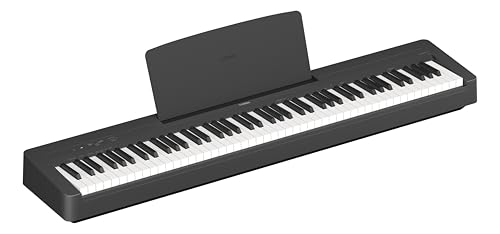
 YAMAHA P71 88-Key Weighted Action Digital Piano withFull52.25 x 11.5 x 6 inches25 poundsCheck on Amazon
Top 3 picks at a glance
Quick Picks
As an Amazon Associate we earn from qualifying purchases.
| Product | Best for | Key spec from title |
|---|---|---|
| Yamaha PSR-E383 | First-time players and younger learners | 61 touch-sensitive keys |
| Yamaha P-71 | Piano lessons on a straightforward setup | 88-key weighted action |
| Yamaha P-145BT | Small rooms and app-based practice | 88 weighted keys with Bluetooth |
| Yamaha P-225 | Advancing players who want richer sound | 88-key weighted keys, portable design |
| Yamaha DGX-670 | Players who want a built-in backing band | 88-key weighted digital piano, 630 voices |
How to Choose
Start with the number of keys
Key count decides what music you can play before anything else does. A 61-key board like the PSR-E383 covers most pop songs, school pieces and early method books, and its shorter body fits small desks and younger arms. The trade-off appears as soon as lessons turn serious: piano repertoire uses the full 88-key range, and a student who practises on 61 keys learns to avoid the notes that are not there. If lessons with a teacher are the plan, start at 88 keys and skip the upgrade you would otherwise need within a year or two.
Weighted keys versus touch-sensitive keys
These two phrases sound similar but describe different things. Touch-sensitive keys, found on the PSR-E383, respond to how hard you press, so loud and soft playing is possible, but the keys themselves are light and springy. Weighted keys on the P-71, P-145BT, P-225 and DGX-670 add graded resistance that feels heavier in the bass and lighter in the treble, much like an acoustic piano. That resistance builds the finger control teachers grade on. Players who only want chords and songs can live happily without it; piano students cannot.
Polyphony and the voice library
Polyphony is how many notes can sound at once before the earliest ones get cut off. The PSR-E383 lists 48-note polyphony, which is fine for solo practice but can clip during fast passages with the sustain pedal held down and accompaniment running. Voice count matters for a different reason: the DGX-670 carries 630 voices and hundreds of styles, turning one player into a small band, while the P-145BT keeps just 10 voices and asks for nothing but playing. Neither approach is wrong; the mistake is paying for a library you never open.
Match the keyboard to the job it will actually do
Write down the main job before you compare models. Daily lesson practice points to a weighted 88-key piano with a sustain pedal in the box. Playing along with songs, recording ideas and entertaining family points to an arranger with styles and speakers that fill a room. Tight living space points to a compact slab like the P-145BT that slides onto a desk or into a corner. When the job is clear, the right Yamaha usually picks itself, and the remaining choice is only about which extras are worth having.
The 5 Best Options
Yamaha PSR-E383

The PSR-E383 is the friendliest starting point in Yamaha’s line for someone who has never touched a keyboard. Its 61 touch-sensitive keys keep the instrument light and compact, while 650 voices and 260 accompaniment styles mean a beginner can play along with a full backing band from the first week. Built-in lesson features guide early practice, and the listing includes the power adapter, which many entry keyboards sell separately. For children, casual adult starters and anyone testing whether piano will stick before committing to weighted keys, this is the lowest-friction way in.
Specs
- Keys: 61, touch-sensitive
- Voices: 650
- Accompaniment styles: 260
- Polyphony: 48 notes
- Includes: music rest and power adapter, per the listing title
Best for: first-time players and younger learners who want songs and styles from day one.
Watch out for: the unweighted keys will not prepare a student for acoustic piano touch, and a stand is not part of this listing.
ASIN: B0D1CTPFL8
Yamaha P-71
The P-71 is Yamaha’s Amazon-exclusive version of its long-running entry piano, and it strips the formula down to what a lesson student needs: 88 fully weighted keys, 10 voices and a sustain pedal in the box. There is no Bluetooth, no style library and no screen to distract from practice, which many teachers quietly prefer. The weighted action trains proper finger strength from the first scale, and the full key range means no piece in a method book has to be adapted or skipped. For a household that wants one honest piano for lessons, this is the default pick.
Specs
- Keys: 88, weighted action
- Voices: 10
- Touch-sensitive keys, per the listing
- Includes: sustain pedal and power supply, per the listing title
- Sold as an Amazon-exclusive model
Best for: piano students who want a simple, teacher-friendly 88-key instrument at home.
Watch out for: no stand or bench is included, and the listing does not promise Bluetooth or app connectivity.
ASIN: B01LY8OUQW
Yamaha P-145BT
The P-145BT takes the compact end of Yamaha’s P-series and adds the one modern feature the P-71 lacks: Bluetooth, so practice apps and streamed audio connect without cables. It keeps 88 weighted, touch-sensitive keys in a slim body that suits apartments, dorm rooms and shared living spaces where a full furniture piano would never fit. Ten voices keep the focus on piano playing rather than menus, and the listing bundles the music rest and sustain foot switch, so the box arrives ready for daily practice on any stable table or stand you already own.
Specs
- Keys: 88, weighted and touch-sensitive
- Voices: 10
- Bluetooth connectivity, per the listing title
- Includes: music rest and sustain foot switch, per the listing title
- Built-in speakers
Best for: learners in small spaces who practise with apps and want a tidy, compact piano.
Watch out for: the compact body means modest speaker output for large rooms, and the furniture stand is a separate purchase.
ASIN: B0F9H3SHFJ
Yamaha P-225

The P-225 is the step up for players who have outgrown an entry piano’s sound but still need something portable. Its listing pairs 88 weighted keys with 24 voices, double the P-145BT’s library, and the portable design keeps the body slim enough to move between rooms or take to a teacher’s studio. A music rest and sustain foot switch are included, and the built-in speakers are voiced for playing at home rather than through an amp. If you expect to keep the same instrument through several years of graded study and home performance, this is where the P-series gets serious.
Specs
- Keys: 88, weighted
- Voices: 24
- Includes: music rest and sustain foot switch, per the listing title
- Built-in speakers
- Color option in this listing: Black (P225B)
Best for: advancing students and home players who want a richer piano sound in a portable body.
Watch out for: confirm the color variant on the listing before ordering, since the white version carries a different ASIN.
ASIN: B0CBN7HYKB
Yamaha DGX-670
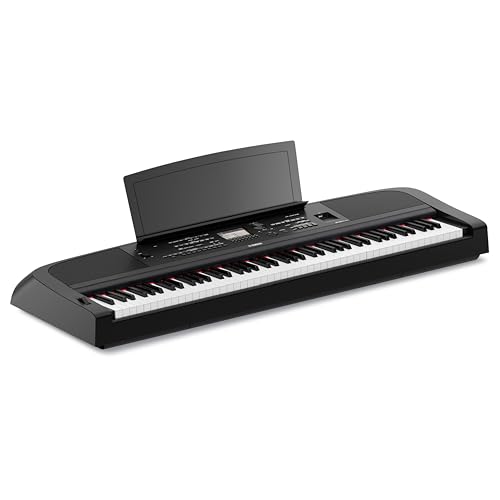
The DGX-670 is for the player who wants a piano and a band in the same instrument. Under its 88 weighted keys sit 630 voices and a deep library of accompaniment styles, so a solo player can rehearse with drums, bass and strings following along. It keeps the graded touch a piano student needs, which makes it the rare arranger that does not force a choice between lessons and entertainment. The listing includes a sustain foot switch and music rest, while the matching furniture stand is sold separately, so plan the setup before it arrives rather than after.
Specs
- Keys: 88, weighted
- Voices: 630
- Includes: sustain foot switch and music rest, per the Amazon listing title
- Furniture stand sold separately, per the listing title
- Color option in this listing: Black (DGX-670B)
Best for: home players who want weighted keys plus full arranger accompaniment.
Watch out for: at this size and weight it suits a fixed spot at home far better than regular travel.
ASIN: B08RNFJ98M
Which One Fits Your Situation
Your child is starting lessons this term
Choose between the P-71 and the PSR-E383 based on the teacher’s expectations. If the teacher grades on acoustic pianos, the P-71’s weighted 88 keys build the right habits from the start. If the goal is keeping a young beginner interested with songs and rhythms, the PSR-E383’s styles and lesson features make practice feel like play, with an upgrade path to weighted keys later.
You are an adult learning in a small apartment
The P-145BT fits this life best. Its slim 88-key body sits on a desk or compact stand, Bluetooth connects practice apps without a cable across the room, and headphone practice keeps neighbours out of your evening sessions. It covers the full piano range, so the space saving never turns into a musical compromise.
You play songs with friends and family
Pick the DGX-670. The accompaniment styles turn solo playing into a group performance, 630 voices cover everything from electric piano to strings, and the weighted keys still feel respectable when you switch to straight piano pieces. It is the one instrument here that can anchor a living-room music night on its own.
You are returning to piano after years away
The P-225 rewards a returning player. Its weighted action and 24 voices feel closer to the acoustic piano you remember, the portable body is easy to set up in a spare corner, and there is enough sound quality headroom that your recovering technique, not the instrument, sets the limit for the next few years.
Common Mistakes
- Buying a 61-key keyboard for a child whose teacher expects practice on a full 88-key piano range.
- Confusing touch-sensitive keys with weighted keys; only the weighted action builds acoustic piano finger strength.
- Forgetting that many listings exclude the stand and bench, so the real setup needs those ordered separately.
- Choosing an arranger with hundreds of styles for a student who only needs a piano voice, or the reverse.
- Ordering a color or bundle variant without checking that the ASIN on the page matches the exact model wanted.
Frequently Asked Questions
Is the Yamaha P-71 the same as the P-45?
They are closely related instruments. The P-71 is the Amazon-exclusive version sold under its own listing, with the sustain pedal and power supply named in the box contents, while the P-45 is the version sold through regular music retailers. The playing experience, 88 weighted keys and core voices are effectively the same, so choose by which listing is in stock and complete.
Do beginners really need 88 weighted keys?
Only if the goal is piano playing in the traditional sense. Weighted keys train finger strength and control that transfer to acoustic pianos, which is why teachers ask for them. A beginner who mainly wants to play songs, chords and melodies for fun can start happily on the 61 touch-sensitive keys of the PSR-E383 and upgrade when the repertoire demands it.
What is the difference between a Yamaha keyboard and a Yamaha digital piano?
In Yamaha’s range, keyboards like the PSR-E383 are light, portable instruments with unweighted keys, hundreds of voices and automatic accompaniment. Digital pianos like the P-series and DGX-670 prioritise a realistic piano touch with 88 weighted keys and fewer, better piano sounds. The DGX-670 blurs the line by offering weighted keys with an arranger’s voice and style library on top.
Which accessories should I budget for besides the keyboard itself?
Plan on a stand at the correct playing height, a bench or suitable chair, and headphones for quiet practice, because several listings in this guide exclude the stand. Check each product page for what is already in the box: the P-71, P-145BT and P-225 include a sustain pedal or foot switch, while the DGX-670’s furniture stand is a separate purchase.
Related guides
More from Amazon
Programs that pair well with the guide above. Offers and eligibility are set by Amazon and may change.
Free shipping on eligible items, Prime Video and more. Eligible new members can start with a free trial.
Start a Prime free trialAd-free music streaming. Eligible new subscribers can start with a free trial.
Try Music Unlimited freeA Prime membership for ages 18-24 with a trial period. Eligibility is set by Amazon.
See Prime for Young AdultsAudiobooks and podcasts to listen to on the go. Eligible new members can start with a free trial.
Try Audible freeAs an Amazon Associate we earn from qualifying purchases.