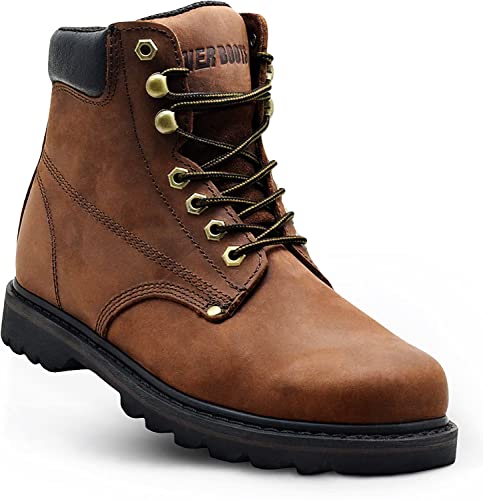
The best work boots for demanding jobs balance a protective safety toe, waterproofing, dependable outsole grip, supportive construction, and a break-in period you can tolerate; for most workers, a well-fitted 6-inch composite- or alloy-toe boot with a slip-resistant rubber outsole is the strongest all-around choice.
As an Amazon Associate we earn from qualifying purchases at no extra cost to you.


Our Top Picks


Top 3 picks at a glance
Quick comparison: which work boot fits your job?
| Work situation | Best boot type | Safety toe | Waterproofing | Outsole priority | Typical break-in |
|---|---|---|---|---|---|
| Indoor warehouse or distribution center | Lightweight 6-inch work boot | Composite or alloy | Optional | Slip resistance and low fatigue | 2–7 days |
| Construction, roofing, or framing | Leather wedge or lug-sole boot | Steel or composite | Useful, but not always essential | Traction, abrasion resistance, and ladder stability | 7–21 days |
| Wet landscaping, utilities, or outdoor maintenance | Waterproof 6- to 8-inch boot | Composite or steel | Required | Deep lugs and mud release | 7–14 days |
| Electrical or controlled industrial work | EH-rated nonmetallic boot | Composite | Job dependent | Oil resistance and stable footing | 5–14 days |
| Cold-weather outdoor work | Insulated waterproof boot | Composite or steel | Required | Cold-flexible rubber and ice traction | 3–10 days |
How to choose the best work boots
1. Start with the hazard, not the brand
Safety-toe footwear is not automatically suitable for every job. Check your employer’s requirements and look for applicable ASTM markings, including ASTM F2412 and F2413 for impact and compression protection. Additional markings may cover electrical hazard protection, metatarsal protection, puncture resistance, or chain-saw protection.
Steel toes offer proven impact protection and usually cost less, but they can feel colder in winter and may add weight. Composite toes use materials such as carbon fiber, fiberglass, or reinforced plastic. They are nonmetallic and often more comfortable around metal detectors or electrical work, but the boot itself must still carry the correct electrical-hazard rating. Alloy toes are lighter than steel and provide more internal room, although they remain conductive metal.
Choose a safety toe that leaves roughly 10–15 mm of space in front of your longest toe when standing. Your toes should not touch the cap when walking downhill, kneeling, or climbing stairs. A boot that is too short cannot be fixed by wearing thinner socks.
2. Match waterproofing to exposure
Water-resistant leather handles occasional splashes, but it is not the same as a waterproof boot. Waterproof models normally use a membrane or sealed construction, while the tongue, seams, and gusset determine how easily water enters from above.
- Occasional rain: Full-grain leather with a water-resistant treatment may be enough.
- Standing in wet grass or mud: Choose a waterproof membrane and a gusseted tongue.
- Frequent puddles or snow: Consider an 8-inch shaft, insulated lining, and waterproof lower construction.
- Constant immersion: A rubber safety boot may outperform a leather boot, even if it provides less flexibility and breathability.
Waterproofing often increases heat and reduces flexibility. For indoor work, a breathable non-waterproof boot can keep feet drier overall because sweat is less likely to accumulate. Also check the collar: a waterproof boot cannot stop water entering over the top of a short shaft.
3. Compare outsole grip by surface
Deep lugs are useful in mud, loose soil, and snow, but they are not automatically safer on smooth concrete. Large, widely spaced lugs can feel unstable indoors and may collect debris. A flatter, softer rubber tread usually performs better on polished floors, oil-contaminated surfaces, and warehouse concrete when it is specifically labeled for slip resistance.
For construction, look for a heel edge that helps when descending ladders, a defined shank for support, and a tread compound that resists abrasion. Wedge soles spread pressure across the foot and are comfortable on concrete, but they generally shed mud less effectively than lug soles. A hybrid outsole is the compromise: a flatter central section for indoor comfort with deeper perimeter lugs for outdoor traction.
Inspect tread depth before buying. A new outsole with approximately 4–6 mm of functional tread is a useful baseline for general work, while aggressive outdoor boots may have considerably deeper lugs. Replace the boot or resole it when the heel becomes uneven, the tread is visibly smooth, or the midsole starts leaning your ankle outward.
Arch support, cushioning, and fit
Arch support should hold the foot in a neutral position rather than create a hard pressure point. If your arch aches after several hours, the problem may be an overly rigid insole, insufficient width, or a boot that is bending in the wrong place.
Removable insoles are valuable because they allow you to use a prescribed orthotic or a replacement footbed with more cushioning. However, adding a thick insole reduces interior volume. If your toes already sit close to the safety cap, a thicker footbed can create numbness or pressure.
- Flat feet or low arches: Choose moderate, broad support instead of a tall, aggressive arch.
- High arches: Look for cushioning and a supportive shank, with enough instep height to avoid lace pressure.
- Long concrete shifts: Prioritize shock absorption, a stable heel counter, and a cushioned wedge or hybrid sole.
- Ladders and uneven ground: Choose a firmer midsole and defined heel for controlled foot placement.
Fit both feet late in the day, when feet are usually largest. Wear the socks used at work, lace the boot firmly around the heel, and walk down an incline if possible. Your heel may lift slightly during the first few steps, but it should not slide enough to cause rubbing. The widest part of your foot should align with the widest part of the boot.
Construction: what lasts and what costs less
Goodyear welt and stitchdown construction
A welt or stitchdown design attaches the upper, midsole, and outsole through a visible joining system. These boots are often durable and resoleable, making them attractive for heavy use. They can also be heavier, stiffer, and slower to break in. A welt does not make a boot waterproof by itself; water can still enter through seams or the tongue.
Direct-attach and cemented construction
Direct-attach boots mold or bond the outsole and midsole to the upper, often reducing weight and improving immediate flexibility. Cemented boots can also be comfortable out of the box, but many are more difficult or impossible to resole economically. They are a practical choice when low weight matters more than long-term rebuildability.
Upper materials
Full-grain leather generally offers strong abrasion resistance and can develop a comfortable fit with use. Nubuck and suede may feel softer but require more careful cleaning. Synthetic uppers usually dry faster and reduce weight, though they may show abrasion sooner in rough environments. Look for reinforced toe and heel zones, secure eyelets, and stitching that does not sit directly on high-friction edges.
Recommended boot categories and proven examples
For concrete-heavy work: Thorogood American Heritage Moc Toe boots are a familiar wedge-sole option, while Red Wing Traction Tred models target workers who want broad, pressure-spreading outsoles. Confirm the exact safety-toe version, because related models may differ in toe protection and electrical ratings.
For wet outdoor jobs: Danner Quarry waterproof boots and Timberland PRO Boondock waterproof models are examples of the taller, more protective category. They emphasize weather protection and rugged outsoles, so expect more weight and a longer break-in than a lightweight warehouse boot.
For a flexible safety-toe option: KEEN Utility Cincinnati models combine a roomier asymmetrical toe shape with work-oriented outsole designs. They can suit workers who dislike narrow safety caps, but the fit still needs to be checked against
Frequently asked questions
How often should I replace work boots?
Replace them when the heel becomes uneven, the tread is visibly smooth, or the midsole starts leaning your ankle outward. Those signs indicate the boot may no longer provide stable footing. If the boot is resoleable, resoling may be an option before replacing it, depending on its condition.
Can I wear waterproof boots indoors?
Yes, but a breathable non-waterproof boot may keep your feet drier for indoor work. Waterproofing can increase heat and reduce flexibility, and sweat may accumulate more in a waterproof boot. Match the boot to your exposure: waterproofing is more useful for wet grass, mud, frequent puddles, or snow.
Are safety-toe boots suitable for electrical work?
Only if the boot has the electrical-hazard rating required for your work. A composite toe is nonmetallic, but that alone does not make the boot electrically protective. Check your employer’s requirements and the boot’s applicable markings; alloy toes are metal and conductive.
Can I use orthotics in work boots?
Yes, removable insoles can make room for a prescribed orthotic or a replacement footbed with more cushioning. Check the fit afterward: a thicker footbed reduces interior volume and can cause pressure or numbness if your toes are already close to the safety cap.
Do welted work boots keep water out?
Not by themselves. Goodyear welt and stitchdown construction can make boots durable and resoleable, but water may still enter through seams or the tongue. For wet conditions, look for waterproof construction and consider whether the tongue is gusseted and the shaft is tall enough for the exposure.