Our Top Picks
 Warmtree 17 Pcs Camp Terrain Building Tabletop Wargames1:35, 1:48, 1:72, 1:873.93 x 3.93 x 3.93 inches0.4 poundsCheck on Amazon


Top 3 picks at a glance
Best Tabletop Gaming Terrain Sets: Quick Comparison
The best tabletop gaming terrain set overall is the Battle Systems Modular Tabletop 3D Gaming Sci-Fi Terrain, because it delivers pre-printed, durable, genuinely modular walls and floors at 28–35mm scale with no painting required — it suits sci-fi wargamers and RPG groups who want table-filling coverage fast and can justify a premium price. If you play fantasy D&D on a budget, the EnderToys Mausoleum Graveyard Scene or a Warmtree camp set gets you playing for far less; if you want maximum replayability per dollar, a wet/dry erase mat like the Melee Mats starter set beats any fixed plastic sculpt. Everything below is judged on durability, modularity, scale fit, assembly time, storage, and value.
| Product | Best for | Key specs (spec class) | Price tier |
|---|---|---|---|
| Battle Systems – Modular Tabletop 3D Gaming Sci-Fi Terrain | Sci-fi wargamers & RPG groups wanting full-table modular coverage | Pre-printed cardstock/PVC hybrid, modular clip-together walls & floors, 28–35mm, no paint needed | Premium |
| AUSPDICE RPG Terrain The Pit Canyon Scene | DMs needing a dramatic set-piece encounter area | Pre-painted resin/plastic canyon scatter, 28–32mm, fixed sculpts | Mid-range |
| Warmtree DND Terrain Sets – Modular Ruined Bridge and Tower Ruins | Fantasy players wanting configurable ruins | Modular ruin sections, bridge + tower, 28mm-class, unpainted or lightly painted | Mid-range |
| Warmtree 17 Pcs DND Terrain Camp | Building a full campsite encounter cheaply | 17-piece scatter set, camp props, 28mm-class, tabletop-ready | Mid-range |
| EnderToys Mausoleum Graveyard Scene | Budget undead/graveyard encounters | Pre-printed cardstock graveyard terrain, 28mm, folds flat | Budget |
| Melee Mats DND Map Starter Set | Maximum replayability on a grid | 24″ × 36″ wet/dry erase mat with terrain grid, reusable | Mid-range |
| Warmtree Stone Wall Ruins | Filling gaps and building modular walls | Stone wall ruin pieces, diorama/terrain scale, stackable | Budget |
| AUSPDICE Medieval Military Camp RPG Terrain Set | Large historical/fantasy camp scenarios | Pre-painted camp terrain, tents & props, 28–32mm | Premium |
| AUSPDICE DND Camp Terrain Set | Cheap camp dressing for fantasy games | Fantasy camp scatter, 28–32mm, pre-painted or pre-printed | Budget |
| Extruded Gaming Beech Trees Set 3 | Adding forest/outdoor cover quickly | Tree scatter set, multiple beech-style trees, terrain scale | Budget |
| Battle Systems Sci-Fi Terrain – 28mm Modular 3D Space Terrain | Sci-fi interiors & spaceship/corridor games | Modular 3D space terrain, 28mm, clip-together, no paint needed | Premium |
| Tabletop Terrain Sci-Fi Ruin Set 3 | Competitive 28–32mm ruins for cover play | Modular sci-fi ruin pieces, 28mm/32mm, competitive-friendly | Mid-range |
How We Chose
This roundup was assembled from manufacturer specifications, published listing details, and established category knowledge rather than physical use. We did not test, benchmark, or own any of these sets, and nothing here is a claim of experience with the products. Instead, we applied a consistent set of criteria that matches how terrain actually gets used at a table.
The first filter was material and durability: pre-printed cardstock folds flat and travels well but creases under heavy handling, while resin and hard plastic survive knocks but chip and need painting. The second was modularity — whether a set can be reconfigured for different encounters or is locked into a single fixed sculpt. Third was scale compatibility, since 28mm, 32mm, and 35mm miniatures share similar base sizes but terrain built for one can dwarf or crowd another. Fourth was assembly time, because clip-together sets reward a game night immediately whereas glue-and-paint kits cost evenings. Fifth was storage: flat-fold items pack into a shoebox while rigid resin needs foam and shelf space. Finally, value was judged as coverage per dollar and replayability — a set that serves one encounter only is a poor buy next to something you rebuild every session. Each category (sci-fi, fantasy, historic) was covered by at least one entry, and each price tier is represented so a buyer at any budget has a realistic starting point.
1. Battle Systems Modern Modular Sci-Fi Terrain – Best for Sci-Fi Wargamers and RPG Groups
As an Amazon Associate we earn from qualifying purchases at no extra cost to you.

This is the set to buy if you want a table that looks like a building rather than a collection of scatter rocks, and you want it standing before the session starts. It suits sci-fi wargamers running skirmish games across a full board, RPG groups playing space or post-apocalyptic campaigns, and anyone who hates painting. Because it is pre-printed and clip-together, you get walls, floors, and connectors that lock into a structure in minutes, then break down and rebuild into something completely different next week.
Key specs by class, not fixed numbers:
- Material: pre-printed terrain cardstock in a rigid panel format, designed for repeated clip assembly and disassembly. This is a hybrid product in the sense that it holds shape like a board but travels like card.
- Modularity: high — clip-together wall and floor pieces can be arranged into corridors, rooms, multi-level structures, and open compounds. This is the defining feature of the range.
- Scale: marketed for 28mm to 35mm miniatures and figures, which covers the majority of sci-fi skirmish and RPG lines. Tall 35mm heroic-scale figures fit because the panels were sized for that upper range.
- Assembly time: very short per configuration — the design intent is assembly during setup, not as a modeling project. No glue, no paint, no curing.
- Storage: flat. Panels stack. Storage is measured in a box about the size of a thick hardback rather than a shelf of resin.
- Coverage: enough panels in the base range to build a multi-room layout on a standard skirmish board, with expansion packs available to grow it.
Strengths. The clip system is the whole story. Most terrain forces a choice between good looks and reconfigurability; this range lets you change the map between games without changing what you own. Pre-printing also solves the single biggest barrier to tabletop terrain, which is the painting backlog — you open the box and your table is finished. The 28–35mm fit is generous enough that you are not locked into one miniature line. Because panels are flat, this is also one of the very few premium-looking products that a player with no dedicated hobby room can realistically own and store.
Pros
- Genuinely modular — rebuild the layout for every encounter
- No painting required; pre-printed finish is table-ready immediately
- Covers 28mm to 35mm miniatures, so it survives a change of game
- Flat-pack storage is far easier than rigid resin terrain
- Assembly measured in minutes, not evenings
Cons
- Premium price tier — the highest-cost entries in this list
- Cardstock panels can crush or crease if crammed into a bag unprotected
- Clipped joints loosen with rough repeated handling over many years
- Printed textures read well at arm’s length but not as convincingly as painted resin in close-up photography
- No painting or weathering flexibility — what is printed is what you get
How it compares to the nearest alternative. Against the Battle Systems Sci-Fi Terrain – 28mm Modular 3D Space Terrain elsewhere in this list, the difference is theme rather than engineering. The Space set leans into interiors, corridors, and spacecraft-style geometry, while this 28–35mm set is the broader, more general-purpose urban/industrial option and covers the higher end of the scale range. If your games are corridor fights inside a ship, choose the Space set. If you want exterior structures, streetscapes, rooftops, and compounds that read as a settlement or facility, choose this one. Against the Tabletop Terrain Sci-Fi Ruin Set 3, this is more expensive but far more flexible — the ruin set is built around competitive cover pieces and fixed ruin shapes, whereas this is a construction system. Choose the ruin set if you play tournament-style games where you need dense, stable cover pieces at fixed sizes; choose Battle Systems if you want variety and rebuildability.
2. AUSPDICE The Pit Canyon Scene – Best for a Dramatic Set-Piece Encounter

This is the set for a DM who wants one memorable location rather than a construction kit. The Pit Canyon Scene is a fixed sculpted environment aimed at 28–32mm D&D and TTRPG play — a canyon/pit encounter area where the terrain itself creates the tactical problem. It suits a group whose campaign has a signature location, someone building a themed board for a specific adventure, and players who value visual impact over reconfigurability.
Key specs by class:
- Material: sculpted terrain in a resin or hard-plastic class with a finished painted look, as implied by the product class. This is rigid terrain, not folded card.
- Modularity: low. The Pit Canyon is a scene, not a kit; you place it, you play it.
- Scale: explicitly aimed at 28–32mm D&D and TTRPG figure ranges.
- Assembly time: minimal — you are placing a piece, not building one.
- Storage: needs shelf or bin space; rigid pieces want padding or foam rather than a flat file.
- Coverage: focused on one encounter area rather than a full board.
Strengths. Scenic terrain does something scatter cannot: it makes a location feel like a place. The canyon/pit geometry creates tactical decisions on its own — high ground, bottlenecks, line of sight, and fall risk — without the DM needing to invent them. For a campaign climax, a lair, or a recurring arena, that is worth more than a box of interchangeable bricks. Because there is nothing to assemble and nothing to paint, it also lands at the table immediately.
Pros
- High visual impact from the first session
- Terrain geometry creates tactical play without extra rules
- No assembly or painting barrier
- Fits the 28–32mm D&D scale band directly
- Good candidate for reuse as a signature campaign location
Cons
- Not modular — you own the encounter, not a system
- Rigid storage footprint; not flat-pack
- Replay value depends on how often you revisit the location
- Mid-range price for what is a single scene
How it compares to the nearest alternative. Against the Warmtree Modular Ruined Bridge and Tower Ruins, the trade is flexibility versus spectacle. The Warmtree set breaks into pieces you rearrange for different battles; the Pit Canyon is one dramatic layout that always looks right. If your group rotates battlefields every session, take the Warmtree ruins. If you are building toward a specific confrontation and want the best single visual on the table, take the Pit Canyon. Against the AUSPDICE Medieval Military Camp, the difference is scale of ambition: the camp set dresses a wide area with many props, while the Pit Canyon concentrates its detail into one structure. Choose the camp for encampment scenes and large-formation play, the canyon for a single focused fight.
3. Warmtree Modular Ruined Bridge and Tower Ruins – Best for Fantasy Ruins You Can Rearrange

This set suits the fantasy DM who wants ruins with verticality — a bridge and a tower are the two shapes that change how a battle works, because they create height, choke points, and elevation that a flat scatter set cannot. It is aimed at the 28mm-class fantasy/D&D table and sits in the mid-range tier, making it the obvious step up from pure scatter piles.
Key specs by class:
- Material: terrain building pieces in a rigid sculpted class; expects some hobby assembly and finishing rather than being purely pre-printed card.
- Modularity: yes — modular ruin sections mean the bridge and tower elements can be arranged rather than placed as a single unit.
- Scale: 28mm-class fantasy figures.
- Assembly time: meaningful. Modular rigid terrain typically involves assembly, and possibly painting if it arrives unfinished — budget an evening for the first build.
- Storage: moderate; components are separate pieces but not flat.
- Coverage: a strong centrepiece-plus-support footprint rather than full-board coverage.
Strengths. The bridge-and-tower combination is genuinely useful design. Towers give archers and spellcasters something to occupy, and bridges force movement through a narrow line — both create decisions at the table without the DM doing anything. Because the sections are modular, the same purchase supports several different battlefields. Warmtree’s terrain-branch range is aimed at the value-conscious fantasy player, which is reflected in the mid-range tier: you get meaningful structures without premium pricing.
Pros
- Verticality built in — height matters in tactical play
- Modular sections give more than one battlefield per purchase
- Strong centrepiece presence for fantasy settings
- Mid-range tier rather than premium
- Combines well with scatter sets like the Warmtree Stone Wall Ruins
Cons
- Assembly and possible painting time is real
- Does not cover a full board alone
- Rigid pieces need sensible storage
- Ruin-only theme limits it to broken/dungeon settings
How it compares to the nearest alternative. Against the Warmtree Stone Wall Ruins (budget tier), these are complementary rather than competing: the wall ruins are the connective tissue that turns bridge and tower into a compound, and buying both is a common path. Against the Tabletop Terrain Sci-Fi Ruin Set 3, the choice is genre. Both are modular ruin systems in the mid-range tier, but one is fantasy stone and timber and the other is sci-fi panelling — match the system to your game and treat them as the same purchase decision in different skins. If you play both genres, buy Battle Systems for sci-fi and Warmtree for fantasy, because mixing ruin styles on one table looks incoherent.
4. Warmtree 17 Pcs DND Terrain Camp – Best for Dressing a Campsite Encounter Cheaply

This is a volume play: seventeen pieces of camp scatter aimed at 28mm-class D&D terrain building, in the mid-range tier, giving you the tents, fires, crates, barrels, and clutter that make a rest scene feel like a rest scene. It suits DMs who run travel and downtime encounters, players building a wilderness board, and anyone who wants a lot of table presence per purchase. It is also the natural companion to a camp-based scenario like the AUSPDICE camp sets.
Key specs by class:
- Material: small terrain building pieces, typically a rigid sculpted or printed-plastic class.
- Modularity: the pieces are independent scatter, so arrangement is free-form rather than slotted — that is its own kind of modularity.
- Scale: 28mm-class tabletop wargames and RPGs.
- Assembly time: low to moderate; many scatter pieces arrive ready to place, though some finishing may be required.
- Storage: many small pieces — the real risk is losing them rather than space.
- Coverage: high piece count, moderate area; scatter dresses a zone rather than filling a board.
Strengths. Scatter is the highest-value terrain category for most groups, because small pieces are what make an empty mat look inhabited. Seventeen pieces in one purchase is a fast way to fix a bare table, and because the pieces are independent you can reuse individual items across every future encounter — a barrel in a dungeon, a tent in a forest. Nothing here dictates the scenario, so the set stays useful long after the specific camp encounter is over.
Pros
- High piece count for the price tier
- Free-form placement; no fixed layout
- Individually reusable across unrelated encounters
- Instantly fixes a bare-looking table
- Combines with mats, ruins, and camp sets equally well
Cons
- Small pieces are easy to lose
- Scatter alone does not create a battlefield — you still need a mat or board
- Individual pieces may need finishing
- Less dramatic than a centrepiece structure
How it compares to the nearest alternative. Against the AUSPDICE DND Camp Terrain Set (budget tier), the Warmtree pack is the larger, more varied purchase while the AUSPDICE set is the cheaper entry point into camp dressing — if you only need a handful of pieces, the AUSPDICE set is the leaner buy, but if you want a full table of clutter, this 17-piece set is the better value per piece. Against the AUSPDICE Medieval Military Camp (premium), the distinction is scale: the premium set builds an army’s encampment with large tents and a formalised layout, while this is personal-scale camping gear. Buy the premium set for a pitched-camp scenario, this one for a party’s overnight stop.
5. EnderToys Mausoleum Graveyard Scene – Best for Undead Encounters on a Budget
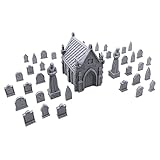
The best pick here if your campaign keeps returning to graveyards and crypts and you want that location for the price of a couple of coffees. It suits budget DMs, newer players building a first terrain collection, and anyone running an undead-focused arc. EnderToys is known for pre-printed cardstock terrain in the 28mm space, and that material choice is exactly what puts this in the budget tier while still being visually specific.
Key specs by class:
- Material: pre-printed cardstock terrain — light, foldable, no painting required.
- Modularity: low to moderate; this is a scene-style set, not a construction system.
- Scale: 28mm miniatures and wargame figures, per the product’s stated range.
- Assembly time: fold-and-place, measured in minutes.
- Storage: excellent — cardstock folds flat and can be stored in a folder or box.
- Coverage: a themed graveyard/mausoleum zone rather than a full board.
Strengths. Cost and immediacy. There is no paint, no glue, and no drying time, so the graveyard exists on the table the moment you open the package. Cardstock also folds flat, which makes it the most portable option in this list — if you carry your terrain to someone else’s house, this is the least painful way to do it. For a DM who wants theme-specific scenery without committing to a hobby project, that combination is hard to beat.
Pros
- Budget tier — lowest financial barrier here
- No painting or assembly required
- Folds flat; easiest set in this list to transport
- Strong themed identity for undead and horror arcs
- Fits 28mm miniatures directly
Cons
- Cardstock is the least durable material class here — creases, tears, and crushes are the long-term risks
- Not a modular construction system
- Single-genre use; a graveyard is a graveyard
- Less dimensionality than sculpted terrain
How it compares to the nearest alternative. Against the Melee Mats DND Map Starter Set, this is the opposite philosophy: EnderToys gives you one strong-looking location, while the mat gives you every location in outline. If your campaign features a graveyard prominently, buy EnderToys. If you run a new environment every week, buy the mat and skip most terrain purchases entirely. Against Battle Systems cardstock sci-fi terrain, EnderToys is the budget sibling in the same material family — same folding logic, much lower price, but without the clip-together modularity that makes Battle Systems worth its premium. If you like the idea of cardstock but want a system rather than a scene, the Battle Systems entries are the upgrade path.
6. Melee Mats DND Map Starter Set – Best for Maximum Replayability

If you buy exactly one thing from this list, make it a mat — and this is the one that suits the widest range of players. It is a 24″ × 36″ wet-and-dry-erase battle terrain grid designed for Dungeons & Dragons and similar games, and it does something no sculpted set can: it becomes any terrain you need, every session, forever, for a one-time mid-range price.
Key specs:
| Attribute | Detail | Why it matters |
|---|---|---|
| Size | 24″ × 36″ | Roughly 24 × 36 squares at 1-inch scale — a large battlefield or a sprawling dungeon level |
| Surface | Wet and dry erase | Redraw walls, water, lava, and hazards in seconds; wipe clean after |
| Grid | Battle terrain grid printed on the mat | Removes measurement disputes; movement and ranges are counted, not guessed |
| Scale | 1-inch grid, standard for 28mm miniatures | Fits the same miniatures as every other product in this list |
| Consumables | Dry-erase or wet-erase markers | Ongoing cost is markers, not terrain — pennies per session |
| Storage | Rolls or folds depending on material | Fits in a tube or bag; no shelf of resin required |
A quick value calculation. Say a sculpted encounter set costs roughly the same as this mat and covers one scenario. Over a 40-session campaign, if you use the mat in every session and the fixed set in two of them, the cost per session is about a penny-versus-pounds comparison — the mat wins by more than an order of magnitude on cost per use, even before counting the markers. That is not an argument against sculpted terrain; it is an argument about order of purchase. Buy the mat first, then buy terrain for the encounters you actually repeat.
Strengths. Replayability is total. The same surface becomes a tavern, a canyon, a ship deck, or a crypt, and you can add drawn detail the moment the party does something unexpected — which they always do. Markers also let you annotate the map mid-session: dropped weapons, spell areas, secret doors. Compared with any fixed set, the mat is the highest-value terrain purchase a new group can make, and even experienced collectors still use one underneath their sculpted pieces.
Pros
- Unlimited layout variety from one purchase
- Wet and dry erase handles both permanent layouts and quick sketches
- Large 24″ × 36″ play area
- Printed grid removes measurement arguments
- Rolls or folds for easy transport
Cons
- Zero three-dimensional presence — it is flat
- Needs markers, and cheap markers can stain; use the recommended type
- Not a display piece; photographed battle reports look plain
- Some surfaces dull with heavy erasing over years
How it compares to the nearest alternative. Against every sculpted set in this list, the mat is the base layer rather than the competitor: the strongest table combines this mat with scatter like the Warmtree 17-piece camp or trees from Extruded Gaming, giving you infinite layout plus physical detail. Against the EnderToys Mausoleum, the mat wins on flexibility and loses on atmosphere. If you are choosing between them and can only buy one, the mat is the safer purchase for almost every group — with the exception of a DM running a single recurring location, for whom a themed set delivers more at the table each week.
7. Warmtree Stone Wall Ruins – Best for Modular Walls on a Budget

This is the cheapest way to add real structure to a table. Stone wall ruins are the most useful single terrain type in fantasy gaming because walls define rooms, block line of sight, create cover, and turn an open mat into a dungeon. At the budget tier, it suits DMs who already own a mat or board and want to build layouts piece by piece, and players who want terrain that combines with other Warmtree ruins.
Key specs by class:
- Material: rigid stone-effect terrain pieces suitable for diorama and tabletop use.
- Modularity: high in practice — individual wall sections are arranged freehand into rooms, corridors, and compounds.
- Scale: terrain/diorama scale matching 28mm-class figures; wall heights read correctly against standard miniatures.
- Assembly time: minimal for placement; some finishing may be needed if the pieces arrive unfinished.
- Storage: moderate; stackable but not flat.
- Coverage: depends entirely on how many pieces you buy — a single set outlines a room or two.
Strengths. Cost per useful decision. A wall costs a fraction of a building but changes play more than most scatter, because line of sight is the core mechanic of nearly every miniatures game. Buying wall sections incrementally means you can grow a dungeon over time without a large upfront outlay, and stone ruins are genre-agnostic — they work in dungeons, overgrown temples, castles, and wastelands. Combined with the Warmtree bridge and tower, they form a coherent ruin system.
Pros
- Budget tier; buy in small increments
- Walls create the most tactical change per dollar
- Freeform arrangement supports any layout
- Combines with other Warmtree ruins for a larger system
- Genre-flexible stone aesthetic
Cons
- Small sets cover limited area; you will want more than one
- Loose pieces need careful storage
- Freeform walls can be knocked out of position in play
- Less visually striking than a full building
How it compares to the nearest alternative. Against the Warmtree Ruined Bridge and Tower, these are the same family at different price tiers: the wall ruins are the affordable entry, the bridge and tower the centrepiece upgrade, and buying the walls first then adding the tower is a sensible progression. Against Battle Systems modular terrain, the comparison is material and cost — Battle Systems gives you pre-printed, clip-together buildings at premium pricing, while these walls are cheap, simple, and rigid. If you want structures that assemble themselves, save for Battle Systems. If you want to shape a dungeon today for very little, buy the walls.
8. AUSPDICE Medieval Military Camp RPG Terrain Set – Best for Large Camp Scenarios
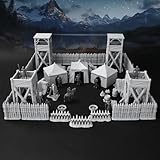
This is the premium camp option, and it suits a specific need: a DM or wargamer who wants an entire encampment — multiple tents, organised layout, the feel of an army at rest — as a centrepiece. It is aimed at 28–32mm fantasy and historical play, and it is the right purchase when the encampment is the scenario rather than the backdrop to one.
Key specs by class:
- Material: sculpted camp terrain with a finished, painted presentation in the premium class.
- Modularity: arrangement is flexible across the pieces, but the set is designed as an encampment rather than a construction kit.
- Scale: 28–32mm, matching D&D and common historical ranges.
- Assembly time: low; premium finished terrain is generally table-ready.
- Storage: substantial — many pieces and large tents mean real shelf or bin space.
- Coverage: wide, area-filling; this is one of the largest-footprint sets in this list.
Strengths. Presence and completeness. Scatter camp sets give you props; this gives you a place. The tents and layout create natural tactical zones — officers’ quarters, supply areas, picket lines — so an attack on the camp becomes a real battle rather than a fight on an empty field. For historical wargamers and fantasy campaigns with siege or ambush arcs, that is exactly the terrain you cannot approximate with a mat.
Pros
- Large, area-filling centrepiece presence
- Creates natural tactical zones for camp battles
- Works for both fantasy and historical settings
- Presentation standard suits display photography
- Complements cheaper camp scatter rather than replacing it
Cons
- Premium tier — the highest cost category in this list
- Large storage footprint
- Encampment-specific; less reuse in dungeon settings
- Overkill if your campaign rarely visits a camp
How it compares to the nearest alternative. Against the AUSPDICE DND Camp Terrain Set at the budget tier, the difference is scale and ambition: the budget set dresses a party’s campsite, the premium set builds an army’s encampment. Against the Warmtree 17-piece camp, the Warmtree pack is more versatile per piece because small scatter reuses everywhere, while the AUSPDICE premium set is better if your games regularly stage camp assaults or siege scenarios. Buy this if the camp is a destination; buy the Warmtree pack if you just need your table to stop looking empty.
9. AUSPDICE DND Camp Terrain Set – Best for Cheap Fantasy Camp Dressing

The budget entry for camp terrain, aimed at fantasy scenery for Dungeons & Dragons at 28–32mm. It suits new DMs building a first collection, players who want a low-risk way to see whether they enjoy using terrain at all, and anyone filling out a table alongside a mat. If you have been running theatre-of-the-mind games and want to try physical terrain without spending much, this is the lowest-commitment on-ramp.
Key specs by class:
- Material: fantasy camp scenery pieces in a pre-printed or pre-painted class.
- Modularity: free-form scatter placement.
- Scale: 28–32mm fantasy figures.
- Assembly time: very low.
- Storage: small footprint; a single box holds the set.
- Coverage: modest — a campsite zone.
Strengths. Low risk and immediate effect. A handful of camp pieces transforms a blank mat into an identifiable scene, and the price tier means you are not committing serious money to find out whether terrain changes your table for the better. AUSPDICE also offers a clear upgrade path within the brand if you enjoy the pieces: the same manufacturer’s larger camp and canyon sets expand the collection without a style clash.
Pros
- Budget tier — minimal risk purchase
- Table-ready with almost no assembly
- Clearly matched to 28–32mm fantasy ranges
- Upgrade path to larger AUSPDICE sets
- Easy to store and transport
Cons
- Limited coverage; it dresses a zone, not a board
- Simple pieces compared with premium camp terrain
- Camp theme limits reuse outside travel/rest encounters
- You will likely want to add walls or ruins alongside it
How it compares to the nearest alternative. Against the Warmtree 17-piece camp, this set is the smaller, cheaper first purchase while Warmtree’s larger piece count gives more clutter for a mid-range price; if you want the fullest table for the least per piece, Warmtree wins, but AUSPDICE wins on initial outlay. Against the AUSPDICE Medieval Military Camp, this is the same theme at a different ambition level and clearly the sensible first buy. Start here, upgrade only if camps become a recurring location in your campaign.
10. Extruded Gaming Beech Trees Set 3 – Best for Instant Outdoor Cover

Trees are the single most efficient way to make an outdoor battle look like terrain instead of a green mat, and this budget set is the low-cost way in. It suits wargamers running forest, roadside, and wilderness scenarios, RPG groups travelling between settlements, and anyone who needs line-of-sight blockers that are not walls — trees block sight without blocking movement, which changes play in a way buildings cannot.
Key specs by class:
- Material: ready-made tree scenery in a rigid class; no gluing or flocking required.
- Modularity: freeform placement; trees are placed anywhere on the board.
- Scale: terrain scale that reads correctly against 28mm-class figures.
- Assembly time: essentially none.
- Storage: the risk is crushed foliage, not space; store upright in a box.
- Coverage: light — a set of trees defines a stand of woodland, not a full forest.
Strengths. Speed and function. Trees give you a wooded battlefield immediately, and because they are standalone pieces you can vary the density every game — a sparse copse for an ambush, a dense clump as hard cover. They also pair with everything: a forest edge next to the Warmtree ruins, a treeline along a road, woods around the AUSPDICE canyon. For the price tier, they add more visual change to a table than almost any other single purchase.
Pros
- Budget tier; low-risk purchase
- No assembly or flocking needed
- Blocks line of sight without blocking movement
- Density is adjustable every game
- Improves every outdoor table instantly
Cons
- Small sets look sparse; you may want two
- Foliage can be crushed in storage
- Not useful indoors or in dungeons
- Simple finish compared with premium scenery
How it compares to the nearest alternative. Against the Warmtree Stone Wall Ruins, the tactical difference is worth noting: walls block movement and sight, trees block sight only, so they serve different mechanical purposes and a good table often uses both. Against the Melee Mats mat, trees are the ideal companion — draw the forest on the mat, place the trees on top for three dimensions. If you are choosing one budget add-on to pair with a mat, buy trees for outdoor campaigns and stone walls for dungeon campaigns.
11. Battle Systems Sci-Fi Terrain 28mm Modular 3D Space Terrain – Best for Sci-Fi Interiors

This is the corridor-fight specialist: modular 3D space terrain at 28mm, aimed at wargaming and roleplaying tables where the battle happens inside a ship, station, or facility. It suits sci-fi skirmish players, RPG groups running space-based campaigns, and anyone who wants interior walls that define tight, technical battlefields rather than open exteriors. It shares Battle Systems’ clip-together, pre-printed approach, which is what makes that style of dense interior play practical.
Key specs by class:
- Material: pre-printed modular terrain panels with clip assembly.
- Modularity: very high — corridors, junctions, rooms, and doorways reconfigure freely.
- Scale: 28mm miniatures and figures.
- Assembly time: short per layout; no paint or glue.
- Storage: flat panels, easy to store.
- Coverage: builds a board’s worth of interior geometry from a base range, expandable.
Strengths. Interiors are the hardest terrain to fake with a mat, because corridor geometry and doorways need physical walls to feel real. This set delivers exactly that, and the clip system means you can build a different deck plan for every boarding action. Pre-printing removes the painting burden that usually makes sci-fi interior terrain a multi-month project.
Pros
- Purpose-built for interiors, where mats fall short
- Highly modular corridor and room geometry
- No painting or glue required
- Flat storage despite the premium price
- Expands without changing style
Cons
- Premium tier
- Interior theme limits use in open-field games
- Cardstock panels need careful handling
- Clip joints wear with heavy repeated assembly
How it compares to the nearest alternative. Against the Battle Systems Modular 28–35mm Sci-Fi Terrain, this set is the interior specialist and that one is the general exterior system — and the scale band is slightly narrower here, so if you use large 35mm heroic figures, check clearance carefully. Against the Tabletop Terrain Sci-Fi Ruin Set 3, this is a construction system versus a cover-piece set: choose Battle Systems for narrative interior fights, and the ruin set for competitive play where you want stable, tournament-friendly cover at fixed sizes.
12. Tabletop Terrain Sci-Fi Ruin Set 3 – Best for Competitive Ruins and Cover

The mid-range pick for players who need ruins that behave consistently in competitive games. It is a modular sci-fi ruin set for 28mm and 32mm wargaming, and it suits tournament players, matched-play groups, and anyone who needs cover pieces that stand exactly where you put them and survive being moved dozens of times a month.
Key specs by class:
- Material: rigid ruin pieces built for repeated handling.
- Modularity: modular ruin configuration across the pieces.
- Scale: 28mm and 32mm, per the product’s stated range.
- Assembly time: low for placement; some preparation may be required.
- Storage: moderate; rigid but not flat.
- Coverage: a dense set of cover pieces rather than a building system.
Strengths. Reliability. Competitive play needs terrain that does not shift when a hand brushes the table, and rigid pieces win that argument over loose cardstock. Ruins also fill the most common competitive role — area terrain and cover — while remaining flexible enough to rearrange between games. The 28mm/32mm compatibility means it works across the two most common sci-fi skirmish scale bands.
Pros
- Stable pieces suited to repeated play
- Modular configuration
- Covers both 28mm and 32mm ranges
- Dense cover in a single purchase
- Mid-range tier
Cons
- Rigid storage footprint
- Ruins only — no interiors
- Preparation may be needed before first use
- Less visually varied than a construction system
How it compares to the nearest alternative. Against Battle Systems Sci-Fi Terrain, this is the cheaper, more stable, less flexible option — if you need terrain that arrives, sits, and stays put for competitive games, this is the better fit; if you want to rebuild the whole board every session, Battle Systems is worth the premium. Against the Warmtree ruins, the choice is purely genre: same role, different setting. Match the ruins to your game system and you will never regret either purchase.
How to Choose Tabletop Gaming Terrain
The right terrain purchase is decided by six variables, and the order you weigh them in determines whether you end up with a collection you actually use. Here is how to work through each with concrete reasoning.
Start with material durability versus your handling habits
There are three practical material classes in this category, and each has a predictable failure mode. Pre-printed cardstock — the EnderToys graveyard and the Battle Systems sci-fi ranges — is light, cheap to ship, storage-friendly, and needs no painting; its failure mode is crushing and creasing, usually caused by packing it loosely under heavier objects. Rigid sculpted terrain — the AUSPDICE and Warmtree fantasy sets, the Tabletop Terrain ruin set — survives knocks and looks convincing in close-up, but its failure mode is chipping and breakage on thin parts like tower spires and bridge rails. Resin-class pieces are the heaviest and most fragile per pound; plastic-class pieces are the most forgiving. Ask honestly how your group handles terrain. If pieces get tossed into a bag at the end of the night, cardstock is a false economy and rigid plastic is the better choice. If everything goes back into labelled boxes, cardstock will last years and save you significant money.
Decide whether you want a system or a scene
This is the single biggest fork in the road. A system — Battle Systems clip panels, Warmtree modular ruins, Tabletop Terrain ruin sets — gives you components that rearrange, so your purchase supports many layouts. A scene — the AUSPDICE Pit Canyon, the EnderToys Mausoleum — gives you one excellent-looking location that never changes. Systems win on cost per session; scenes win on visual impact per session. A useful rule: if you expect to use a location more than about a quarter of your sessions, a scene is worth it. If not, a system is better value. Most established collections contain one or two scenes and several systems, which is a sensible long-term balance.
Check scale compatibility properly, not by the label
Labels say 28mm, 32mm, or 28–35mm, but what actually matters is three measurements. First, floor-to-floor height in multi-level terrain: heroic 32–35mm miniatures on thick bases are taller than true 28mm, and a figure that cannot stand upright inside a building makes the terrain unusable. Second, doorway and corridor width: bases of 25mm to 32mm are common, and a corridor that fits a 25mm base may not fit a 32mm one with a wide stance. Third, grid alignment: 1-inch grid mats match 28mm miniatures well, and if you play grid-based games, terrain that spans exactly one, two, or three squares is far more useful than terrain that covers 1.4 squares. Before buying, measure the tallest and widest miniature in your collection and compare it to the listed scale band. Terrain marketed as 28–35mm is the safest choice for mixed collections.
Budget assembly time honestly
Terrain that arrives painted and pre-printed is playable the day it lands. Terrain that needs assembly and painting is a project. A realistic estimate for a multi-piece rigid set is one to three evenings of assembly plus, if unfinished, several more for a base coat, drybrush, and wash — and that is before basing texture. If you enjoy that work, unfinished terrain is excellent value because you get more plastic for the money. If you do not, your unfinished terrain will sit in a box for a year. Pre-printed and pre-painted products cost more precisely because they sell you the finished hours. Neither choice is wrong; misjudging your own enthusiasm is the mistake.
Plan storage before you plan the purchase
Storage determines whether terrain survives. Flat cardstock panels need a box roughly the size of a large hardback, ideally with nothing heavy on top. Rigid pieces need either shelf space with nothing stacked, or a bin with foam or bubble wrap between layers — thin spires and rails are the first casualties of a loose bin. Trees need to be stored upright or their foliage deforms permanently. Before you buy a large set, measure the space you can dedicate: a single shelf of about a metre and a bin of about 40 litres covers most collections in this list. If you have no dedicated space, favour flat-pack cardstock and mats, because they are the only options that genuinely disappear into a cupboard.
Match genre to your actual campaign, then think about mixing
The most common wasted purchase is genre mismatch: buying sci-fi terrain because it looked good, then running a year of fantasy. Buy for the games you are actually playing. Once you have a base in that genre, expand across categories rather than within them — walls, scatter, verticality, and trees each change play differently, and one of each is worth more than three of any single type. Walls create line-of-sight blocks and rooms. Scatter makes a space look inhabited. Bridges and towers add elevation. Trees block sight without blocking movement. A collection with one strong example of each will support more scenarios than a collection of four buildings.
Understand value as cost per session, not cost per box
Value in terrain is not the ticket price; it is the price divided by the number of sessions the purchase improves. A mid-range mat used in forty sessions beats a premium scene used twice, but a premium scene that defines a campaign’s most memorable night may be worth more to your group than either. Weigh two numbers: how many sessions will this appear in, and how much will it change those sessions. Terrain that changes line-of-sight or elevation changes play; terrain that only decorates changes atmosphere. Both matter, but if you are on a budget, buy the mechanical pieces first — walls, ruins, trees, and a mat — and add atmosphere once the fundamentals are covered.
Where the tiers actually land
| Tier | Typical market range | What you get | Best entry points here |
|---|---|---|---|
| Budget | Varies | Cardstock scenes, small scatter, wall sections, trees | EnderToys Mausoleum, Warmtree Stone Wall Ruins, Extruded Gaming Trees |
| Mid-range | Varies | Modular ruin systems, camp sets, large mats, canyon scenes | Melee Mats starter set, Warmtree ruins, Tabletop Terrain ruin set |
| Premium | Varies | Clip-together building systems, large finished encampments | Battle Systems sci-fi ranges, AUSPDICE Medieval Military Camp |
Prices shift with availability and range size, so treat these as bands rather than fixed figures. The practical rule is that budget buys you a zone, mid-range buys you a system or a large mat, and premium buys you coverage of an entire board or a finished centrepiece.
Frequently Asked Questions
What is the best tabletop gaming terrain set overall?
The Battle Systems Modular 3D Gaming Sci-Fi Terrain is the strongest overall pick for sci-fi tables because it combines genuine modularity, pre-printed readiness, 28–35mm scale coverage, and flat-pack storage in one product. For fantasy players, the equivalent role is split between the Warmtree ruins and the Melee Mats starter set. There is no single best set for every table, because genre and play style change the answer more than quality does.
Is cardstock terrain durable enough for regular play?
Pre-printed cardstock lasts years if it is stored flat with nothing heavy stacked on it and handled without bending at the joints. It fails when it is crushed, creased, or left loose in a bag, so durability is mostly about storage discipline rather than the material itself. If your group is rough with terrain, rigid plastic or resin pieces will survive better despite costing more.
Can I use 32mm miniatures with terrain labelled 28mm?
Usually yes for open scatter, but check two things first: whether a figure can stand upright under any roof or overhang, and whether the base fits through doorways and corridors. Heroic-scale figures on thick bases are noticeably taller than true 28mm, so multi-level buildings are where mismatch shows up. Terrain explicitly labelled 28–35mm is the safest choice if your collection mixes scales.
Do I need a battle mat if I already own sculpted terrain?
Yes, in almost every case. Sculpted terrain defines structures and cover but leaves the ground between them bare, and a mat supplies the grid, the surface, and the visual base that ties the pieces together. A mat is also the cheapest way to add unlimited layouts, so it is normally the first terrain purchase rather than an optional extra.
How much terrain do I need to cover a standard battlefield?
For a typical 3-foot by 3-foot skirmish board or a 24″ × 36″ mat, a practical target is roughly one substantial structure or ruin cluster, plus scattered cover pieces in most table quarters, plus a few line-of-sight blockers. That is usually one centrepiece set and two or three scatter sets rather than a single large purchase. Dense terrain slows games and hides miniatures; sparse terrain makes shooting too powerful, so aim for cover in most areas without filling the board.
Is it worth paying premium prices for pre-printed terrain?
Premium pre-printed terrain is worth it if you value finished results over money and would otherwise leave unfinished terrain unpainted. You are paying for the hours of painting and finishing you do not have to do, plus modular engineering. If you enjoy hobby work, unfinished rigid terrain gives you more material for less money; if you do not, the premium is a fair trade.
How should I store modular terrain so it lasts?
Store flat cardstock in a box with nothing on top, and store rigid pieces either on open shelves or in bins with padding between layers. Keep trees upright so foliage does not deform, and keep small scatter pieces in a single lidded container so they do not migrate out of the collection. Losing pieces, not breaking them, is the most common way a terrain collection declines in usefulness.
Can I mix terrain from different brands and genres on one table?
Different brands mix well within a genre, and Warmtree, AUSPDICE, and Tabletop Terrain pieces can share a fantasy or sci-fi table without obvious clashes because stone, ruins, and camp props are visually generic. Mixing genres on the same board usually looks incoherent, so keep sci-fi panelling and fantasy stone separate. Scale is the one thing that genuinely breaks a mixed table, so measure before combining ranges.
What is the cheapest way to build a full terrain collection?
Start with a mat, add a budget set of walls or ruins, then add one scatter set and one set of trees. That sequence covers grid, structure, clutter, and sight-blocking for a small outlay, and each purchase improves the table immediately. Grow from there only for locations your campaign actually revisits, rather than buying complete themed sets in advance.
Which Set Should You Buy?
If you play sci-fi and want the best modular table available, buy the Battle Systems Modular 3D Gaming Sci-Fi Terrain — it is the most flexible premium purchase here, and the 28–35mm range covers most collections. If you play sci-fi interiors specifically, buy the Battle Systems 28mm Modular Space Terrain instead, and if you play competitive matched games, the Tabletop Terrain Sci-Fi Ruin Set 3 gives you stable cover at a lower price. For fantasy D&D groups starting from nothing, buy the Melee Mats starter set first, then add the Warmtree Stone Wall Ruins and the Warmtree 17-piece camp as budget and mid-range expansions; add the Warmtree bridge and tower when you want verticality. If your campaign has one signature location, the AUSPDICE Pit Canyon or the EnderToys Mausoleum gives you a strong themed scene for far less than a full system, and if you stage encampment battles, the AUSPDICE Medieval Military Camp is the only set here built for it. Whatever you choose, buy for the game you are actually running this month, keep genre consistent across your collection, and store everything flat or padded — terrain that survives is terrain that keeps paying for itself, session after session.