Low profile graphics cards solve a problem that full-size cards cannot: they fit inside slim desktops and small form factor cases where a standard card will not. Many office PCs, home theatre PCs, and compact builds ship with a short expansion slot and a low-power supply, which rules out most gaming cards at once. A low profile card changes that. It brings a proper display output and light gaming ability to a machine that was never built for a big cooler.
This guide is for owners of slim desktops, home theatre PC builders, and anyone adding a display card to a compact machine. It also suits buyers reviving an old office PC for light games and extra monitor outputs. Every card below was chosen from its name and specifications on the Amazon product page, so the details here match what the listing itself states.
Our Top Picks
 ASUS GeForce GT 1030 2GB GDDR5 Graphics CardGT 1030 2GB Low Profile6.8 x 2.7 x 0.1 inches1.75 PoundsCheck on Amazon

Top 3 picks at a glance

Quick Picks
As an Amazon Associate we earn from qualifying purchases
| Product | Best for | Key spec from title |
|---|---|---|
| ASUS GeForce GT 1030 2GB GDDR5 | A slim desktop that needs a low-profile bracket | 2GB GDDR5, low-profile bracket included |
| ASUS GeForce GT 1030 SL 2G BRK | A silent home theatre PC with no fan noise | 2GB GDDR5, fanless passive cooling |
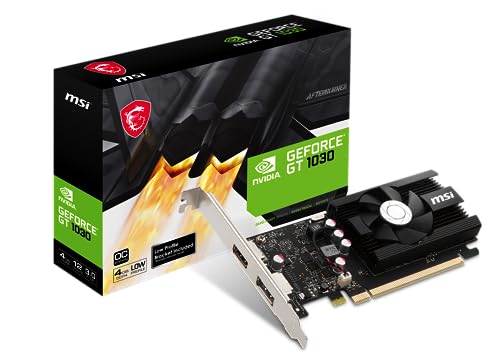
| MSI GeForce GT 1030 2GHD4 LP OC | A compact build on a tight budget | 2GB DDR4, low profile, single-fan OC design |
| MSI GeForce GT 1030 4GD4 LP OC | A slim PC that needs more memory for extra monitors | 4GB DDR4, low profile, DisplayPort and HDMI |
How to Choose
Confirm the card is truly low profile
Not every short card is low profile. A low profile card uses a half-height bracket that fits slim cases, while a short full-height card still needs a tall slot. Check the listing for the words low profile and for a low-profile bracket in the box, and measure the slot height inside the case before ordering. Slim desktops often have only a half-height opening, so a full-height bracket cannot be fitted at all. If the listing mentions a low-profile bracket included, the card should fit a slim case, but measuring the opening takes a minute and removes the guesswork.
Match the memory type to the workload
Low profile cards come with different memory types, and the difference matters for daily use. GDDR5 memory moves data faster than DDR4, so a 2GB GDDR5 card suits light gaming and video playback better than a 2GB DDR4 card. DDR4 cards cost less and still handle extra monitors, office work, and video playback, but they run slower in games. A 4GB DDR4 card helps when several monitors are connected or when the system needs more video memory for its workload. Read the memory type and size on the listing before comparing two cards with the same chip.
Check the power draw and the PSU
Most low profile cards draw very little power, which is why they suit slim desktops with small supplies. A GT 1030 with a 20 W draw runs from the PCIe slot alone and needs no extra power cable, so it works in machines where a larger card would demand a PSU upgrade. Still, check the wattage on the listing and compare it with the supply in the case. An old supply with a low rating may still struggle, and a card that needs no cable is the safest choice for a machine that has never had a graphics card before.
Count the outputs the desk needs
A low profile card is often bought for its outputs as much as its graphics power. Count the monitors on the desk and check the ports on the listing before ordering. A card with one HDMI and one DVI-D port suits a two-monitor desk, while a card with DisplayPort and HDMI covers a newer monitor and an older one at the same time. Adapters can bridge a gap, but a card that already has the right ports saves money and avoids a second order. Read the output list on the listing, not the photos, since photos can show a different bracket than the one in the box.
The 4 Best Options
ASUS GeForce GT 1030 2GB GDDR5
The ASUS GT 1030 2GB GDDR5 is the standard low profile pick for a slim desktop that needs a proper display card. Its low-profile bracket fits half-height slots, and the 2GB of GDDR5 memory handles video playback, office work, and light games better than DDR4 cards in the same class. HDMI and DVI-D outputs cover a two-monitor desk, and the 384 CUDA cores give the card enough power for casual titles at low settings. It suits a home office PC that needs a second monitor and a quiet card that draws its power from the slot alone.
Specs
- 2GB GDDR5 memory
- PCIe 3.0 interface
- HDMI and DVI-D outputs
- Low-profile bracket included
- 384 CUDA cores
- Boost clock up to 1506 MHz OC mode, 1468 MHz default
- 1227 MHz base clock, 6008 MHz memory, 64-bit
Best for: A slim desktop that needs a low-profile bracket and a second monitor output.
Watch out for: Confirm the case takes a half-height bracket before ordering, since full-height slots cannot use it.
ASUS GeForce GT 1030 SL 2G BRK
The ASUS GT 1030 SL 2G BRK is the silent option in this group, built with fanless passive cooling and no moving parts. Its heatsink cools the card without a fan, so a home theatre PC stays silent during films and music. The low profile design with I/O port brackets fits slim cases, and the 2GB of GDDR5 memory handles video playback and light games. HDMI and DVI-D outputs cover a television and a monitor at the same time. It is the pick for a living-room machine where fan noise matters more than gaming speed.
Specs
- 2GB GDDR5 memory
- Fanless passive cooling
- Low profile with I/O port brackets
- Boost clock up to 1506 MHz OC mode, 1266 MHz base
- 384 CUDA cores, 6008 MHz memory, 64-bit
- 173 x 69 x 40 mm
- HDMI and DVI-D outputs
Best for: A silent home theatre PC where fan noise must stay at zero.
Watch out for: Fanless cards need airflow in the case, so confirm the case has a fan or vent near the card before ordering.
MSI GeForce GT 1030 2GHD4 LP OC
The MSI GT 1030 2GHD4 LP OC is the budget pick for a compact build that needs a low profile card at the lowest cost. Its single-fan OC design keeps the card cool in a small case, and the 20 W power draw means it runs from the PCIe slot with no extra cable. The 2GB of DDR4 memory suits office work, video playback, and extra monitors, while the low profile bracket fits slim desktops. It is the card for a machine that needs a display output and a little graphics power without a PSU upgrade or a large budget.
Specs
- 2GB DDR4 memory
- Low profile design
- Single-fan OC design
- Boost clock up to 1430 MHz
- 384 CUDA cores
- 2100 MHz memory, 64-bit
- PCIe 3.0 x4 interface, 20 W
Best for: A compact build on a tight budget that needs a low profile card with no extra power cable.
Watch out for: DDR4 memory runs slower than GDDR5, so keep gaming expectations modest with this card.
MSI GeForce GT 1030 4GD4 LP OC
The MSI GT 1030 4GD4 LP OC is the pick for a slim PC that needs more video memory than the 2GB cards offer. Its 4GB of DDR4 memory helps when several monitors are connected or when the system runs applications that need more video memory. DisplayPort and HDMI outputs cover a newer monitor and a television at the same time, and the single-fan OC design keeps the card cool in a small case. The low profile bracket fits slim desktops, and the card runs from the PCIe slot alone. It suits a compact machine used for office work, video playback, and extra displays.
Specs
- 4GB DDR4 memory, 64-bit
- DirectX 12 support
- DisplayPort and HDMI outputs
- Single-fan OC design
- Low profile design
- Boost clock up to 1430 MHz
Best for: A slim PC that needs more memory and both DisplayPort and HDMI outputs.
Watch out for: Confirm the monitors match the DisplayPort and HDMI outputs before ordering, since this card has no DVI port.
Which One Fits Your Situation
You own a slim office desktop and need a display card
Pick the ASUS GT 1030 2GB GDDR5. Its low-profile bracket fits the half-height slot in a slim desktop, and the 2GB of GDDR5 memory handles video playback and office work with ease. HDMI and DVI-D outputs cover a two-monitor desk. The card draws power from the slot alone, so no PSU upgrade is needed.
You are building a silent home theatre PC
Pick the ASUS GT 1030 SL 2G BRK. Its fanless passive cooling has no moving parts, so the machine stays silent during films and music. The low profile design fits a slim case, and HDMI output connects to a television. Check that the case has airflow near the card, since a fanless heatsink needs moving air to stay cool.
You want the cheapest low profile card that works
Pick the MSI GT 1030 2GHD4 LP OC. Its single-fan OC design and 20 W power draw suit a compact build with a small supply, and it needs no extra power cable. The 2GB of DDR4 memory handles office work, video playback, and extra monitors. Keep gaming expectations modest, since DDR4 memory runs slower than GDDR5.
You need more memory and modern outputs
Pick the MSI GT 1030 4GD4 LP OC. Its 4GB of DDR4 memory helps when several monitors are connected, and DisplayPort and HDMI outputs cover a newer monitor and a television at the same time. The low profile bracket fits slim desktops, and the single-fan OC design keeps the card cool. Confirm the monitors match those outputs before ordering.
Common Mistakes
- Ordering a short full-height card for a slim case that only takes a half-height bracket.
- Buying a DDR4 card for gaming and expecting GDDR5 speed from it.
- Choosing a fanless card for a sealed case with no airflow.
- Forgetting to count monitor outputs and ordering a card with the wrong ports.
- Assuming a low profile card needs no power check and overloading an old supply.
Frequently Asked Questions
Will a low profile card fit my slim desktop?
Usually, yes, if the case has a half-height slot. Measure the slot height inside the case and check the listing for a low-profile bracket included. A low profile card uses a half-height bracket, while a short full-height card still needs a tall slot. If the case opening is half height and the listing names a low-profile bracket, the card should fit.
Does a GT 1030 need a power cable?
No. Most GT 1030 cards draw their power from the PCIe slot alone, and the MSI 2GHD4 LP OC lists a 20 W draw with no extra connector. Check the wattage on the listing and compare it with the supply in the case, but a card with no power cable is the norm in this class and suits machines that have never had a graphics card.
Is GDDR5 better than DDR4 on a GT 1030?
Yes, for gaming and video work. GDDR5 memory moves data faster than DDR4, so a 2GB GDDR5 card runs light games more smoothly than a 2GB DDR4 card. DDR4 cards cost less and still handle office work, video playback, and extra monitors. Choose GDDR5 when gaming matters, and choose DDR4 when the card is mainly for displays and everyday use.
Can a low profile card drive two monitors?
Yes, if it has two outputs. Most cards in this guide carry two ports, such as HDMI with DVI-D or DisplayPort with HDMI, which cover a two-monitor desk. Count the monitors and check the output list on the listing before ordering, since a card with only one port cannot drive a second monitor without an adapter or a second card.
Related guides
More from Amazon
Programs that pair well with the guide above. Offers and eligibility are set by Amazon and may change.
Free shipping on eligible items, Prime Video and more. Eligible new members can start with a free trial.
Start a Prime free trialAd-free music streaming. Eligible new subscribers can start with a free trial.
Try Music Unlimited freeA Prime membership for ages 18-24 with a trial period. Eligibility is set by Amazon.
See Prime for Young AdultsAudiobooks and podcasts to listen to on the go. Eligible new members can start with a free trial.
Try Audible freeAs an Amazon Associate we earn from qualifying purchases.