You’ve probably hit this decision mid-upgrade: your CPU is running hot, your laptop is thermal throttling, or your small-form-factor build needs better cooling without more noise. You search for a fix and run into two terms that sound interchangeable — copper heat pipes and vapor chambers — at wildly different prices.
Both technologies rely on the same physics: a sealed chamber containing a working fluid that evaporates at the hot end, travels as vapor, and condenses at the cool end, moving heat far faster than solid copper alone. The difference is geometry. A heat pipe is a linear tube — typically 3–8mm wide and 100–300mm long — that carries heat from point A to point B. A vapor chamber is a flat plate, usually 2–4mm thick, that spreads heat across a two-dimensional area. That single distinction drives nearly every practical difference below.
As an Amazon Associate we earn from qualifying purchases at no extra cost to you.


Our Top Picks
 uxcell Copper Flat Heat Pipe for Cooling Laptop120mm x 8mm x 3.0mm4.72 x 0.31 x 0.12 inches0.1 PoundsCheck on Amazon


Top 3 picks at a glance
Quick Verdict
Copper heat pipes win on price and flexibility; vapor chambers win on heat spreading under concentrated loads.For most home users doing routine maintenance or upgrades, heat pipes are the answer; for new SFF builds pushing thermal limits, the vapor chamber earns its premium.
Side by Side
| Factor | Copper Heat Pipes | Vapor Chamber Cooling |
|---|---|---|
| Comfort (noise/heat impact) | Indirect — performance depends on the heatsink and fan they feed; a good pipe retrofit can drop fan speeds noticeably | Direct — even heat spreading lets fans run slower and quieter under the same load |
| Durability | Sealed copper tubes lasting 10+ years; can kink or dent if bent repeatedly past ~2–3 bends | Sealed flat plates, equally long-lived, but cannot be bent or reshaped at all |
| Price range | , a 4-piece 80mm flat pipe set around $14; 120mm x 8mm x 3mm singles around $9) | $60–90+ for a complete vapor chamber cooler; bare plates run $20–50 |
| Maintenance | None beyond occasional dusting; no refill possible once sealed | None; fully sealed, just dust the fin stack |
| Space needed | Minimal and flexible — 3mm-thick flat pipes fit inside laptop and slim cooler clearances, and can be routed around components | Fixed footprint plate; typically adds 2–4mm thickness under a cooler base but no routing flexibility |
| Look | Exposed copper tubes have a distinctive retro-tech appeal in open builds | Clean, monolithic appearance; vapor chamber coolers look like premium engineered blocks |
| Resale/transferability | Easy to reuse or resell; universal fitment across heatsinks if lengths match | Integrated into a specific cooler; resale tied to socket compatibility (AM4/AM5, LGA 1700/1851, etc.) |
| Failure mode | A punctured pipe loses its working fluid and that pipe stops conducting — the rest keep working | A punctured plate usually means full cooler replacement |
| Heat capacity | Each 6–8mm pipe handles roughly 20–50W depending on length and orientation | A single plate spreads 150–300W+ across its surface, ideal for concentrated die sizes |
| Best for | Repairs, laptop cooling, budget heatsink upgrades, custom routing | High-wattage SFF builds, direct-die cooling, thin high-performance laptops |
Where Copper Heat Pipes Wins
Cost per watt moved is unbeatable.The uxcell 120mm x 8mm x 3mm flat pipe, for example, is thin enough to slot into laptop heatsink assemblies or between stacked fins, something no rigid vapor chamber can do.
Routing flexibility. Heat pipes can be bent (within their bend-radius limits, usually a radius of at least 3–5 times their diameter) to carry heat around RAM, VRMs, or case constraints. A vapor chamber sits flat, period. If your cooling problem is “get heat from this chip to that fin stack three inches away, around an obstruction,” pipes are the only option.
Graceful degradation. In a four-pipe heatsink, one damaged pipe reduces capacity by roughly 25% — annoying, not fatal. Repairs cost a few dollars.
Proven and ubiquitous. Nearly every mainstream CPU cooler on the market uses heat pipes. Replacement parts, compatibility data, and community knowledge are everywhere, which matters when you’re troubleshooting at your desk at 11pm.
Where Vapor Chamber Cooling Performance Wins
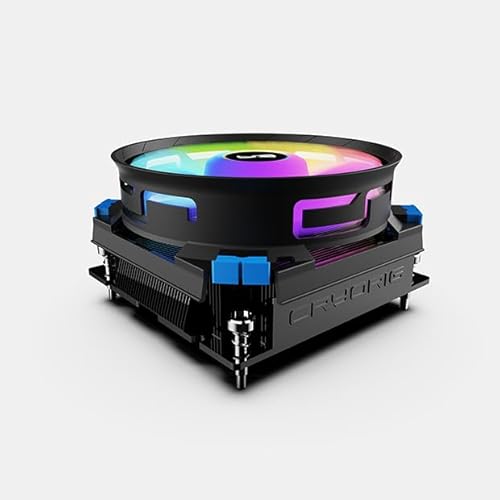
Two-dimensional heat spreading. Modern CPUs concentrate 100–200W into a die area of a few square centimeters. Heat pipes collect heat at points; a vapor chamber spreads it instantly across its whole face. That means the entire fin stack above works at full efficiency instead of just the section above each pipe. In low-profile coolers — where there’s no room for a tall tower of pipes and fins — this is often the only way to hit the needed performance. That’s precisely why the CRYORIG C5 exists as a compact SFF design: the vapor chamber base lets a 47–60mm-tall cooler handle CPUs that would otherwise demand a tower cooler twice its size.
Lower thermal resistance under concentrated loads. With a point or line heat source, a plate typically shows lower resistance to the fin stack than an equivalent set of pipes. The real-world result is lower peak temperatures and, importantly, lower fan speeds for the same temperature target — quieter operation in a living-room or bedroom PC.
No orientation penalty. Heat pipes lose meaningful capacity when working against gravity (evaporator above condenser). Vapor chambers are far less sensitive to orientation, which matters in unusual SFF layouts and horizontal motherboard mounts.
Thinner total stack. A 2.5–3mm plate can replace several pipes plus their mounting clearance, saving 5–10mm of height in ultra-thin designs.
Cost Over 5 Years
Copper heat pipe route:Zero electricity impact — pipes don’t draw power — though a slightly hotter CPU may keep fans spinning modestly faster.
Vapor chamber route:No failure replacement is realistically needed; sealed two-phase devices routinely exceed a decade of service.
What you’re buying with that gap is headroom: if you upgrade to a hotter CPU mid-cycle, the vapor chamber cooler likely carries you through without another purchase, while a marginal pipe-cooled setup might force a full cooler upgrade anyway. Buy the vapor chamber once if your thermal demands will grow; buy pipes if they won’t.
Which One for Your Home
Small Apartment / Dorm
Space and noise are your constraints, and every watt matters in a room that doubles as office and bedroom. A compact vapor chamber cooler like the CRYORIG C5 keeps a powerful mini-ITX build quiet enough for video calls and late-night gaming.
Family with Kids or Pets
Durability and zero-maintenance matter most. Both technologies are sealed and maintenance-free, but a desktop PC on the floor faces pet hair and vacuum bumps. A mainstream pipe-based tower cooler is cheap to replace if something goes wrong, and spare pipes cost pocket change.
Rental / Temporary Home
You want value, portability, and reversibility. By 2026, cheap flat pipes have become reliable enough that a careful retrofit is a legitimate option rather than a hack.
Long-Term Home
Optimize for the next decade. Build around a quality vapor chamber cooler with socket coverage for both current and next-gen boards — the C5’s AM4/AM5 and LGA 1150/1200/1700/1851 support means one cooler survives multiple builds. Keep a couple of spare flat pipes in the drawer for the laptops and consoles that inevitably need attention.
FAQ
Can I replace the heat pipes in my existing cooler with a vapor chamber?
Not directly. Heat pipes and vapor chambers are different form factors, and coolers are engineered around one or the other. You can’t slide a plate where pipes went.
Do vapor chambers actually cool better than heat pipes?
For concentrated heat sources (modern CPU dies), yes — typically by improving how evenly the fin stack is used, which lowers peak temperatures. For spreading heat across a distance, they’re equivalent. Anyone quoting exact degree improvements should show you their test setup; results vary too much with case airflow and fan curves to trust blanket numbers.
Are cheap replacement heat pipes worth it?
The caveat: measure your clearance precisely (thickness of 3mm is common but not universal) and confirm your cooler’s design leaves room for them.
How long do heat pipes and vapor chambers last?
Both are sealed systems with no pumps or moving parts, and either should outlast the electronics it cools — commonly 10–15 years. The main risks are physical: a crushed pipe or punctured plate ends its working life immediately, and neither can be recharged at home.