Our Top Picks

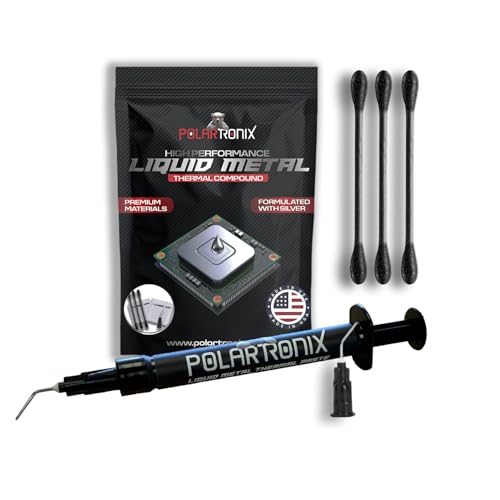
The Short Answer
Liquid metal thermal compound is worth the risk for one group of people: experienced builders running high-wattage hardware (roughly 200W and above) who need every last degree of thermal headroom for overclocking or sustained heavy loads. For everyone else — general gaming rigs, consoles you’re not comfortable opening, office PCs, or first-time builders — the answer is no. The performance gain over a high-quality paste simply doesn’t justify the electrical conductivity and corrosion risks involved.
The one condition that makes it “worth it”: your cooler’s contact surface must be nickel-plated copper. Liquid metal is gallium-based, and gallium attacks aluminum on contact, permanently. If your cooler cold plate or IHS situation involves bare aluminum, walk away now.
As an Amazon Associate we earn from qualifying purchases at no extra cost to you.


What You Actually Get
Unlike paste, which is a suspension of solids in a carrier, liquid metal is a true metal liquid with thermal conductivity in the neighborhood of 40 W/mK or more. That’s several times better than the best thermal pastes, which top out around 8–14 W/mK.
One gram is genuinely enough. A single application uses a very thin film — most CPUs need well under 0.1 grams, and PS5 and Xbox console applications use even less because the die and IHS are small. Expect roughly 8 to 15 applications per gram on typical desktop chips. The compound applies like a dense liquid, flows to fill microscopic gaps, and never dries out, so it doesn’t need repasting on the same schedule as paste — though it can oxidize over years and may need a touch-up on the contact points.
The catch is everything around the application. You’re working with a substance that conducts electricity, bonds with aluminum, stains copper, and will absolutely destroy a motherboard if it drips. Application requires precision, masking of surrounding components, and a steady hand.
Pros
- Best-in-class thermal conductivity. At roughly 40 W/mK or higher, it dramatically outperforms premium pastes, which matters most on direct-die applications and high-heat chips.
- Significant temperature drops where it counts. On directly cooled dies (consoles, delidded CPUs), builders commonly report meaningful reductions versus paste — though exact gains vary by hardware and workload.
- Never dries or pumps out. No carrier fluid means no dry-out cycle, no pump-out under thermal cycling, and no repasting every year or two.
- Ideal for consoles and overclockers. It’s what Sony uses stock on the PS5, and it’s the go-to for direct-die and extreme-cooling setups.
Cons
- Electrically conductive. A single drop bridging capacitors or traces can short and kill a component instantly. This is the big one.
- Destroys aluminum on contact. Gallium embrittles and absorbs into aluminum; there is no undo button. Verify nickel-plated copper or bare copper before you buy.
- Tricky application. No forgiveness for shaky hands. You need masking, applicator tools, and patience. Cleanup requires careful work if it escapes.
- Corrosion concerns over time on some platings. Liquid metal can slowly degrade nickel plating, especially with heat cycles, occasionally requiring reapplication or inspection after long service.
- Storage and transport. It must be kept sealed; small amounts can oxidize in the syringe over time if left open.
- Voids certain warranties. Opening a PS5, a GPU cooler, or delidding a CPU can end warranty coverage — by the time you’re reading this in 2026, check your specific manufacturer’s terms before committing.
Who Should Buy It
Liquid metal makes sense for overclockers chasing benchmark records, builders running sustained 200W+ workloads (heavy rendering, AI work, competitive gaming with maxed frames), anyone doing direct-die cooling on a delidded chip, and console modders replacing factory-applied compound on a PS5 or refurbishing an out-of-warranty Series X. It’s also the right call if your hardware already runs near thermal limits and throttling is measurably costing you performance — a few degrees can be the difference between boost clocks held and boost clocks lost.
Who Should Skip It
Skip it if you’re a first-time builder, if your cooler has any aluminum contact surface, if your hardware is under warranty and you can’t afford to void it, if your system runs comfortably cool with paste, or if the idea of conductive liquid near your motherboard makes you nervous — because that nervousness causes shaky hands, and shaky hands cause dead boards. There is no shame in this category; it’s most PC owners.
Cheaper Alternatives
| Option | Cost | Trade-off |
|---|---|---|
| Top-tier thermal paste (e.g., performance-oriented compounds) | Varies | Maybe 3–10°C warmer under peak load than liquid metal, but zero electrical risk and forgiving application. |
| Good mid-range paste | Varies | A degree or two behind premium paste; completely adequate for stock and mild overclocked systems. |
| Graphite pads or carbon-based pads | Varies | Reusable and nearly idiot-proof, but slightly higher temps than good paste and no liquid mess at all. |
| PTM-style phase-change sheets | Varies | Paste-like performance with easy application; excellent long-term stability, slightly less peak cooling. |
FAQ
Will liquid metal ruin my cooler?
Only if it touches aluminum — and it will ruin aluminum quickly and permanently. Copper and nickel-plated copper are safe, though nickel plating can slowly dull or degrade over years of heat exposure. Always check your cooler’s contact plate material before applying.
How long does liquid metal thermal compound last?
It doesn’t dry out like paste, but gallium alloys can oxidize and slowly degrade at contact surfaces, especially nickel plating. Many users get several years of reliable service; heavy-duty setups often inspect and touch up the compound annually or every couple of years.
Is liquid metal safe for PS5 and consoles?
Yes — it’s what manufacturers designed these consoles around, and aftermarket compounds are sold specifically for PS5 and Xbox Series X/S repasting. The PS5’s die uses a copper IHS-compatible setup, but opening the console typically voids the warranty, and the application still demands care.
How much temperature drop can I expect?
It depends entirely on your hardware and how poorly your current compound is performing. On a well-applied paste baseline, gains are usually modest; on direct-die or high-wattage chips, gains can be more substantial. Beware of anyone promising exact universal numbers — real results vary by chip, cooler, and workload.