Quick disconnect (QD) fittings let you separate sections of a custom water-cooling loop without draining it, thanks to self-sealing valves that snap together and apart. They add convenience and modularity, but they also add cost, flow restriction, and potential leak points. Whether they earn their place depends heavily on how often you plan to open your loop.
As an Amazon Associate we earn from qualifying purchases at no extra cost to you.


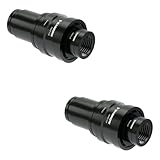

Our Top Picks


Top 3 picks at a glance
What quick disconnects actually do
A QD fitting is a two-piece coupling with spring-loaded seals on each half. When mated, coolant flows through; when separated, each half seals itself so only a few drops escape. This lets you, for example, detach the GPU block to remove the card, or split the loop for transport, without a full drain-and-refill.
Where they shine
The killer use cases are frequent maintenance and modular builds: swapping a GPU often, moving a PC to LAN events, or a case where components must be separated for access. If opening your loop currently means an hour of draining, QDs turn that into a two-minute job.
| Aspect | With quick disconnects | Without (hard/soft tube) |
|---|---|---|
| GPU swap effort | Minutes, no drain | Full drain and refill |
| Flow restriction | Some, varies by design | Minimal |
| Extra leak points | Two per coupling | Fewer joints |
| Cost each | Varies | Standard fitting price |
The trade-offs
Flow restriction
The internal valve mechanism narrows the passage, so QDs restrict flow more than a plain fitting. Good high-flow QD designs minimize this, but pump-limited loops or setups with many restrictive blocks may notice a small drop in flow rate. One or two well-chosen couplings rarely hurt cooling meaningfully; a loop stuffed with cheap ones can.
Cost and leak risk
Each coupling also introduces two more sealed interfaces that could, in theory, leak or fail over time. Buying reputable, well-reviewed fittings mitigates this, but budget QDs are a false economy near a water loop.
Who should buy them
QDs are worth it if you genuinely open your loop often, transport your PC, or value modularity enough to pay for it. If you build a loop, seal it, and leave it running for a year between coolant changes, the convenience rarely justifies the cost, flow penalty, and added complexity. Match the purchase to your actual habits, not the aspiration of easy maintenance you may never use.
Frequently asked questions
Do quick disconnects leak when separated?
Quality QDs are designed to lose only a few drops on disconnection thanks to their self-sealing valves. Keep a cloth handy, but a good coupling will not dump coolant across your components.
Will they hurt my cooling performance?
A couple of high-flow QDs usually cause a negligible temperature change. The risk grows if you add many restrictive couplings to an already pump-limited loop with dense fin blocks.
Bottom line
For a set-and-forget loop, they are a nice-to-have you can skip. Buy quality, use them sparingly, and match them to how often you truly plan to break the loop.