Designing a modern home office or gaming setup requires balancing raw performance with daily living space needs. When building or upgrading a desktop computer, choosing a cooling system is one of the most significant practical decisions you will make. The central debate often comes down to a dual tower air cooler vs 240mm aio liquid cooler. While hardware enthusiasts debate thermal charts, homeowners and interior designers look at how these choices impact living space noise, desk stability, maintenance routines, and long-term electronics reliability.
A dual tower air cooler relies on a massive aluminum heatsink, multiple heat pipes, and twin fans to pull heat directly off the processor into the surrounding room air. A 240mm All-In-One (AIO) liquid cooler transfers heat via fluid through flexible tubing to a top- or front-mounted 240mm radiator (roughly 275mm long overall including frame housing). Both designs are capable of managing high-power CPUs producing between 200W and 260W of heat. However, the way they interact with your desk, case aesthetic, and daily routine differs significantly.
As an Amazon Associate we earn from qualifying purchases at no extra cost to you.


Our Top Picks
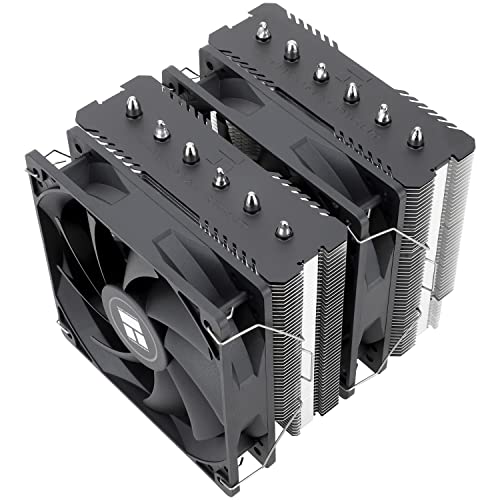
 Thermalright Peerless Assassin 120 SE ARGB CPU Air6 Heat Pipe4.92 x 5.31 x 6.1 inches2 PoundsCheck on Amazon
 Thermalright Aqua Elite 240 V3 Water Cooling CPUAE240 BLACK V34.72 x 0.98 x 4.72 Inches0.2 PoundsCheck on Amazon
 Cooler Master Elite Liquid 240 AIO Liquid CPU240mm Radiator4.7 x 4.7 x 1 inches2.87 PoundsCheck on Amazon
Top 3 picks at a glance
Quick Verdict
If your primary goals are long-term reliability, minimal home maintenance, and unbeatable dollar-per-watt cooling efficiency, choose a dual tower air cooler.
If you prefer a sleek aesthetic for a open glass desk, require tall RAM memory module clearance, or want to route exhaust heat directly out the top of a small PC chassis, a 240mm AIO liquid cooler is the superior fit. Liquid loops clean up the center of your motherboard view and absorb quick thermal bursts gracefully, making them ideal for modern home office decor.
Side by Side
| Feature | Dual Tower Air Cooler | 240mm AIO Liquid Cooler |
|---|---|---|
| Comfort & Noise Profile | Low fan hum; pure air movement sound with no pump motor whirring. | Ultra-quiet fan performance under light loads; faint pump noise continuously present. |
| Durability & Lifespan | 7–10+ years; passive metal fins cannot break. Only fans wear out over time. | 3–6 years; internal pump motors and fluid levels degrade over time. |
| Price Range | Check on Amazon | Varies |
| Maintenance Needed | Dusting heatsink fins with compressed air every 6 to 12 months. | Dusting radiator mesh; replacing full unit once pump fails or fluid permeation occurs. |
| Space & Clearance | Requires 155mm–165mm cooler height clearance; can overhang RAM slots. | Requires 240mm radiator mount (approx. 275mm × 120mm space) on top or front panel. |
| Visual Aesthetics | Industrial, heavy physical presence; fills the central PC interior view. | Minimalist pump block on CPU; spacious, sleek window showcase look. |
| Resale & Moving | Heavier weight (approx. 0.9kg–1.2kg) on motherboard socket; best removed when moving homes. | Radiator distributes weight to case frame; safer for moving whole desktop intact. |
| Best For | Budget-conscious builders, home offices prioritizing zero-upkeep equipment. | Style-focused setups, compact cases, users wanting RGB showcase lighting. |
Where Dual Tower Air Cooler Wins
When evaluating a dual tower air cooler vs 240mm aio liquid cooler, air cooling shines brightest in mechanical simplicity and longevity. A dual tower cooler consists of a solid copper base, 6 to 7 heat pipes, two stacked aluminum fin arrays, and two 120mm fans. Because there are zero moving parts outside of the fans, failure modes are essentially non-existent.
Value is another huge advantage. High-value options like the Thermalright Peerless Assassin 120 SE CPU Cooler and the Thermalright Peerless Assassin 120 SE ARGB CPU Air Cooler feature 6 heat pipes with anti-gravity heat pipe (AGHP) technology and dual PWM fans reaching 1550RPM. These air coolers deliver cooling performance matching liquid loops that cost twice as much, making them an incredible investment for sensible home budgets.
Acoustically, air coolers are predictable. They do not produce the high-frequency motor whine or liquid bubbling sounds that some home office workers find distracting during quiet focused hours. Furthermore, you will never worry about fluid leaks damaging expensive wooden desk surfaces, carpets, or underlying components.
Where 240mm Aio Liquid Cooler Wins
A 240mm AIO liquid cooler moves the bulk of thermal management away from the middle of your motherboard to the outer frame of your PC enclosure. The small water block sits neatly on the processor, connected by twin flexible tubes to a 240mm radiator equipped with two 120mm fans.
The primary win here is spatial elegance and motherboard clearance. Because massive metal heat towers are absent, you enjoy unrestricted access to high-profile RGB memory sticks, primary PCIe slots, and motherboard power connections. This makes working inside the case easier and yields an open, modern interior look that compliments clean glass desk setups in contemporary home offices.
Affordable entry points have closed the price gap significantly in recent years. Models like the Cooler Master Elite Liquid 240 AIO Liquid CPU Cooler and the Thermalright Aqua Elite 240 V3 Water Cooling CPU Cooler offer efficient PWM-controlled pumps and ARGB lighting at prices competing directly with mid-range air coolers. Liquid also possesses a higher specific heat capacity than air; the fluid acts as a buffer against sudden CPU temperature spikes during burst tasks like opening massive media files, keeping fan speeds smoother and less prone to abrupt revving.
Cost Over 5 Years
Looking at total cost of ownership over a 5-year period reveals a clear financial winner. Air coolers have nearly zero ongoing costs.
A 240mm AIO liquid cooler has a higher long-term cost profile. Most AIO liquid coolers carry functional lifespans of 3 to 5 years. By year five, pump noise often increases or cooling performance degrades due to trapped air pockets, usually necessitating a complete cooler replacement.
Which One for Your Home
Small Apartment
In compact living spaces or studio apartments, heat management and PC chassis dimensions are critical. A 240mm AIO liquid cooler lets you use shorter, narrower computer cases because you do not need 155mm+ vertical height clearance for a tower. Mounting the radiator as a top exhaust pushes hot air directly out of the case and up into the room, preventing thermal buildup around your sitting space.
Family with Kids/Pets
For homes with active children, curious pets, or high dust levels from household activity, a dual tower air cooler provides essential peace of mind. If a child bumps into a desk or pet hair accumulates on the PC, a heavy-duty air heatsink keeps operating safely. Air coolers do not mind physical vibrations that might stress AIO tube fittings, and dusting large heatsink fins is much easier than cleaning dense liquid radiator channels clogged with pet dander.
Rental
If you live in a rental home where you move every year or two, transportability matters. A heavy dual tower air cooler weighs over 1.0kg suspended from the motherboard socket, requiring you to dismount it before moving the PC to avoid warping the board on bumpy drives. A 240mm AIO liquid cooler secures its main mass (the radiator) directly to the steel chassis frame, making the PC safer to pack and transport intact between rental properties.
Long-Term Home
When setting up a dedicated home office for years of seamless productivity, a dual tower air cooler remains the gold standard for “set-it-and-forget-it” reliability. As technology shifts in 2026 and beyond, an air cooler will quietly perform year after year without pump decay, keeping your daily workstation quiet, reliable, and maintenance-free.
FAQ
Does a 240mm AIO perform better than a dual tower air cooler?
In raw cooling capacity, a quality dual tower air cooler and a standard 240mm AIO liquid cooler perform remarkably similarly, both capable of cooling workloads in the 200W–250W TDP range. The 240mm AIO absorbs short, sudden heat spikes better due to liquid thermal capacity, while dual tower air coolers offer steady, predictable long-term cooling without pump degradation.
Can liquid coolers leak and damage home office furniture or electronics?
Modern closed-loop AIO liquid coolers are factory-sealed and built with anti-leak tubing, making leaks extremely rare. However, the risk is non-zero over a 5-year lifespan. If a seal degrades or tube fitting fails, fluid could damage components or drip onto desk surfaces. Dual tower air coolers carry zero fluid leakage risk.
Will a dual tower air cooler block my RAM or graphics card?
Dual tower air coolers stand approximately 155mm to 160mm tall and extend over memory channels. While many models allow you to raise the front 120mm fan slightly to clear standard RAM sticks, tall RGB RAM modules may be blocked. Graphics cards installed in the primary PCIe slot generally fit without issue, but clearance around the top release latch can be tight.
How often do you need to replace or maintain each cooler?
Dual tower air coolers require almost no maintenance beyond blowing dust off the aluminum fins every 6 to 12 months with compressed air. They can last over a decade. A 240mm AIO cooler cannot be refilled or serviced by the user and typically requires full replacement after 3 to 6 years when pump wear or liquid loss reduces cooling efficiency.