Every desktop power supply you have ever handled sends several voltages down to the motherboard at once: 12V, 5V, 3.3V, and a couple of standby rails. ATX12VO throws most of that out. It is a single-rail standard where the PSU delivers only 12V, and the motherboard makes its own 5V and 3.3V on-board for SATA drives, USB, and RAM. If you have seen the term on a spec sheet and wondered whether it changes what PSU to buy, here is the plain-English version.
How ATX12VO differs from standard ATX
A conventional ATX unit uses a 24-pin motherboard connector packed with 12V, 5V, 3.3V, and sense wires. ATX12VO replaces that with a slim 10-pin connector carrying 12V and signaling only. The efficiency win comes at low load: a normal PSU keeps its 5V and 3.3V converters running even when your PC is idling at 10-15W, and those converters waste power. Collapsing everything to 12V lets the unit sit closer to its efficiency sweet spot when the machine is doing almost nothing.
Where the other voltages come from
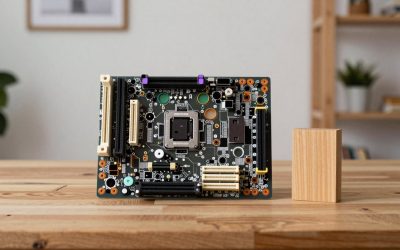
The motherboard grows small DC-DC converters that turn 12V into 5V and 3.3V right next to the devices that need them. SATA power for drives is generated on the board and routed through a new connector, which is why an ATX12VO board looks unfamiliar around the storage area.
| Trait | Standard ATX | ATX12VO |
|---|---|---|
| Main connector | 24-pin | 10-pin |
| Rails from PSU | 12V, 5V, 3.3V, 5VSB | 12V + standby only |
| Idle efficiency | Baseline | Roughly 3-7% better at very low load |
| SATA power source | PSU cables | Motherboard header |
| Board cost | Standard | Slightly higher |
Who actually benefits
ATX12VO was pushed largely by efficiency regulations for pre-built office PCs, where machines idle for hours and every watt of standby draw is multiplied across millions of units. For a gaming rig that spends its life between 60W idle and 400W+ under load, the practical power-bill saving is small, often a dollar or two a year. The bigger friction for enthusiasts is ecosystem: compatible boards and PSUs are still niche, and mixing an ATX12VO PSU with a standard ATX board (or vice versa) is not directly possible without an adapter that undoes the efficiency benefit.
Should you buy into it today?
For a self-built gaming or workstation PC in the current market, a good 80+ Gold or Platinum standard-ATX unit is the pragmatic choice. It is widely compatible, easy to replace, and its low-load efficiency is already strong on quality models. ATX12VO makes the most sense if you are buying a pre-built specifically engineered around it, or if you are a homelab tinkerer chasing idle wattage on an always-on machine.
What to look at on the spec sheet
If you are cross-shopping an ATX12VO system, do not just chase the standard name, check the actual efficiency curve. A good ATX12VO unit shines at the 5-15% load band where a desktop idles, but at 50% load (say a 400W gaming session on an 800W-class unit) it lands very close to an equivalent 80+ Gold ATX supply. So the real payoff scales with how much of its life the machine spends near idle. A media PC or always-on home server that sits at 25-40W for 20 hours a day captures far more of the benefit than a rig that boots up only for evening gaming.
Also weigh the hidden costs: ATX12VO motherboards carry extra DC-DC circuitry, so they tend to run a little pricier and can put SATA-power headers in awkward spots. Factor those into the total build cost before deciding the idle savings are worth it.
FAQ
Can I use an ATX12VO PSU with a normal motherboard?
Not directly. The connector and voltage layout are different. Adapter boards exist that regenerate 5V and 3.3V from the PSU’s 12V, but they add cost, clutter, and cancel most of the efficiency advantage, so it is rarely worth it.
Does ATX12VO improve gaming performance?
No. It changes how voltages are delivered, not how much power your components can draw. Frame rates, boost clocks, and thermals are unaffected; the only real-world difference is marginally lower idle power consumption.
Bottom line
ATX12VO is a genuine efficiency improvement aimed mostly at mass-produced office machines that idle all day. For a typical gaming build, the savings are too small to justify chasing scarce, pricier hardware. Buy a quality standard-ATX Gold/Platinum unit today, and revisit ATX12VO only if the ecosystem matures or you are optimizing an always-on low-power system.