Most builders learn ATX first, then discover SFX for small cases. TFX sits in a quieter corner of the market, and it trips people up because it looks like a shrunken ATX unit but does not mount like one. If you are eyeing a slim prebuilt chassis or a low-profile office tower, understanding TFX now can save you an expensive return later.
As an Amazon Associate we earn from qualifying purchases at no extra cost to you.

TFX in plain terms
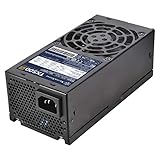
TFX stands for Thin Form Factor. It is a long, narrow power supply designed for slim desktop cases that are too shallow for a standard ATX unit and shaped differently from a compact SFX cube. A TFX unit is typically around 85mm wide, 65mm tall, and 175mm or more deep, with the fan usually mounted on the long side rather than the bottom. That elongated shape lets it tuck into thin tower and small OEM chassis where height is the main constraint.
How it differs from ATX and SFX
The three form factors are not interchangeable without an adapter and, often, not even then. The mounting screw pattern and physical dimensions differ, so a case designed for one will rarely accept another cleanly.
| Form factor | Rough size (W×H×D) | Common wattage range | Typical home |
|---|---|---|---|
| ATX | 150 × 86 × 140–180mm | 500–1200W+ | Standard mid and full towers |
| SFX | 125 × 63.5 × 100mm | 450–1000W | Mini-ITX small form factor |
| SFX-L | 125 × 63.5 × 130mm | 500–1000W | SFF with more fan room |
| TFX | 85 × 65 × 175mm+ | 250–500W | Slim towers, OEM desktops |
When you actually need TFX
You need a TFX unit when your case explicitly calls for one. That happens most often with slim prebuilt desktops from major OEMs, thin home or office towers, and some compact media PCs. These chassis are shallow enough that an ATX PSU physically will not fit, and their mounting bracket is cut for the TFX screw pattern. If you open a slim tower and see a long, skinny power supply with a side-mounted fan, that is your sign.
Wattage expectations and limits
TFX units usually top out around 300–500W. That is plenty for an integrated-graphics office box, a light 1080p build with a 75W-class card, or a home server. It is not enough for a modern gaming GPU that spikes well past 200W under transient load. If your slim case only takes TFX and you want a hungry graphics card, you have hit the ceiling of that platform and should reconsider the chassis rather than fight the power budget.
Buying and efficiency notes
Because TFX is a niche category, the selection is smaller and premium efficiency tiers are less common than in ATX. Aim for at least an 80 Plus Bronze rating, and prefer Gold if your budget allows, since a higher rating means less waste heat inside a cramped slim case where airflow is already limited. Confirm the exact length, because some slim cases only clear a 175mm unit and a longer TFX model can foul the drive cage.
Frequently asked questions
Can I put a TFX power supply in a normal ATX case?
Usually not without an adapter bracket, and even then it is awkward. The screw holes do not line up with an ATX mount and the shape leaves gaps. If your case takes ATX, just buy an ATX unit — it will be cheaper, more powerful, and easier to source.
Is TFX enough for a gaming PC?
For light 1080p gaming on a low-power card, a 400–500W TFX unit can work. For any build with a modern mid-range or high-end GPU, TFX wattage and connector options are too limited. Those builds belong in a case that accepts SFX or ATX instead.
Bottom line
TFX is a specialist form factor for slim and OEM desktops, not a choice you make for a from-scratch gaming rig. Buy one only when your case demands it, match the length carefully, target Bronze efficiency or better, and respect the roughly 500W ceiling. If your ambitions outgrow that budget, the smarter move is changing the case, not forcing a bigger load through a thin-form supply.