Every power supply worth buying carries an 80 Plus badge in some colour, from white up to Titanium. Marketing leans on it heavily, yet many builders are unsure what it actually promises. Understanding the rating helps you spend wisely instead of paying for a shinier sticker that saves you pocket change.
As an Amazon Associate we earn from qualifying purchases at no extra cost to you.

Our Top Picks
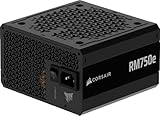
 CORSAIR RM750e ATX 3.1 PCIe 5.1 Ready 750W750 watts5.91 x 5.51 x 3.35 inches3.3 poundsCheck on Amazon

The core idea: efficiency
The 80 Plus program certifies how efficiently a supply converts AC wall power into the DC power your components use. An 80 percent efficient unit delivering 400W to your parts pulls about 500W from the wall, wasting 100W as heat. A 90 percent efficient unit pulls closer to 444W for the same job. The higher the tier, the less energy is lost as heat.
| Tier | Efficiency at 50% load (115V) |
|---|---|
| 80+ White | ~82% |
| 80+ Bronze | ~85% |
| 80+ Silver | ~88% |
| 80+ Gold | ~90% |
| 80+ Platinum | ~92% |
| 80+ Titanium | ~94% |
Why efficiency is measured at different loads
A supply is not equally efficient everywhere. Ratings are checked at 20, 50, and 100 percent load, and efficiency typically peaks around the middle. This is exactly why sizing a unit so your system’s real draw lands near half its capacity is smart: you sit in the most efficient part of the curve.
What the badge does not tell you
Crucially, 80 Plus says nothing directly about safety, ripple, protection circuits, or build quality. A poorly built unit can still earn a Bronze or even Gold badge. That is why experienced builders check warranty length and independent reviews rather than trusting the sticker alone.
How much money does a higher tier save?
Higher tiers make more sense on high-wattage units, systems that run for long hours, or hot climates where reducing waste heat has value beyond the electricity bill.
Efficiency across the load curve
One detail the badge hides is that efficiency changes with load, and the shape of that curve is why sizing matters. A supply is typically least efficient at very low load, climbs to its peak somewhere near the middle, and dips slightly again at full load. This is why a wildly oversized unit powering a tiny load can actually waste a touch more energy proportionally, sitting down in the inefficient low-load region.
| Load level | Relative efficiency |
|---|---|
| 10-20% | Lower, below rated tier |
| 40-60% | Peak, at or above rated tier |
| 90-100% | Slightly reduced from peak |
The practical lesson is to size your unit so that your real-world gaming draw lands near the middle of its capacity. For a system that peaks around 400 watts, a 700 to 800 watt unit keeps you in the efficient band during play while leaving headroom for spikes. Chasing a higher tier is worthwhile, but pairing any tier with correct sizing delivers more of the benefit than jumping a rung and running the unit at an awkward load point.
FAQ
Is a higher 80 Plus tier always better?
For efficiency, yes, but the payback can be slow. A quality Bronze or Gold unit is the sweet spot for most builds; Platinum and Titanium mainly benefit heavy, always-on systems where efficiency compounds over time.
Does the rating affect gaming performance?
No. Efficiency changes how much power is wasted as heat, not how much reaches your components. Frame rates are identical between tiers of the same wattage.
Bottom line
The 80 Plus rating measures conversion efficiency and nothing more. It is a useful shorthand, but it is not a quality guarantee. Aim for a well-reviewed Bronze or Gold unit sized so your load sits near 50 percent, and treat the badge as one factor among several rather than the deciding one.