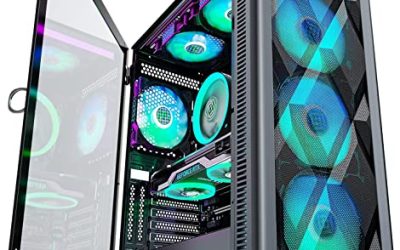
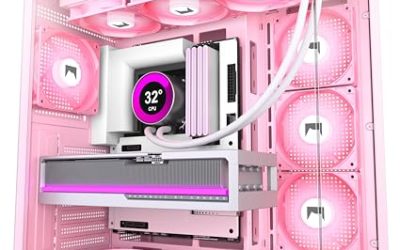
Choosing an AIO for a Ryzen 9 sounds simple until you realize the CPU can pull far more power than its box TDP suggests. Many buyers grab a 240mm cooler because it fits and looks clean, then wonder why a Ryzen 9 7950X or 9950X still hits 95C and throttles under sustained loads. Others overspend on a 420mm giant that will not fit their mid-tower case without heavy modification. For a high-core-count chip like this, radiator size is not just about bragging rights. It directly affects thermal headroom, noise, and how long the CPU can hold boost clocks. Understanding the real trade-offs before you buy will save you a return and a weekend of rebuilding.
Our Top Picks
 ARCTIC Liquid Freezer III Pro 360 A-RGBLiquid Freezer III Pro 360 A-RGB15.7 x 4.7 x 2.9 Inches4.5 PoundsCheck on Amazon


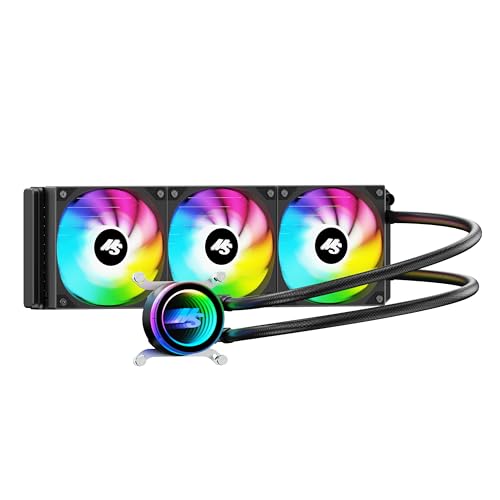
Top 3 picks at a glance
Decide These 3 Things First
Before you compare models, lock in these three decisions. They narrow your options instantly and prevent the most common sizing mistakes.
As an Amazon Associate we earn from qualifying purchases at no extra cost to you.


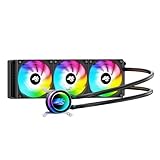
1. Your exact Ryzen 9 and its power behavior. A Ryzen 9 7900 with a 65W base TDP and ~90W Package Power Tracking (PPT) limit is very different from a Ryzen 9 9950X or 7950X with a 170W TDP and a PPT up to 230W. The X3D gaming chips like the 7950X3D and 9950X3D run cooler on average than the non-3D flagships but still spike hard due to the dense chiplet design. Check the PPT for your SKU, not just the TDP on the box.
2. Your case’s actual radiator support. Do not trust the marketing line that says “supports up to 360mm.” Measure usable clearance. A 360mm radiator is typically 394-405mm long, 120-125mm wide, and 27-38mm thick before fans, plus another 25mm for fans. A 280mm is about 312-322mm long and 140mm wide. Check front vs. top mount limits, RAM clearance, and thickness with fans installed. If your case only supports a 240mm up top and a 360mm only in the front with the drive cage removed, that changes your plan.
3. Your noise and boost priority. If you want the quietest system possible while rendering or compiling for 30+ minutes, you need more surface area. If you mainly game in short bursts and do not mind fans at 1400-1600 RPM, you can get away with a smaller radiator. Ryzen 9 holds higher all-core clocks longer when coolant temperature stays under 38-42C, which is easier with a larger radiator.
Radiator Size and Case Fit: 240mm vs 280mm vs 360mm vs 420mm
Radiator size is about surface area and airflow volume, not just length. Here is how the four common sizes stack up for Ryzen 9 in 2026 builds.
240mm (2x 120mm): Roughly 276 x 120mm, 27-30mm thick. Budget-friendly and fits almost any ATX or large micro-ATX case. It can cool a Ryzen 9 7900 or 9900X at stock settings but will run fans at 1600-1900 RPM under full all-core load to keep a 170W-class chip from throttling. Expect coolant to saturate faster during 10-minute sustained workloads. Best if your case is compact and you undervolt or use Eco Mode (105W or 65W PPT).
280mm (2x 140mm): Roughly 312 x 140mm, 27-32mm thick. Often overlooked, but the surface area is about 15-20 percent larger than a 240mm and close to a 360mm in real cooling capacity. Two larger 140mm fans move more air at lower RPM (900-1300 RPM) for less noise. The catch is case compatibility. Many mid-towers support 280mm in front but not on top. Check width: you need at least 145mm of clearance.
360mm (3x 120mm): The sweet spot for most Ryzen 9 builds, especially the 7900X, 7950X, 9900X, and 9950X at stock PPT. At 394-402 x 120mm, it provides about 50 percent more surface area than a 240mm. That extra area lets three fans run at 1000-1400 RPM while keeping coolant delta 6-10C lower than a 240mm at the same noise level. For a case like a standard ATX mid-tower (440-470mm tall, 210-230mm wide), this is the best balance of fit, price, and headroom.
420mm (3x 140mm): Roughly 457 x 140mm, 27-38mm thick. Maximum surface area for consumer AIOs, but only full-tower or large airflow-focused mid-towers fit it, usually in the front. It is overkill for a 65W-120W Ryzen 9 but useful if you run a 170W chip at unlimited PPT, overclock, or want near-silent operation at 800-1100 RPM. Weight is also higher: radiator plus fans and coolant often totals 1.8-2.3 kg vs 1.3-1.7 kg for a 360mm.
Practical rule: For a Ryzen 9 with a 170W TDP (230W PPT), plan on a 360mm as your baseline. For a 65W or 120W Ryzen 9, a 280mm or 360mm gives you quiet headroom, while a 240mm is the minimum viable option if case space is tight and you are willing to accept higher noise.
Material and Cold Plate Construction
Nearly all modern AIO radiators are aluminum with a copper cold plate, connected by rubber tubing with a nylon or EPDM sleeve. Full-copper radiators are rare in AIOs and mostly found in custom loops, so do not pay extra expecting one. What matters more is construction quality.
Look for a cold plate that is solid copper with a dense micro-fin array inside (often 0.15-0.25mm fin channels) and a flat, machined surface. For Ryzen 9’s chiplet layout, where heat is concentrated in two CCDs offset from center, a slightly convex or perfectly flat cold plate with even mounting pressure makes a 3-6C difference. An offset mounting bracket for AM5, which shifts the cold plate 5-7mm toward the hotspot, is a meaningful advantage on Ryzen 7000 and 9000 series.
Tubing length is typically 350-450mm. If you front-mount in a tall case, 450mm gives you more routing flexibility without kinking. Braided or tightly sleeved EPDM tubing resists evaporation better than thin PVC. Permeation still happens at a rate of 5-15 percent coolant loss over 3-5 years, which is why a 5 to 6-year warranty matters.
Fan and Pump Performance That Dictates Real Cooling
Radiator size means little if fans and pump are weak. Focus on these numbers.
Fans: For 120mm fans, look for 600-2000 RPM PWM range, airflow of 55-75 CFM, static pressure of 1.5-3.0 mmH2O, and noise rated 22-32 dB(A) at full speed. For 140mm fans, 600-1700 RPM, 70-95 CFM, and 1.2-2.5 mmH2O. Fluid dynamic or ceramic bearings last longer and run quieter than rifle bearings at low RPM. Three-phase fan motors tend to have less humming at 800-1100 RPM, which is where you will run them most of the time on a 360mm.
Pump: Most AIO pumps run at 2000-3200 RPM, draw 2-4W, and are rated at 30-45 dB(A) if poorly isolated. A good pump block should keep noise under 30 dB(A) at 60-70 percent speed. Speed control via PWM is preferable to fixed DC. Pump height matters for clearance: total pump-block height of 50-65mm clears most RAM and top-mounted radiators, while taller 70mm+ caps can interfere with side panels or tall DIMMs over 45mm.
Real-world performance: A 360mm AIO with three decent 120mm fans at 1200 RPM will typically keep a Ryzen 9 7950X / 9950X at 82-88C during a 20-minute all-core Cinebench run in a 22C room, with fans still reasonably quiet. A 240mm at the same noise level will run 6-12C hotter or need 400-600 RPM more to match. Do not expect any AIO to keep a 170W Ryzen 9 under 70C at unlimited PPT under full load; the chip is designed to run to its 95C thermal limit and boost until it hits that wall.
Price Tiers: What $50, $75, and $120 Actually Buy You
You do not need to spend a fortune to cool a Ryzen 9, but the cheapest options cut corners that show up in noise and longevity.
Budget: $48-$70. This range gets you a functional 360mm AIO with three ARGB PWM fans, a basic copper cold plate, and standard aluminum radiator. Example specs at this tier: 27-28mm thick radiator, 400mm tubing, 3-year to 5-year warranty. Cooling is solid for the money, but fans may be louder above 1500 RPM and pump noise isolation may be minimal. Good for Ryzen 9 7900, 7900X, or 9900X on a tight budget if your case has good airflow.
Premium: $110-$180+. Premium buys you brand-specific features: LCD screens, software control, extra-thick 38-58mm radiators, upgraded tubing, or 140mm-based 280mm/420mm designs with exceptionally quiet operation. Thermal improvement over a good mid-range 360mm is usually only 2-5C, so you are paying for noise reduction, aesthetics, and software, not raw cooling. Only worth it for silent-focused builds or if you want the screen or ecosystem integration.
Warranty, Support, and Long-Term Reliability
AIOs are sealed systems with a finite lifespan. Coolant slowly permeates through tubing, and pump life is typically rated at 40,000-70,000 hours (4.5-8 years of continuous use). For a Ryzen 9 that will likely stay in your system 4-6 years, warranty length is a proxy for build confidence.
Look for a minimum 3-year warranty, with 5-6 years being the standard for reputable brands in the mid-range. A good warranty should explicitly cover leaks and damage to other components, not just the cooler itself. Keep your receipt and register the product if the brand requires it.
Reliability checks before you buy: Ask whether replacement mounting hardware for future AM5+ sockets will be available, whether the pump is serviceable or has a refill port (most AIOs do not), and how the company handles RMA shipping. Brands that offer advanced replacement or cross-shipping save you weeks without a PC.
Delivery, Installation, and Clearance Checks
Even the right size fails if it does not fit cleanly. Before ordering, run through this pre-install checklist.
Case measurements: Confirm radiator + fan thickness. A 30mm radiator + 25mm fans = 55mm total. Add 5-10mm for cable clearance. For top mount, measure from the top of the motherboard VRM heatsink and RAM to the case roof. Tall RAM (44-60mm) often conflicts with top-mounted 360mm radiators. If clearance is under 55mm, front-mount instead.
Socket compatibility: All current AIOs support AM5 and AM4 out of the box, but verify that the box includes the AM5 backplate and standoffs. Some older stock may require a free AM5 kit request. Weight: complete 360mm units ship at 1.6-2.1 kg boxed; make sure your case’s radiator tray is rated for that load, especially for front vertical mounts.
Airflow direction: Front-mounted radiator as intake gives the CPU 3-5C lower coolant temps but raises GPU temps by 2-4C. Top-mounted radiator as exhaust does the opposite. For Ryzen 9 productivity builds where CPU load dominates, front intake is usually better. For gaming where GPU heat is high, top exhaust is often quieter overall.
Installation tip: Mount the radiator so the tubes are at the bottom if front-mounted, or at least not at the highest point of the loop. This keeps any small air bubble away from the pump inlet and reduces gurgling. Tighten the cold plate in a cross pattern to 0.5-0.7 Nm (snug, not forced) for even pressure over the IHS.
Spec Checklist
| Spec | Budget | Mid | Premium |
|---|---|---|---|
| Radiator Size for 170W Ryzen 9 | 360mm recommended; 240mm minimum with higher noise | 360mm ideal; 280mm viable with good fans | 360mm or 420mm for lowest noise |
| Radiator Dimensions | 394-400 x 120 x 27-28mm | 394-405 x 120-140 x 30-38mm | 394-457 x 120-140 x 30-58mm |
| Fan Specs (per fan) | 120mm, 600-1800 RPM, 55-65 CFM, rifle bearing | 120/140mm, 600-2000 RPM, 60-80 CFM, fluid dynamic/ceramic | 120/140mm, 500-2000 RPM, 70-95 CFM, premium bearing + low noise |
| Pump Speed & Noise | 2600-3200 RPM fixed, 32-40 dB(A) | 2000-3200 RPM PWM, under 32 dB(A) at 70% | 2000-3000 RPM PWM, under 28 dB(A) with isolation mount |
| Cold Plate | Copper, standard mount | Copper with AM5 offset bracket and contact frame | Copper with offset, high-density microfins, premium paste pre-applied |
| Tubing Length | 350-400mm, standard EPDM | 400-450mm, sleeved EPDM/nylon | 450mm+, reinforced sleeved with swivel fittings |
| Warranty | 3-5 years | 5-6 years with leak coverage | 5-6 years with leak + component damage coverage |
| Total Installed Weight | 1.3-1.6 kg | 1.5-1.9 kg | 1.7-2.3 kg |
Red Flags
Watch for these warning signs when shopping for a Ryzen 9 AIO.
- No AM5 offset hardware: If a cooler does not include or offer an offset bracket for AM5, you are leaving thermal performance on the table for a chiplet CPU.
- Vague radiator thickness or fan specs: Listings that hide CFM, static pressure, or dB(A) often use low-pressure fans that struggle on dense 27-30 FPI radiators.
- Fixed-speed pump with no PWM: A pump locked at 100 percent is unnecessarily loud at idle and offers no tuning.
- 120mm or 140mm single-fan AIO for a 170W Ryzen 9: A 120mm or 140mm radiator does not have enough surface area for sustained all-core loads on a 16-core chip and will throttle quickly.
- Warranty under 3 years or no leak coverage: Short warranties signal lower confidence in tubing and pump longevity.
- Requires proprietary software to control pump/fans: If the cooler will not run at full functionality without software, you lose control in BIOS or on Linux.
- Unrealistic temperature claims: Any listing that promises a 170W Ryzen 9 will stay at 60-65C under full load at 20C ambient is misleading. The CPU is designed to push to 95C.
FAQ
Is a 240mm AIO enough for a Ryzen 9 7950X or 9950X?
It is enough to prevent immediate throttling, but it is not ideal for sustained work. A 240mm has about two-thirds the surface area of a 360mm, so fans must run 400-600 RPM faster to match coolant temps. For short gaming sessions at stock settings, a 240mm will work. For rendering, compiling, or video encoding lasting more than 10 minutes, a 360mm keeps boost clocks higher and noise lower. If you must use a 240mm on a 170W chip, enable Eco Mode or a 105W PPT limit in BIOS to reduce heat by 25-35 percent with only a small performance loss.
Do I need a 360mm or 420mm for a Ryzen 9 7900 or 9900X?
Not strictly. The 7900 (65W TDP, ~90W PPT) and 9900X (120W TDP, ~162W PPT) are less demanding than the 16-core flagships. A 280mm or 360mm is the quiet, comfortable choice, while a well-ventilated 240mm can handle the 7900 even at full load if you set a reasonable fan curve. Choose based on case support and noise preference rather than fear of overheating, but do not go below 240mm for any Ryzen 9.
Will a bigger radiator make my Ryzen 9 run much cooler at idle?
No. At idle or light browsing (15-35W), any AIO from 240mm to 420mm will show similar CPU temperatures, typically 35-48C depending on ambient and paste. Radiator size matters at high sustained loads when coolant heat soaks. The benefit of a larger radiator is lower coolant temperature under load and the ability to run fans slower for the same cooling, not a dramatically lower idle temperature.
What clearance issues should I check before buying a 360mm?
Check four things: radiator plus fan thickness versus top clearance over RAM and VRM heatsinks, total radiator length versus case tray (394-405mm needs a true 360mm mount), tubing length for front-mount routing (aim for 400mm minimum, 450mm is better in tall cases), and GPU length if front-mounting (a front 360mm can reduce max GPU length by 30-60mm). Also verify the pump-block height clears your side panel and that the case can support the 1.6-2.1 kg loaded weight without bowing.