The best self-watering planters are the ones whose reservoir matches your plant’s water demand, whose wick or insert can deliver moisture without saturating roots, and whose overflow design suits the room where you will use them.
As an Amazon Associate we earn from qualifying purchases at no extra cost to you.

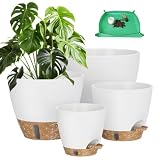


Our Top Picks
 Dexceder 18x17 Self Watering Planter with Wheels18x1717.52 x 17.52 x 16.73 Inches10.14 poundsCheck on Amazon

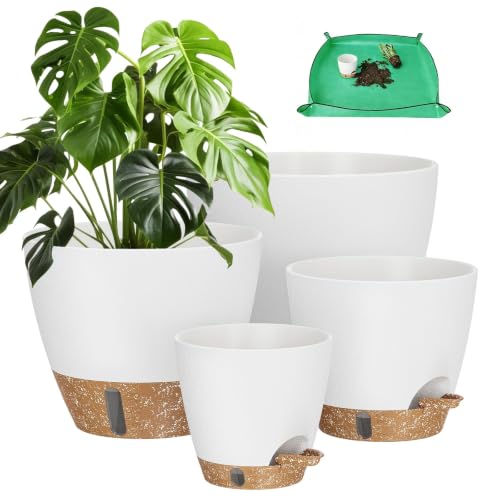

Top 3 picks at a glance
Quick recommendations by situation
| Use case | Best planter type | Useful target specifications | Why it works |
|---|---|---|---|
| Small desk plant | Wick-fed pot or insert | 1–2 L soil volume, 0.25–0.75 L reservoir | Compact enough for a desk and less likely to stay wet for weeks |
| Large indoor floor plant | False-bottom reservoir planter | 15–30 L soil volume, 2–5 L reservoir, water-level indicator | Supports a substantial root ball while reducing watering frequency |
| Sunny balcony | Outdoor reservoir box with overflow outlet | 8–20 L reservoir per box, UV-resistant plastic, drainage overflow | Handles rapid evaporation and prevents rain from flooding the roots |
| Frequent travelers | Large reservoir with visible gauge | 3–6 L reservoir, 20–30 L soil capacity | Provides useful reserve capacity without requiring a pump or electronics |
How self-watering planters actually work
Most self-watering planters have two zones: a growing container for potting mix and a lower reservoir for water. A wick, capillary column, or perforated insert moves water upward as the mix dries. The system does not automatically know how much water a plant needs; it simply makes water available at a controlled rate.
That distinction matters. A self-watering planter can reduce missed waterings, but it will not correct a plant that needs a fast-draining mix, a dry rest period, or excellent airflow. Cacti, many succulents, and plants with roots that are sensitive to constantly wet conditions are often better in a conventional pot with a drainage hole.
Wick systems
Wick planters use one or more fabric or synthetic cords to pull water into the soil. They are usually inexpensive and work well for herbs, foliage plants, seedlings, and smaller pots. Their performance depends on the wick touching both the reservoir and the potting mix. A loose wick, compacted soil, or a wick that has dried completely can interrupt capillary action.
False-bottom systems
These use a raised inner pot or molded platform rather than a dangling cord. Water rises through a capillary insert or column. False-bottom designs are generally more stable for medium and large plants, and they often include a water-level indicator. They usually cost more, but the reservoir is easier to inspect and refill.
Reservoir-integrated planters
Planters such as the Lechuza CLASSICO Color, Lechuza BALCONERA Color, and elho Greenville represent the better-known integrated-reservoir approach. Exact capacity varies by size, so check the specific model rather than assuming every size has the same watering interval. These designs are especially useful when appearance matters in a living room, office, or balcony.
Reservoir capacity: calculate the useful interval
A larger reservoir is not automatically better. The practical question is how long it can supply the plant before refilling. A simple estimate is:
Approximate interval in days = usable reservoir volume in milliliters ÷ estimated daily water use.
For example, suppose a medium foliage plant uses about 120–180 ml per day in a warm, bright room. A planter with a 3,000 ml reservoir may theoretically last:
3,000 ÷ 180 = 16.7 days at the high-use estimate, or 3,000 ÷ 120 = 25 days at the low-use estimate.
Real intervals are shorter or less predictable because the reservoir should not always be drained completely, and evaporation changes with temperature, sunlight, humidity, plant size, and airflow. Treat this as a planning range of roughly two to three weeks, not a guarantee. Outdoor planters can use water much faster in direct sun and wind.
| Plant and location | Typical daily use range | Reservoir size to target | Expected planning interval |
|---|---|---|---|
| Small pothos or peperomia indoors | 30–80 ml | 0.5–1.5 L | About 7–20 days |
| Medium monstera or ficus indoors | 100–250 ml | 2–5 L | About 8–30 days |
| Balcony herbs in partial sun | 150–400 ml | 3–8 L | About 7–30 days |
| Flowering plants in hot, windy sun | 300–800 ml | 8–20 L | About 5–25 days |
These figures are planning estimates rather than product guarantees. A small plant in a large pot may use less water but can remain wet for too long, while a mature plant in a crowded balcony box may empty the same reservoir quickly.
Pot size and plant matching
Choose the planter by root-ball size first and reservoir capacity second. Moving a plant into a container that is dramatically larger than its current root system creates a large volume of damp mix that may not dry evenly.
- Plants in 7–10 cm nursery pots: choose a final pot around 10–14 cm wide, with a small reservoir. This is suitable for pothos cuttings, spider plants, peperomia, and compact herbs.
- Plants in 12–17 cm nursery pots: choose a 17–24 cm planter with approximately 1–3 L of reservoir capacity. This suits many tabletop foliage plants.
- Plants in 20–25 cm nursery pots: choose a 25–35 cm floor planter with a stable base and approximately 2–5 L of reservoir capacity.
- Balcony boxes: prioritize root depth, mounting stability, UV resistance, and overflow drainage. A long box with a modest reservoir is safer than an extremely deep container that stays saturated.
Use a loose, air-filled mix rather than ordinary garden soil. For tropical foliage, a blend containing potting mix, orchid bark, and perlite allows the wick to supply moisture without eliminating air around the roots. Herbs often prefer a lighter mix with extra perlite. Avoid blocking the reservoir’s capillary openings with fine soil or roots.
Overflow protection is essential indoors
An overflow outlet is one of the most valuable features in a self-watering planter. Without one, overfilling can raise the water level into the root zone or send water onto flooring. Indoor models should have a fill tube, a maximum-level marker, and either an overflow port or a removable reservoir that can be emptied easily.
For balconies, an overflow outlet must direct excess rainwater away from the plant’s root zone. Check whether the planter is designed to sit on a saucer, hang from a railing, or connect to a drain. A balcony box that retains every drop of heavy rain can become waterlogged even when the reservoir was correctly filled.
How to set up a new planter
- Confirm the reservoir is empty before planting. This prevents roots from starting in stagnant water.
- Fit the wick or capillary insert exactly as instructed. It must contact the potting mix and the water path.
- Use fresh, porous potting mix. Dense soil can prevent even moisture movement.
- Water from above for the first one to two weeks. Newly transplanted roots may not yet reach the capillary zone.
- Begin reservoir filling only after the plant is established. Use the gauge or maximum-fill mark, not the top edge of the decorative pot.
- Let the indicator fall toward minimum before refilling. This refreshes the reservoir and reduces the chance of stale, permanently wet conditions.
Best choices by owner type
For busy owners
Select a planter with a gauge that can be read without lifting the plant, a reservoir of at least 2–3 L for medium foliage plants, and an accessible fill opening. A low, wide planter is often more reliable than a narrow tall one because it is less likely to tip and provides more consistent capillary contact.
For balconies
Choose UV-resistant plastic or another weather-tolerant material, secure the planter against wind, and demand a working overflow system. Long balcony boxes such as the Lechuza BALCONERA Color can be practical when their mounting and drainage requirements match the railing or ledge. Do not place a water-filled box where its load exceeds the balcony or bracket’s rated capacity.
For design-focused rooms
Integrated systems such as the Lechuza CLASSICO Color and elho Greenville offer cleaner silhouettes than a nursery pot placed inside a saucer. Match the planter’s diameter to the plant’s existing root ball and leave enough clearance to read the water-level indicator. A concealed reservoir is attractive, but it is less useful if refilling requires removing a heavy plant.
Common problems and fixes
The soil stays wet and smells sour
Check whether the reservoir is permanently full, the mix is too fine, or the plant is too small for the pot. Empty the reservoir, improve aeration with a fresh mix, and wait for the upper layer to dry slightly before restoring bottom watering. If roots are brown and soft, inspect them before replanting.
The wick does not seem to work
Make sure it has not slipped away from the soil, become coated with dry salts, or lost contact with the reservoir. Pour a small amount of water over the mix to reactivate capillary contact, then confirm that the water level falls over the next several days.
The plant wilts while water remains
The root ball may be too dry to accept water, the wick may be undersized, or the plant may be using water faster than the system can supply it. Top-water thoroughly once, verify the wick position, and move a sun-baked planter out of intense afternoon exposure while it recovers.
Frequently asked questions
Can I use ordinary garden soil in a self-watering planter?
No, ordinary garden soil is not recommended for these planters. Use a loose, porous, air-filled potting mix so moisture can move upward without eliminating air around the roots. For tropical foliage, combine potting mix with orchid bark and perlite. Herbs often benefit from extra perlite. Dense or fine soil can interfere with even moisture movement and contribute to persistently wet conditions.
Should I fill the reservoir immediately after transplanting?
No, water from above for the first one to two weeks after planting. Newly transplanted roots may not yet reach the capillary zone, so they need time to establish. Start filling the reservoir only after the plant is established. Confirm that the reservoir is empty before planting, and use the gauge or maximum-fill mark rather than the top edge.
How do I know when to refill the water reservoir?
Refill when the water-level indicator has fallen toward minimum, rather than topping up continuously. This helps refresh the reservoir and reduces the chance of stale, permanently wet conditions. Use the planter’s maximum-fill mark when adding water. If the model lacks a visible gauge, check the reservoir according to its design and avoid filling above the intended water level.
Which plants are usually poor choices for self-watering planters?
Cacti, many succulents, and plants with roots that are sensitive to constantly wet conditions are often poor choices. They may need a dry rest period, fast-draining mix, or excellent airflow that a continuously available water reservoir does not provide. These plants are often better in a conventional pot with a drainage hole, rather than a self-watering design.
Why might a balcony planter become waterlogged after rain?
A balcony planter can become waterlogged when it retains heavy rain instead of directing excess water away from the root zone. Check that the overflow outlet works and that the planter’s drainage design suits its position on a railing, ledge, saucer, or drain. Secure the planter against wind, and make sure its water-filled load does not exceed the bracket or balcony’s rated capacity.
Bottom line
The best self-watering planters combine an appropriately sized pot with a visible reservoir, dependable capillary delivery, and overflow protection. For indoor foliage, prioritize a water gauge and a 2–5 L reservoir; for balconies, prioritize drainage and weather resistance; for small desks, choose a modest wick system rather than maximum capacity. The right match reduces routine watering without turning plant care into permanently wet soil.