
The best mining rig in 2026 is a modern ASIC for Bitcoin at very cheap electricity, while a six-GPU rig is the better choice when you need flexibility, lower heat concentration, or the option to mine different GPU-friendly algorithms.
As an Amazon Associate we earn from qualifying purchases at no extra cost to you.


Our Top Picks


Top 3 picks at a glance
Best mining rigs at a glance
| Rig type | Typical hardware | Hash-rate class | Power draw | Best for |
|---|---|---|---|---|
| High-efficiency Bitcoin ASIC | Bitmain Antminer S21 XP | About 270 TH/s | About 3,645 W | Lowest-cost Bitcoin mining at favorable power rates |
| Balanced Bitcoin ASIC | Bitmain Antminer S21 Pro | About 234 TH/s | About 3,510 W | Commercial or home mining with adequate ventilation |
| Alternative Bitcoin ASIC | MicroBT WhatsMiner M60S | About 180–190 TH/s | About 3,400–3,500 W | Buyers finding better availability or pricing than S21 models |
| Flexible GPU rig | Six GeForce RTX 4070 Super GPUs | Algorithm-dependent | About 1,450–1,550 W total | Multi-algorithm mining, resale value, and experimentation |
| High-memory GPU rig | Six Radeon RX 7900 XT or 7900 XTX GPUs | Algorithm-dependent | About 1,900–2,300 W total | Algorithms that benefit from AMD performance and larger VRAM |
ASIC figures are primarily relevant to SHA-256 Bitcoin mining. GPU hash rate cannot be compared directly with ASIC terahashes: each algorithm produces different units, software efficiency, and revenue. Treat the table as a hardware comparison, not a profitability ranking.
1. Best overall for Bitcoin: Antminer S21 XP
The Antminer S21 XP is the strongest choice when your goal is specifically Bitcoin mining and you can provide industrial-style power and cooling. Its approximate 270 TH/s output and roughly 13.5 J/TH efficiency put it in the current high-efficiency ASIC class.
Its main weakness is not computing performance but infrastructure. A 3.6 kW miner runs continuously, produces substantial heat, and commonly requires a dedicated 240-volt circuit. Air-cooled ASICs also sound much louder than a normal desktop PC. A garage, utility room, or purpose-built mining enclosure is generally more suitable than a bedroom or office.
Who should buy it?
- Operators with 240-volt power, strong ventilation, and a suitable noise-tolerant location.
- Buyers who want the greatest Bitcoin hash rate per machine rather than easy resale.
2. Best balanced ASIC: Antminer S21 Pro
The Antminer S21 Pro offers a slightly lower hash rate than the S21 XP while retaining the advantages of a current-generation Bitcoin ASIC. Its approximate 234 TH/s output and 3.5 kW draw can make it attractive when the purchase price is meaningfully lower or when several units fit an existing electrical design.
Do not select it solely because its advertised wattage is lower. The important comparison is efficiency: watts per terahash, acquisition cost, expected uptime, and the local electricity tariff. A cheaper miner with worse efficiency can lose its price advantage during periods of high network difficulty or lower Bitcoin prices.
3. Best ASIC alternative: WhatsMiner M60S
The WhatsMiner M60S is a credible alternative in the same broad generation of high-performance Bitcoin miners. Depending on the exact variant, it delivers approximately 180–190 TH/s at around 3.4–3.5 kW.
It can make sense when the unit price, warranty, shipping, or availability is better than an equivalent Bitmain model. Check the exact nameplate rating before buying: M60S variants do not all have identical hash rates or efficiency. Also confirm that your mining pool, firmware, and power distribution equipment support the intended operating mode.
4. Best flexible option: a six-GPU RTX 4070 Super rig
A GPU rig built around six GeForce RTX 4070 Super cards is usually a better fit than an ASIC for someone who values flexibility. GPUs can switch between supported algorithms, be resold as gaming hardware, or be repurposed for rendering and machine-learning workloads. Their lower individual power draw also makes heat easier to distribute around a room.
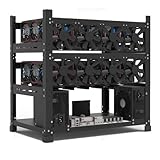
A practical build normally includes six GPUs, an open-air frame, a motherboard with sufficient PCIe slots or riser support, 8–16 GB of system memory, a small SSD, and one or more high-quality power supplies. Set conservative power limits rather than running every card at its maximum board power.
Worked power calculation
Assume six RTX 4070 Super cards are tuned to 220 W each. The GPUs consume 1,320 W. Add approximately 150 W for the motherboard, CPU, memory, storage, fans, and risers:
Total estimated draw: 6 × 220 W + 150 W = 1,470 W.
This is before pool fees, rejected shares, internet equipment, cooling, taxes, and hardware depreciation. That example explains why a small change in coin price, network difficulty, or electricity cost can eliminate GPU mining profits.
5. Best high-memory GPU class: Radeon RX 7900 XT or 7900 XTX
AMD’s Radeon RX 7900 XT and RX 7900 XTX provide large VRAM capacities and strong general-purpose GPU performance. They are worth considering when the target algorithm benefits from AMD hardware or when the rig will also be used for graphics workloads.
These cards use more electricity than RTX 4070 Super cards and can release considerably more heat into the room. Six high-power cards may exceed 2 kW after adding the rest of the system, so power-supply capacity and airflow become central design constraints. The higher purchase cost also lengthens payback unless the selected algorithm provides a durable efficiency advantage.
ASIC versus GPU: which rig fits your situation?
| Your situation | Better choice | Reason |
|---|---|---|
| Varies | High-efficiency ASIC | ASICs deliver far more Bitcoin hash rate per machine and usually better SHA-256 efficiency. |
| Varies | Only efficient ASIC after careful calculation | Energy cost can consume most mining revenue; GPU mining is especially vulnerable. |
| Apartment, office, or noise-sensitive room | Low-power GPU rig, or no rig | Air-cooled ASIC noise and heat are difficult to manage in living spaces. |
| You may resell or repurpose the hardware | GPU rig | Gaming GPUs have uses outside cryptocurrency mining; ASICs have limited secondary uses. |
| Lowest upfront cost per mining experiment | Small GPU build | You can start with fewer cards and expand after measuring actual power and temperatures. |
| Maximum Bitcoin production per unit | Antminer S21 XP-class ASIC | Purpose-built silicon provides vastly greater SHA-256 throughput than consumer GPUs. |
Cooling and electrical requirements
Mining hardware turns nearly all of its electrical input into heat. A 3,645 W ASIC therefore behaves like a continuously operating 3.6 kW heater. Removing that heat requires more than placing a household fan beside the machine. Use a short, unobstructed intake path, a separate hot-air exhaust path, dust filtration that does not choke airflow, and temperature monitoring at both the intake and exhaust.
For a GPU rig, leave space between cards, use an open frame, and direct intake air across the GPUs before it reaches the motherboard. Keep GPU memory temperatures within the manufacturer’s recommended range. Undervolting and reducing the power limit often lowers heat disproportionately while sacrificing less hash rate than expected.
Never size a power supply exactly to the sum of GPU labels. A 1,470 W GPU rig should generally use at least 1,800 W of reliable capacity, split across suitable units if necessary. Follow connector limits, avoid overloaded splitters, and have high-current circuits installed or inspected by a qualified electrician.
How to estimate payback potential
Use this simplified formula before purchasing:
Daily net return = daily mining revenue − electricity cost − pool fees − cooling and operating costs.
Payback period = hardware and setup cost ÷ daily net return.
For electricity, multiply the rig’s measured kilowatt draw by 24 and by your tariff. Use the miner’s actual wall draw rather than its theoretical chip rating. For revenue, use a current calculator that includes network difficulty, block subsidy, coin price, pool fee, and the specific algorithm. Then model a pessimistic case with lower coin revenue and higher difficulty. A projected payback longer than 12–18 months is particularly exposed to hardware obsolescence and market changes.
Buying checklist
- Confirm the exact model variant, hash rate, efficiency, and wall-power rating.
- Calculate electricity cost using your full tariff, including demand charges where applicable.
- Verify circuit voltage, amperage, plugs, breakers, and cable ratings.
- Measure room ventilation before installing an ASIC.
- Budget for fans, risers, replacement parts, networking, and downtime.
- For GPU rigs, compare tuned watts per hash rather than maximum stock performance.
- Use a reputable pool and enable temperature, fan, and hashrate alerts.
For most buyers, the decision is simple: choose an S21 XP-class ASIC for efficient, dedicated Bitcoin mining with cheap power; choose a tuned RTX 4070 Super GPU rig for flexibility and easier resale; and avoid either option when electricity and cooling costs leave no realistic margin.
Frequently asked questions
How loud is an air-cooled Bitcoin ASIC?
An air-cooled Bitcoin ASIC is substantially louder than a normal desktop PC. The Antminer S21 XP runs continuously at roughly 3.6 kW and produces substantial heat, so it is better suited to a garage, utility room, or purpose-built mining enclosure than a bedroom or office. A noise-tolerant location and strong ventilation are important.
What parts are needed for a six-GPU RTX 4070 Super rig?
A six-GPU RTX 4070 Super rig normally needs six GPUs, an open-air frame, a motherboard with sufficient PCIe slots or riser support, 8–16 GB of system memory, a small SSD, and one or more high-quality power supplies. Fans and risers also contribute to system power consumption, so they should be included in the electrical estimate.
Why can’t GPU hash rate be compared directly with ASIC terahashes?
GPU hash rate cannot be compared directly with ASIC terahashes because each algorithm uses different units, software efficiency, and revenue characteristics. ASIC figures in the article primarily apply to SHA-256 Bitcoin mining, while GPU performance depends on the selected algorithm. The comparison table is therefore a hardware comparison, not a profitability ranking.
How much power capacity should a six-GPU rig have?
A six-GPU rig estimated at 1,470 W should generally use at least 1,800 W of reliable power-supply capacity. Power supplies may need to be split across suitable units, and connector limits must be followed. Avoid overloaded splitters, and have high-current circuits installed or inspected by a qualified electrician.
What should buyers verify before ordering a WhatsMiner M60S?
Buyers should verify the exact WhatsMiner M60S nameplate rating because variants do not all have identical hash rates or efficiency. They should also confirm that the mining pool, firmware, and power distribution equipment support the intended operating mode. Unit price, warranty, shipping, and availability can affect whether this model makes sense compared with an equivalent Bitmain model.









