The best beginner surfboards are stable, high-volume soft-top boards—usually 8–9 feet long, 22–25 inches wide, and carrying roughly 70–100 liters—matched to your body weight, local wave size, and whether you want easy first rides or a faster path toward turning.
As an Amazon Associate we earn from qualifying purchases at no extra cost to you.
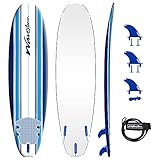


Our Top Picks


Top 3 picks at a glance
What makes a surfboard beginner-friendly?
Beginner stability comes from more than length. A suitable board combines enough volume to float you, generous width for balance, a broad nose for early wave entry, and a forgiving construction that reduces injury and damage during inevitable falls.
- Volume: Determines flotation and how easily the board paddles. More volume is usually better for a first board.
- Length: Adds glide and makes catching small waves easier. Longer boards also track more predictably.
- Width: Improves side-to-side stability, especially while standing and trimming.
- Construction: Soft tops are safer and more durable for learning. Fiberglass boards are lighter and more responsive but less forgiving.
- Fin setup: A single fin or wide-set soft-board setup is stable and easy to control. Performance thrusters turn more sharply but feel less steady.
- Shape: A fuller outline and flatter rocker help beginners paddle and catch waves before they learn precise positioning.
Choose volume before brand or graphics
A useful beginner target is approximately 1.0–1.5 liters of board volume for every kilogram of body weight. New surfers who are older, less athletic, or learning in weak waves should stay toward the upper end. Children and lightweight, athletic beginners may be comfortable nearer the lower end, provided the board remains wide and stable.
For example, a 75 kg beginner can calculate a practical starting range like this:
75 kg × 1.2–1.4 L/kg = 90–105 liters
That does not mean a 100-liter board is automatically correct. A 9-foot board with 100 liters may feel stable and glide well, while a narrow 7-foot board with similar volume can feel noticeably more difficult. Volume should be considered alongside width, length, and distribution. A board with volume concentrated under the chest is especially helpful for paddling and wave entry.
Beginner surfboard decision matrix
| Surfer and conditions | Recommended size | Useful construction | Fin setup | Why it works |
|---|---|---|---|---|
| Adult under 70 kg, small mellow waves | 7’6″–8’0″, 60–85 L, at least 22″ wide | Soft-top foam | 2+1 or soft thruster | Enough glide without feeling excessively long |
| Adult 70–90 kg, first board | 8’0″–9’0″, 75–105 L, 23″–25″ wide | Soft-top foam | Three-fin soft setup or 2+1 | Strong balance of flotation, safety, and wave-catching ability |
| Adult over 90 kg or low-fitness beginner | 8’6″–9’6″, 90–120+ L, broad tail and nose | Thick soft-top or durable epoxy | Wide-set thruster or 2+1 | Extra volume prevents sinking during paddling and standing |
| Child or small teenager | 6’6″–8’0″, roughly 45–75 L | Soft-top foam | Soft fins, usually thruster | Short enough to control while retaining a stable platform |
| Beginner progressing toward turns | 7’0″–8’0″ funboard, 50–80 L | Epoxy or reinforced soft-top | 2+1 or thruster | More maneuverable without jumping to an unstable shortboard |
Best beginner surfboard types
8- to 9-foot soft-top longboards
These are the safest default for most adults. They paddle efficiently, catch weak waves early, and provide enough deck area to practice standing, trimming, and foot placement. A model such as the Wavestorm 8ft is a familiar example of this category; the important characteristics are its soft deck, broad outline, and high flotation rather than the logo.
Choose this class if you are learning in small beach-break waves, taking lessons, or want the highest probability of standing up during your first sessions. The trade-off is slower turning and more awkward transport than a shorter board.
7- to 8-foot funboards and mini-malibus
A funboard is a good second step or a sensible first board for a lightweight, coordinated adult. It offers more maneuverability than a traditional 9-footer while keeping a rounded nose, moderate width, and generous volume. The Softech Roller and NSP Elements Funboard are examples of established board lines in this general category, although exact dimensions vary by model year and size.
Do not choose a funboard merely because it looks closer to an advanced board. If it is narrow, thin, or below your volume target, it may turn a manageable learning curve into repeated missed waves.
Foam shortboards
Shorter foam boards can work for teenagers, lightweight surfers, or beginners with strong balance who have consistent access to small, clean waves. They are generally less stable while paddling and standing, so they require better positioning and more precise pop-ups. They are not the best universal first choice for a larger adult.
Hard epoxy funboards
Epoxy boards are lighter, more responsive, and often more durable against pressure dents than traditional fiberglass boards. However, their hard rails and fins demand better awareness around other surfers. They make sense when you already surf regularly, have learned basic control, and want one board to carry you beyond the earliest stage.
Match the board to wave conditions
For weak waves below waist to chest height, prioritize length, volume, and a flatter rocker. These features help the board accelerate before the wave becomes steep enough to lift you. A wide 8- or 9-foot soft-top is usually more useful than a sleek shortboard.
For steeper beach breaks, a little more rocker can prevent the nose from catching, but excessive rocker makes paddling harder. A mid-length funboard around 7’6″–8’6″ can be a practical compromise once you can reliably stand and ride straight.
For crowded surf, soft construction and rounded edges reduce the consequences of contact. You should still follow local etiquette, leave space, use a leash, and avoid taking a large board into conditions beyond your control.
How fin setup changes learning
- Single fin: Smooth and directionally stable, but slower to pivot. It suits relaxed trimming and traditional longboard technique.
- 2+1: A large center fin with smaller side fins gives stability with moderate turning ability. It is a strong progression setup.
- Thruster: Three fins provide predictable grip and turning. On a soft beginner board, this is usually easy to control; on a narrow hard board, it can expose balance problems.
- Soft fins: Preferable for new surfers because they reduce injury risk during falls and board handling.
Beginners should avoid treating fin count as a performance upgrade. A larger, stable board with a simple fin setup will teach wave timing more effectively than a small board with expensive fins.
Construction: soft-top versus hard board
A soft-top is the best choice for most first sessions because the deck is forgiving during a knee or shoulder impact, the rails are less hazardous, and minor collisions are less likely to cause serious damage. Look for a waterproof foam deck, a firm internal stringer, a strong leash plug, and fins that remain secure without sharp exposed edges.
Inspect a used soft board for waterlogged foam, delamination, cracked fin boxes, and a loose leash plug. A soft surface can hide structural problems, so flex the board gently and check whether it twists or feels unusually heavy.
Move to a hard epoxy or fiberglass board when you can consistently catch unbroken waves, stand without immediately falling, control your direction, and avoid dropping the board near other people. For many surfers, that transition happens after the first board has become easy rather than after an arbitrary number of lessons.
Common sizing mistakes and fixes
The board is too short
Symptoms: You miss waves despite paddling hard, the nose sinks during takeoff, and the board wobbles as soon as you stand. Fix: Add length and volume before changing fins. An extra 6–12 inches can improve glide substantially.
The board is long but narrow
Symptoms: It paddles well but rolls from rail to rail when you stand. Fix: Choose a wider outline, ideally around 23–25 inches for an average-size adult beginner, rather than simply adding more length.
The board is too large for the waves
Symptoms: You catch waves easily but cannot control the board in steeper sections or turn without burying a rail. Fix: Keep the same basic stable shape but step down gradually—perhaps from a 9-foot board to an 8-foot funboard—after developing reliable pop-ups.
The board feels unstable despite enough liters
Symptoms: The listed volume looks suitable, yet the board tips easily. Fix: Check where the volume is located. A narrow tail, thin rails, or a high-performance outline can feel less stable than a wider foam board with fewer liters.
Buying checklist
- Calculate a target of about 1.0–1.5 L per kilogram of body weight.
- Prefer a broad, rounded outline and moderate or flat rocker.
- Choose an 8- to 9-foot soft-top if you are an average-size adult starting from zero.
- Confirm the board has compatible fins, a leash plug, and a leash rated for its length.
- Check that the board fits your vehicle, storage space, and local break conditions.
- Buy a slightly oversized board for progress, not a small board you hope to grow into.
The best beginner surfboards make wave timing and balance easier while leaving room to improve. For most first-time adults, that means a durable 8- or 9-foot soft-top with roughly 75–105 liters, a width near 23–25 inches, and a forgiving fin setup. Once you can catch waves consistently and control your direction, move down in small steps rather than replacing stability with frustration.
Frequently asked questions
Is a soft-top board safer for someone learning to surf?
Yes, a soft-top is generally the best first choice because its deck is forgiving during knee or shoulder impacts, and its rails are less hazardous during falls and minor collisions. Look for a waterproof foam deck, a firm internal stringer, a strong leash plug, and fins without sharp exposed edges. You should still leave space around other surfers and use a leash.
How do I know when to move from a beginner board to a hard board?
Move to a hard epoxy or fiberglass board when you can consistently catch unbroken waves, stand without immediately falling, control your direction, and avoid dropping the board near other people. The transition does not need to happen after an arbitrary number of lessons. It can happen when your first board feels easy rather than while you are still struggling with basic control.
Should a beginner choose a single fin, 2+1, or thruster setup?
A 2+1 setup is a strong progression choice because it combines a large center fin with smaller side fins for stability and moderate turning ability. A single fin is directionally stable but pivots more slowly, while a thruster provides predictable grip and turning. On soft beginner boards, a thruster is usually easy to control; on narrow hard boards, it may expose balance problems.
What should I check when buying a used soft surfboard?
Check the used soft board for waterlogged foam, delamination, cracked fin boxes, and a loose leash plug. Flex it gently to see whether it twists or feels unusually heavy, since a soft surface can hide structural problems. Also inspect the fins and deck for secure construction. A strong leash plug and fins without sharp exposed edges are useful features for learning.
Can a beginner use a smaller board in small, clean waves?
Yes, but shorter foam boards are most suitable for teenagers, lightweight surfers, or beginners with strong balance who consistently access small, clean waves. They are less stable while paddling and standing and require better positioning and more precise pop-ups. For most adults, especially larger beginners, a wide 8- or 9-foot soft-top provides a more reliable learning platform.