The Short Answer
Yes — server-style Scythe air coolers are absolutely worth it over an AIO for most builders, with one condition: your case and RAM clearance have to accommodate a large dual-tower heatsink. If you have roughly 160mm of CPU cooler height clearance and standard-height memory (or enough offset), a cooler like the Scythe Fuma 3If you’re limited to a low-profile case, want maximum RAM clearance, or simply prefer the aesthetics of liquid cooling, the AIO remains a reasonable pick.
What You Actually Get
Let’s compare the two products head to head, because this is really a question about air versus closed-loop liquid cooling at the same performance tier.
As an Amazon Associate we earn from qualifying purchases at no extra cost to you.

The Scythe Fuma 3 is a dual-tower air cooler standing approximately 154mm tall, with a black top cover, six heatpipes, and dual 120mm fans in a push-pull configuration. It supports Intel LGA1700 and LGA1151 sockets plus AMD AM5/AM4. It weighs a bit over 1kg once mounted, so you’ll want to use the included backplate rather than relying on the stock retention clips. The offset twin-tower design means the front tower sits slightly forward, which helps it clear RAM slots in most boards — but tall RGB memory sticks can still interfere depending on your motherboard layout.
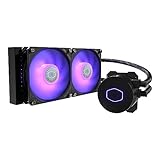
The CoolerMaster MasterLiquid ML240L RGB V2 is a closed-loop AIO with a 240mm radiator, a Gen3 dual-chamber pump, and two SickleFlow 120 PWM ARGB fans. It supports the same sockets (AM5/AM4, LGA1700/1200). The radiator is roughly 277 x 120 x 27mm, and the pump head adds an addressable RGB element to your build. You’ll need mounting space for the radiator — typically a 240mm fan mount at the top or front of your case — and the tubes take up some cable-routing and clearance planning.
In practical terms, both coolers handle something in the neighborhood of 200-250W of sustained thermal load well enough to keep modern mainstream CPUs (Ryzen 7 / Ryzen 9 non-X, Intel Core i5/i7 class chips) in check under normal workloads. Neither is a real bottleneck for gaming or content creation at this tier; the differences are in noise, longevity, cost, and installation.
Pros
- Longer usable life. A quality air cooler works for a decade and can carry over across multiple builds. Most AIOs are warrantied for around five to six years and slowly lose coolant over time.
- Equal or better sustained cooling. Dual-tower air coolers at this class routinely match 240mm AIOs in sustained thermal performance, especially in noise-normalized testing.
- Zero-maintenance installation risk. No radiator mounting, no tube routing, no worry about pump placement relative to the loop.
- Fail-safe behavior. When an air cooler fails, your PC shuts down from heat. When an AIO pump fails, it can fail slowly and degrade performance for weeks before you notice.
- Quieter at idle. No pump hum — just two PWM fans that can spin down completely at low load.
Cons
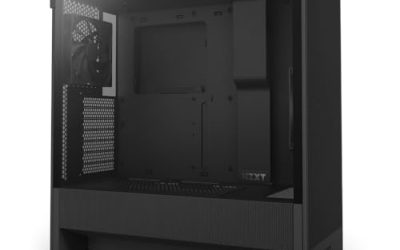
- Case clearance. At roughly 154mm tall, the Fuma 3 needs a mid-tower case with documented CPU cooler clearance of 155mm or more. Many compact and mid-tower cases won’t fit it.
- RAM height limitations. Dual-tower coolers can overhang the first RAM slot. Standard-height sticks are fine; tall heat-spreader or RGB modules may not be, depending on your board.
- Weight on the motherboard. Over 1kg of hanging mass means you should always use the backplate mount and avoid moving the case with the cooler cantilevered.
- Less dramatic aesthetics. The Fuma 3’s black top cover looks clean, but it won’t deliver the RGB showcase the SickleFlow ARGB fans and illuminated pump provide.
- Blocks the view of your build. A large tower cooler dominates the center of the case; an AIO keeps the socket area open.
- Slightly worse in airflow-restricted cases. AIOs can exhaust heat directly out the rear or top of the chassis, while a tower cooler dumps heat into internal case air.
Who Should Buy It
Buy the Scythe-style air cooler if you’re building a mainstream gaming or productivity PC in a mid-tower or full-tower case with at least 155mm of cooler clearance. It’s also the right call if you’re pairing it with a 65W to 150W class CPU where the extra headroom of a 360mm AIO would be wasted anyway.
Who Should Skip It
Skip the air cooler and go AIO if you have a compact case with limited CPU cooler height but a 240mm radiator mount, if you’re running very tall RGB RAM that won’t clear the towers, or if you want the front-of-case radiator to act as an intake for looks and airflow.
Cheaper Alternatives
| Option | Cost | Trade-off |
|---|---|---|
| Scythe single-tower cooler (e.g., compact 120mm models) | Check on Amazon | Lower thermal capacity; fine for 65W CPUs, limits you on 100W+ chips and boost behavior |
| Quality 120mm/140mm single-fower dual-tower from competing brands | Check on Amazon | Comparable performance to the Fuma 3; check clearance and RAM offset before buying |
| Your CPU’s stock cooler (AMD Wraith-class) | Check on Amazon | Adequate only at idle and light loads; noisy and thermally limiting for anything above 65W |
| Used or previous-generation dual-tower coolers | Check on Amazon | No warranty and you must verify socket mounts (AM5 and LGA1700 kits) are included |
FAQ
Do server-style Scythe coolers actually outperform 240mm AIOs?
They perform on par in most mainstream builds. Dual-tower air coolers like the Fuma 3 are competitive with 240mm AIOs on sustained thermals and often quieter at matched noise levels. Only when you move to 360mm AIOs or very high-wattage CPUs does liquid cooling pull clearly ahead.
Will a dual-tower cooler fit with tall RGB RAM?
It depends on your motherboard and the cooler’s front-tower offset. The Fuma 3’s offset design helps, but if your first RAM slot sits directly under the front tower, modules taller than roughly 32–40mm may not clear it. Check your motherboard’s layout and the cooler’s published clearance before buying.
How long does an AIO last compared to an air cooler?
Most AIOs carry a five-to-six-year warranty and slowly lose coolant through permeation over time. A quality air cooler has no consumables — fans and mounts aside, the heatsink itself effectively lasts forever and can move between builds for a decade or more.
Yes, in specific cases: compact builds with radiator mounts but low cooler clearance, showcase builds where ARGB matters to you, and cases where front-mounted radiator intake improves component cooling. If none of those apply, the air cooler is the smarter buy in 2026 just as it has been for years.