Our Top Picks


Top 3 picks at a glance
The Short Answer
For a 200W CPU, you need 6 to 8 heat pipes for reliable air cooling. Four heat pipes are designed for 125W to 180W and will struggle to keep a 200W processor from thermal throttling under sustained load. Six heat pipes with a 120mm fan is the practical minimum for 200W, while eight heat pipes gives you the headroom for overclocking, high ambient temperatures, and quieter operation. In 2026, most 200W-rated air coolers pair 6x6mm heat pipes or 4x8mm heat pipes with a dense aluminum fin stack and at least one 120mm PWM fan.
Diameter matters as much as count. A standard 6mm heat pipe carries approximately 30W to 40W of heat, while an 8mm pipe carries 45W to 55W. That is why a 4-pipe cooler with thicker 8mm pipes can be rated for 200W, but a 6-pipe or 8-pipe design with 6mm pipes will run cooler and quieter at the same wattage. For a true 200W load like an Intel Core i9-14900K or AMD Ryzen 9 9950X at full all-core load, choose a cooler explicitly rated for 200W TDP or higher, not one that simply lists a compatible socket.
As an Amazon Associate we earn from qualifying purchases at no extra cost to you.


Standard Sizes
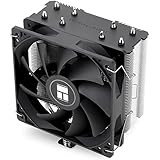
Heat pipe CPU coolers are sized by cooler height, fin stack dimensions, heat pipe count and diameter, and fan size. Height is the critical measurement because it must clear your case’s CPU cooler clearance spec. The table below shows common size classes you will see when shopping for a 200W-capable air cooler.
| Cooler Class | Heat Pipes | Pipe Diameter | Cooler Height | Fin Stack (W x D) | Fan Size | Typical Weight | Rated TDP |
|---|---|---|---|---|---|---|---|
| Compact Single-Tower (120mm) | 4 | 6mm (0.24 in) | 5.71 in / 14.5 cm | 4.92 x 2.05 in / 12.5 x 5.2 cm | 1x 120mm | 1.32 lb / 600 g | 125W – 180W |
| Standard Single-Tower (120mm) | 5 | 6mm (0.24 in) | 6.10 in / 15.5 cm | 4.92 x 2.83 in / 12.5 x 7.2 cm | 1x 120mm | 1.65 lb / 750 g | 180W – 210W |
| Performance Single-Tower (120mm) | 6 | 6mm (0.24 in) | 6.18 in / 15.7 cm | 5.08 x 2.95 in / 12.9 x 7.5 cm | 1x 120mm or 1x 140mm | 1.87 lb / 850 g | 200W – 230W |
| Dual-Tower (120mm) | 6 | 6mm (0.24 in) | 6.22 in / 15.8 cm | 5.51 x 5.31 in / 14.0 x 13.5 cm | 2x 120mm | 2.43 lb / 1100 g | 220W – 260W |
| Heavy-Duty Single/Dual-Tower | 7 – 8 | 6mm (0.24 in) | 6.22 – 6.30 in / 15.8 – 16.0 cm | 5.12 x 3.15 in / 13.0 x 8.0 cm (single) / 5.51 x 5.51 in / 14.0 x 14.0 cm (dual) | 1x 120mm or 2x 120mm | 2.20 – 2.87 lb / 1000 – 1300 g | 240W – 280W |
| Thick-Pipe Single-Tower | 4 | 8mm (0.31 in) | 6.10 – 6.22 in / 15.5 – 15.8 cm | 5.08 x 2.95 in / 12.9 x 7.5 cm | 1x 120mm or 1x 140mm | 1.98 lb / 900 g | 200W – 220W |
Price tracks closely with this sizing.
How to Measure Your Space
An 8-pipe cooler will not help if it does not fit your case or blocks your RAM. Measure before you buy.
- Check case CPU cooler clearance. Find your case spec sheet and note the maximum CPU cooler height, usually listed as CPU Clearance or CPU Cooler Height. Most mid-towers allow 6.10 to 6.69 in (15.5 to 17.0 cm). Compact cases may only allow 5.90 in (15.0 cm) or less.
- Measure from CPU to side panel. With the side panel off, measure from the top of the CPU heat spreader to the inside edge where the side panel sits. Subtract 0.20 in (5 mm) for fan clip and heat pipe cap clearance. Your cooler height must be under this number.
- Measure RAM clearance. Measure from the center of the CPU socket to the first RAM slot, typically 1.18 to 1.50 in (30 to 38 mm). Single-tower coolers with asymmetrical fin stacks or recessed front fins offer full memory clearance. Dual-tower coolers often overhang RAM and require low-profile RAM under 1.34 in (34 mm) tall.
- Measure motherboard and PCIe clearance. From the socket center to the top PCIe slot is usually 2.0 to 3.0 in (50 to 76 mm). A wide dual-tower at 5.51 in (14.0 cm) wide can press against a top M.2 heatsink or the backplate of a large GPU. Check the cooler’s length and width against your board layout.
- Confirm fan and case airflow. A 120mm fan is 4.72 in (12.0 cm) square and 0.98 to 1.0 in (25 mm) thick. If you add a second fan for push-pull, add another 1.0 in (25 mm) to total depth. Make sure your case has at least 1.0 in (2.5 cm) between the cooler’s top and the side panel for exhaust.
- Weigh the load. Coolers over 2.20 lb (1000 g) put significant stress on the motherboard. Use the included backplate and ensure your case will stay upright during moves. For heavy dual-towers over 2.43 lb (1100 g), avoid frequent transport without additional support.
By Room or Use Case
Your case size and workload determine whether you need 6 pipes, 8 pipes, or a different cooling approach altogether.
Compact Mid-Tower Gaming Build (ATX with 6.10 to 6.50 in / 15.5 to 16.5 cm clearance)
This is the most common scenario for a 200W CPU. Choose a 6-heat-pipe single-tower that is 6.10 to 6.18 in (15.5 to 15.7 cm) tall with a single 120mm PWM fan. Look for 6x6mm pipes, four to five direct-contact or nickel-plated copper base, and a fin stack around 5.08 x 2.95 in (12.9 x 7.5 cm). This handles gaming and mixed workloads at 200W while keeping noise under 30 dBA with a tuned fan curve. If you want lower noise at full load, choose the same cooler with a second fan mount and add a matching 120mm fan later.
Full Tower or Large Airflow Case (6.50 in / 16.5 cm clearance or more)
With extra height, a dual-tower 6-pipe or 8-pipe cooler is the best fit for sustained 200W loads like rendering, compiling, or streaming while gaming. A dual-tower with 6x6mm pipes measures about 6.22 in tall (15.8 cm) and 5.51 x 5.31 in (14.0 x 13.5 cm) across the two towers, weighs 2.20 to 2.87 lb (1000 to 1300 g), and uses two 120mm fans. An 8-pipe single-tower is a good alternative if you want similar thermal headroom with better RAM visibility.
Small Form Factor and Low-Clearance Cases (Under 6.10 in / 15.5 cm clearance)
Most coolers tall enough for 200W will not fit here. If your case only allows 5.31 to 5.90 in (13.5 to 15.0 cm), you cannot fit a standard 6-pipe tower. A 4-pipe low-profile or 92mm tower cooler will thermal throttle a 200W CPU. For these cases, a 240mm or 280mm all-in-one liquid cooler is a better choice than trying to force a smaller air cooler. If you must use air, limit CPU power to 125W to 150W in BIOS and choose a top-down cooler with at least 5 heat pipes, understanding you will not sustain 200W.
Workstation, Overclocking, and Hot Ambient Rooms
For all-core workloads that hold 200W for minutes at a time, or rooms above 77 degrees F (25 degrees C), target 7 to 8 heat pipes. An 8x6mm cooler with a dense fin stack and a 120mm fan at 1500 to 1800 RPM provides the most thermal mass and surface area in air cooling. Pair it with good case airflow: two front 140mm intake fans and one rear 120mm exhaust fan minimum. If your CPU regularly exceeds 200W with power limits removed, consider a 280mm or 360mm liquid cooler instead of chasing more heat pipes.
Common Sizing Mistakes
Counting pipes without checking diameter. Four 8mm pipes can outperform six thin 6mm pipes on paper, but the fin area and base quality matter just as much. A cheap 6-pipe cooler with thin aluminum fins and a rough base can perform worse than a well-built 6-pipe from a reputable brand. Always check the rated TDP and cooler dimensions, not just pipe count.
Ignoring cooler height. The most common return reason is buying a 6.22 in (15.8 cm) tower for a case that only allows 6.10 in (15.5 cm). The side panel will not close, or the heat pipe caps will press against tempered glass. Verify clearance before ordering.
Forgetting RAM and motherboard heatsinks. Tall RGB RAM at 1.73 to 1.81 in (44 to 46 mm) will collide with wide fin stacks. If you have tall RAM, choose a cooler that specifies full memory clearance or an asymmetrical design that is offset away from the RAM slots.
Assuming more pipes equals proportional cooling. Going from 4 to 6 pipes yields a large drop in temperatures at 200W. Going from 6 to 8 yields a smaller improvement, often 3 to 6 degrees C, and comes with extra weight and size. Beyond 8 pipes, the base cannot feed all pipes evenly unless the design uses a large vapor chamber or wide copper plate, so the benefit plateaus.
Mixing TDP ratings with actual power draw. Intel and AMD TDP numbers are not the same as peak power. A CPU listed as 125W TDP can draw 200W under load with power limits disabled. Size your cooler for the actual sustained power you will allow in BIOS, which you can check with HWInfo or similar monitoring software under a stress test.
Using the wrong mounting pressure. Air coolers need even mounting pressure to make full contact. An improperly tightened mount leaves a gap that no number of heat pipes can overcome. Follow the torque sequence in the manual and use a pea-sized amount of thermal paste in the center of the CPU.
FAQ
Is 6 heat pipes enough for a 200W CPU?
Yes, 6x6mm heat pipes are enough for 200W in a well-ventilated case when paired with a full-size single-tower or dual-tower and a 120mm PWM fan rated for 1500 RPM or higher. Six pipes is the sweet spot for price, size, and noise. Choose 8 pipes only if you want quieter operation at 200W or you run sustained all-core workloads where the CPU stays at 200W for long periods.
Can a 4-heat-pipe cooler handle 200W?
Only if it uses four thick 8mm heat pipes and is explicitly rated for 200W by the manufacturer, and even then it will run hotter and louder than a 6-pipe design. It will thermal throttle under sustained load and require maximum fan speed to stay under 95 degrees C.
What size air cooler do I need for 200W in inches and centimeters?
Plan for a cooler at least 6.10 in (15.5 cm) tall with a fin stack around 5.0 x 2.9 in (12.7 x 7.4 cm) or larger, equipped with 6 or more 6mm heat pipes or 4 or more 8mm heat pipes, and a 120mm or 140mm fan. Total weight will be 1.65 to 2.87 lb (750 to 1300 g) depending on single-tower versus dual-tower. Always confirm your case supports the cooler’s height plus 0.20 in (5 mm) of clearance.
Should I get an air cooler or liquid cooler for 200W?
A 240mm liquid cooler offers similar performance in a smaller footprint over the CPU, while a 280mm or 360mm liquid cooler gives more headroom if you want to exceed 200W or run very quiet. For most users in a mid-tower with good airflow, a 6-pipe air cooler is the simplest and most reliable choice for 200W. Consider liquid cooling if your case is too small for a 6.10 in (15.5 cm) tower or you plan to sustain over 230W.