Our Top Picks

The Short Answer
Yes, Noctua fans are worth the premium price for most PC builders — with one condition: you need to actually care about noise. But if you’re building a quiet workstation, a living-room PC, a home theater setup, or anything where fan noise reaches your ears during quiet moments, Noctua’s engineering genuinely delivers. The premium isn’t marketing fluff; it’s measurable in noise-normalized airflow, bearing quality, and mounting hardware you don’t get elsewhere.
What You Actually Get
As an Amazon Associate we earn from qualifying purchases at no extra cost to you.
Acoustic engineering. Noctua fans use features like inlet side spacers, stepped frame designs, and specially shaped blade tips that reduce turbulence noise. The company’s fans routinely hit noise levels in the low 20s of decibels at moderate speeds — quiet enough to disappear in a normal room.
SSO2 bearing technology. Noctua’s self-stabilizing oil-pressure bearings come with a six-year warranty on most models. Budget fans typically offer one to three years. That warranty alone tells you something about expected lifespan.
Accessories that actually matter. Open a Noctua box and you’ll find anti-vibration mounts, low-noise adapters, extension cables, a y-cable on some models, and often mounting screws for radiators or case positions.
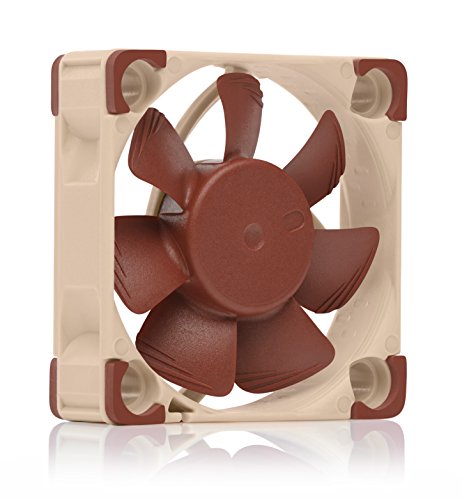
Consistency at every size. Noctua’s lineup runs from tiny 40mm fans up through 200mm, so you can match the same quality across an entire build. Take the NF-A4x10 FLX, a 40mm slim fan measuring just 10mm thick — useful for cramped small-form-factor cases, VRM cooling, or 3D printer enclosures.
Slim options for tight builds. The NF-A12x15 PWM is a 120mm fan only 15mm thick, compared to the standard 25mm thickness. When you need a slim fan, Noctua’s quiet operation at constrained dimensions is nearly unmatched.
Pros
- Exceptional noise-to-airflow ratio. At the same noise level, Noctua fans typically move more air than budget competitors — or run quieter while moving the same air.
- Six-year warranty on most models, backed by responsive customer support that has a long track record of honoring it.
- Excellent PWM control. Noctua fans ramp smoothly and predictably with motherboard fan curves, avoiding the abrupt speed jumps that make cheap fans noticeable.
- Rich accessory bundles that effectively reduce the real-world price premium.
- Proven long-term reliability. Units routinely run for many years without bearing noise developing.
- Full size range, from 40mm oddities like the NF-A4x10 to standard 120mm and 140mm case fans, all with consistent quality.
- Strong resale value — used Noctua fans hold their price far better than generic brands.
Cons
- The color scheme. The signature beige-and-brown brown-and-tan palette clashes with RGB-focused builds. Noctua’s chromax.black line fixes this but usually costs a few dollars more.
- Overkill for hidden builds. If fans are inaudible anyway, you’re paying for a benefit you can’t perceive.
- Modest raw airflow champions. If your priority is maximum static pressure or CFM regardless of noise, some competitors match or beat Noctua at lower prices.
- Aesthetics of simplicity. No RGB, no flashy design — some buyers want their fans to look as good as they perform.
Who Should Buy It
Buy Noctua fans if you work in silence, record audio, keep your PC on your desk, build small-form-factor systems, or simply hate fan noise. They’re also the right call when you need a niche form factor — a 15mm-thick 120mm fan like the NF-A12x15 or a tiny 40mm unit like the NF-A4x10 — where quality options are scarce and a bad fan is very noticeable. Builders who keep a system for five or more years also get excellent value from that six-year warranty.
Who Should Skip It
Skip Noctua if your case sits on the floor under a desk, if you game with a headset on, or if you’re building a budget PC where every dollar needs to go toward the GPU. Skip it too if you’re running an aggressive RGB build on a tight budget — mid-tier fans from reputable brands hit a very reasonable 80–90% of Noctua’s acoustic performance for half the price. And if you’re filling a server rack in a basement, silence is irrelevant; buy whatever’s cheap and in stock.
Cheaper Alternatives
| Option | Cost | Trade-off |
|---|---|---|
| Mid-tier mainstream fans (120mm, from major accessory brands) | Varies | Around 80–90% of Noctua’s quiet performance; shorter warranties (1–3 years); fewer included accessories; PWM behavior can be less smooth. |
| Generic budget fans (120mm multipacks) | Varies | Noticeably noisier under load, inconsistent bearings, minimal accessories — acceptable only for builds where noise doesn’t matter. |
| Generic slim 120mm fans (15mm class) | Varies | Solves the same fitment problem as the NF-A12x15 at a lower price, but slim fans amplify whine, and cheap units get loud quickly under load. |
| Generic 40mm fans | Varies | Fits the same cramped spaces as the NF-A4x10, but 40mm is the hardest size to make quiet — expect a high-pitched hum under load. |
FAQ
How much more do Noctua fans cost than regular fans?
Expect to pay roughly double to triple the price of a decent budget fan.
Do Noctua fans really last longer?
The six-year warranty is the strongest signal. Noctua backs most of its fans for six years of rated operation at up to around 150,000 hours MTBF figures cited across its lineup — far beyond the one- to three-year coverage common elsewhere. Real-world reports of decade-old Noctua fans still running quietly are common.
Does the brown color matter for a build?
Only aesthetically. The classic beige-and-brown scheme looks out of place in RGB-heavy systems. Noctua offers chromax.black versions with all-black frames and blades for builds where appearance matters, typically at a small price premium over the standard versions.
Are Noctua fans still worth it for small form factor builds?
Arguably more so. In compact cases, airflow is constrained and fans often run at higher speeds to compensate, which makes cheap fans louder faster. Specialized models like the 15mm-thick NF-A12x15 PWM and the 40mm NF-A4x10 FLX solve fitment problems with the noise control that cramped builds need most. As small-form-factor builds continue trending into 2026, these niche models remain some of Noctua’s most defensible purchases.