Delidding a CPU — removing the integrated heat spreader to replace Intel’s factory solder or paste with something better — is one of those upgrades that sounds extreme until you’ve done it once. After that, the real question becomes practical, not technical: what should you put between the bare die and your cooling block? Liquid metal and conventional thermal paste each make a legitimate case, and the gap between them is narrower than forum threads suggest. The difference shows up in temperature, yes, but also in how much maintenance you’re signing up for and how much risk you’re comfortable living with inside a machine that sits in your living space.
Here’s an honest breakdown for home users who’ve already taken the delidding leap or are seriously considering it.
As an Amazon Associate we earn from qualifying purchases at no extra cost to you.


Our Top Picks



Top 3 picks at a glance
Quick Verdict
If you’re chasing every last degree for an aggressive overclock and you don’t mind reapplying material every year or two, liquid metal delivers. Expect roughly 5–15°C better die-to-cooler transfer than good paste on a delidded chip, because liquid metal (a gallium-based alloy) fills microscopic gaps far better than any paste. If you want to install it once, forget about it, and never worry about it shorting a component, quality thermal paste is the smarter call for most households. The performance penalty is real but modest; the safety and maintenance advantages are not. For the majority of delidded CPUs in home desktops, a 13 W/m·K paste like the HiSolo kit hits the sweet spot.
Side by Side
| Factor | Liquid Metal | Thermal Paste |
|---|---|---|
| Typical temp improvement | Best; roughly 5–15°C better than mid-grade paste on a delidded die | Good; a 13 W/m·K paste loses a few degrees to liquid metal but beats factory material |
| Comfort of use | Intimidating; electrically conductive, must be applied precisely | Forgiving; mistakes wipe off with isopropyl alcohol |
| Risk if it spills | Severe — can short capacitors and traces permanently | Minimal — most pastes are non-conductive or only capacitively risky |
| Durability | Can dry out or “pump out” over 12–24 months; gallium can alloy with aluminum | Typically stable 3–5 years before a refresh is worthwhile |
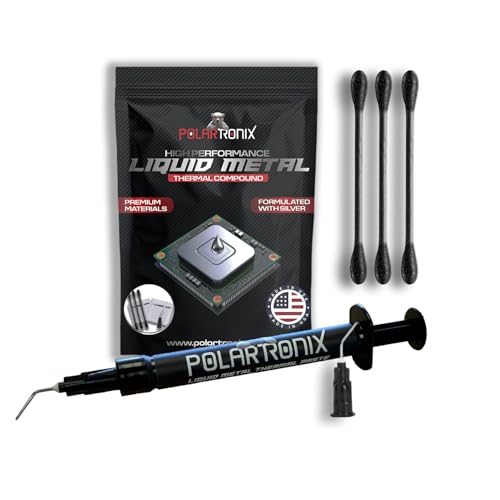
| Price range | About $13–15 per gram (Conductonaut at around $14; PolarTronix at around $12) | Roughly $3–6 per application; HiSolo’s 8g two-pack is around $3 |
| Maintenance | Annual inspection and reapplication recommended | Set and forget for years |
| Quantity needed per delid | Very thin layer; 1 gram covers 2–4 delidding jobs | A rice-grain dot; 1.8g covers dozens of applications |
| Space and storage | Syringe plus sealant/cotton swabs; keep away from aluminum coolers | Small tube or tub, no special handling |
| Look under the IHS | Mirror-like silver finish that stays liquid | Gray or white layer, dulls slightly over time |
| Best for | Dedicated overclockers and benchmarking rigs | Everyday delidded desktops, HTPCs, and family PCs |
Where Liquid Metal Wins
Temperature is the whole reason people delid, and liquid metal maximizes the payoff. Conductonaut is rated at 73.8 W/m·K thermal conductivity — roughly ten times better than a good 13 W/m·K paste — and on a bare die with direct die contact, that translates into meaningfully lower sustained temperatures under identical load. If your delidded chip was thermal-throttling before, liquid metal can be the difference between a 5.4 GHz all-core overclock that holds and one that folds under a stress test.
It also wins on quantity efficiency. One gram of Conductonaut or PolarTronix is enough for multiple delidding jobs because you apply an extremely thin wetted layer, not a blob. For someone servicing several systems — a gaming rig, a console, a workstation — a single syringe stretches a long way. PolarTronix has found a niche here because PS5 and Series X consoles ship with liquid metal from the factory, so repair-minded users already own the application discipline it demands.
Finally, liquid metal never fully cures, so it maintains consistent contact on a die that expands and contracts with heat cycles. In a well-sealed delid where you’ve re-glued the IHS or run direct-die, that consistency holds better than paste that can pump out of tight gaps over months of thermal cycling.
Where Thermal Paste for Delidded Cpu Wins
Safety comes first, and it’s not close. Liquid metal is electrically conductive — one drop bridging two surface-mount components can kill a motherboard instantly. Paste is forgiving; most formulations are non-conductive, and even a sloppy application rarely causes more than a cleanup session. In a home where you might be working on a carpeted floor with a cat supervising, that margin for error matters.
Longevity is the second win. A quality paste maintains its performance for 3–5 years inside a sealed delid, where there’s no pump-out from mounting pressure changes. Liquid metal inside a delid can oxidize or migrate over 12–24 months, requiring you to crack the seal and redo the job — which, on a delidded chip, means re-sealing or going direct-die again. Over the life of the CPU, that’s real labor.
Cost is almost comical in paste’s favor. Even accounting for paste’s smaller quantity needs, you’re spending a fraction as much.
One caution: never use liquid metal with an aluminum heatsink or cold plate — gallium alloys with aluminum, destroying the contact surface. Any direct-die or delidded build needs a copper or nickel-plated cooler, and paste has no such restriction.
Cost Over 5 Years
Liquid metal route:
Paste route:Reapply every three years and you’ll use perhaps 2 grams total.
Whether that’s worth 5–15°C depends entirely on what your CPU is doing. For a 125 W chip that’s already comfortable, paste is the obvious answer. For a 250 W overclocked monster with an aggressive voltage curve, liquid metal may be the only way to keep it stable through a summer heat wave.
Which One for Your Home
Small Apartment
Space-constrained setups often mean small cases, restricted airflow, and a PC doubling as an entertainment center — all reasons heat matters more. If your delidded CPU runs hot in a compact chassis, liquid metal’s temperature advantage buys quietness: a cooler chip lets fans spin slower, which in a studio apartment you’ll appreciate at midnight. Just do the application at a table, not on the carpet, and keep the syringe capped and upright in a drawer.
Family with Kids and Pets
Go with paste, full stop. A tower PC on the floor is one kicked vacuum away from a bump, and while neither material leaks in normal operation, you don’t want conductive gallium alloy anywhere in a household where a curious toddler might someday see “the shiny computer pieces” during an upgrade. Save liquid metal for when the kids are older or the PC lives behind closed doors.
Rental
If you’re renting, you’re likely in a shared or temporarily owned space with modest cooling and no long-term stake in extreme tuning. Paste is the pragmatic pick: cheap, safe, and if you move or sell the machine, nothing exotic needs explaining. A moderate delid-plus-paste improvement (often 5–10°C over factory Intel material) is a great rental-friendly project.
Long-Term Home
This is where liquid metal earns its keep. By 2026, delidding remains one of the best value-per-degree mods available for certain Intel chips, and liquid metal is what unlocks its ceiling. Budget for that 18-month touch-up on your calendar and the math works.
FAQ
Can I use liquid metal on a delidded CPU with the IHS glued back on?
Yes, and it’s the most common approach. A thin layer under the re-sealed IHS gives most of the temperature benefit with less exposure risk than direct-die mounting. Use silicone sealant around the die area and make sure your cooler’s contact plate is copper or nickel-plated — never aluminum.
How much liquid metal do I actually need for one delid?
Far less than you’d think: a drop roughly the size of a grain of rice, spread into a thin wetted film on the die.
Does thermal paste on a delidded CPU still beat the factory stuff?
Usually yes. Delidding replaces whatever Intel used under the IHS — often mediocre paste on non-soldered chips — and even a standard 13 W/m·K paste applied carefully typically drops temperatures several degrees versus stock. It won’t match liquid metal, but it captures a good share of the benefit for pocket change.
What happens if liquid metal spills on my motherboard?
Act fast: power off immediately, then soak it up with a cotton swab. Because it’s electrically conductive, any alloy bridging two contacts can short components — sometimes permanently. If it touches aluminum, it chemically bonds and destroys the surface. This is the single strongest argument for paste in any build where a mistake is likely.