The ASUS Dual NVIDIA GeForce RTX 5060 8GB GDDR7 OC Edition is a two-fan, 2.5-slot graphics card aimed at 1080p gaming and lighter 1440p play, and its main limit is the 8GB of video memory. This review uses the listing text and published specifications to cover what the card is, who it fits, the six alternatives in the same set and the checks to run before it goes into your case. It is a model review built on documents, not a lab report.
Our Top Picks
 ASUS Dual NVIDIA GeForce RTX 5060 8GB GDDR7RTX5060|8GB|OC9 x 4.8 x 2 inches1.4 PoundsCheck on Amazon
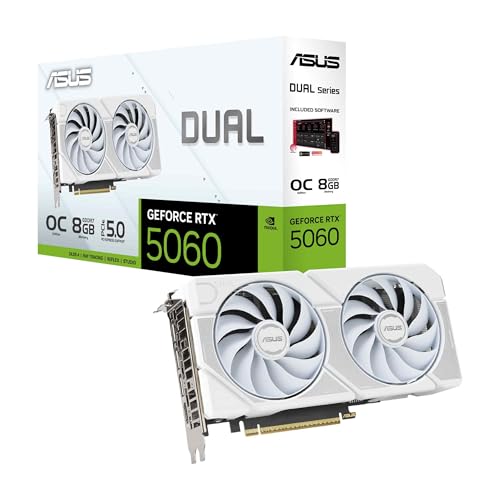 ASUS Dual GeForce RTX 5060 8GB GDDR7 WhiteRTX5060|8GB|OC9 x 4.8 x 0.1 inches2.4 poundsCheck on Amazon
 ASUS Dual GeForce RTX 5050 8GB GDDR6 Gaming8GB (Pack of 1)8 x 4.7 x 1.6 inches1.1 PoundsCheck on Amazon
 ASUS Dual GeForce RTX 5060 Ti 16GB GDDR7RTX5060Ti|OC|16GB9 x 4.7 x 2 inches1.4 PoundsCheck on Amazon
At a glance
ASUS Dual NVIDIA GeForce RTX 5060 8GB GDDR7 OC Edition (PCIe 5.0, 8GB GDDR7, DLSS 4, HDMI 2.1b, DisplayPort 2.1b, 2.5-Slot Design, Axial-tech Fan Design, 0dB Technology), 3 Year Warranty


As an Amazon Associate we earn from qualifying purchases. Product prices and availability are accurate as of the date/time indicated.
ASUS Dual GeForce RTX 5060 8GB GDDR7 White OC Edition Gaming Graphics Card | PCIe 5.0, HDMI 2.1b, DisplayPort 2.1b, 2.5-slot design, Axial-tech Fans, 0dB Technology


As an Amazon Associate we earn from qualifying purchases. Product prices and availability are accurate as of the date/time indicated.

ASUS Dual GeForce RTX 5050 8GB GDDR6 OC Edition Gaming Graphics Card | PCIe 5.0, HDMI 2.1b, DisplayPort 2.1b, 2-slot, Axial-tech Fans, 0dB Technology, Dual BIOS


As an Amazon Associate we earn from qualifying purchases. Product prices and availability are accurate as of the date/time indicated.
ASUS Dual GeForce RTX 5050 8GB GDDR6 Gaming Gaming Graphics Card | PCIe 5.0, HDMI 2.1b, DisplayPort 2.1b, 2-slot, Axial-tech Fans, 0dB Technology, Dual BIOS


As an Amazon Associate we earn from qualifying purchases. Product prices and availability are accurate as of the date/time indicated.
ASUS Dual GeForce RTX 5060 Ti 16GB GDDR7 OC Edition Gaming Graphics Card | PCIe 5.0, HDMI 2.1b, DisplayPort 2.1b, 2.5-slot, Axial-tech Fans, 0dB Technology, Dual BIOS


As an Amazon Associate we earn from qualifying purchases. Product prices and availability are accurate as of the date/time indicated.
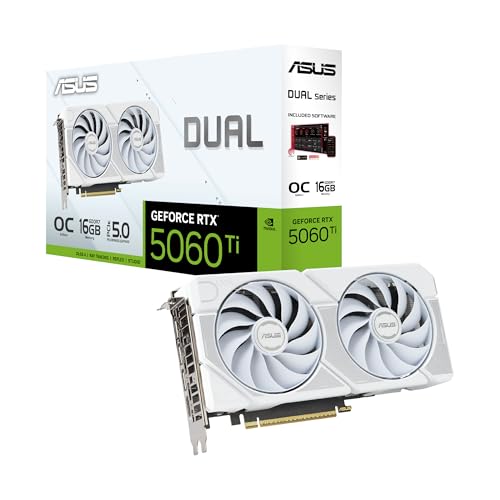
ASUS Dual GeForce RTX 5060 Ti 16GB GDDR7 White OC Edition Graphics Card | PCIe 5.0, HDMI 2.1b, DisplayPort 2.1b, 2.5-slot design, Axial-tech Fans, 0dB Technology


As an Amazon Associate we earn from qualifying purchases. Product prices and availability are accurate as of the date/time indicated.

GIGABYTE GeForce RTX 5060 Ti WINDFORCE OC 8G Graphics Card, 8GB 128-bit GDDR7, PCIe 5.0, WINDFORCE Cooling System, GV-N506TWF2OC-8GD Video Card




As an Amazon Associate we earn from qualifying purchases. Product prices and availability are accurate as of the date/time indicated.
| Item | What the title states |
|---|---|
| Model | ASUS Dual NVIDIA GeForce RTX 5060 8GB GDDR7 OC Edition |
| Memory | 8GB GDDR7 |
| Interface | PCIe 5.0 |
| Features named | DLSS 4, HDMI 2.1b, DisplayPort 2.1b, Axial-tech fan design, 0dB technology |
| Size | 2.5-slot design |
| Warranty | 3 years |
| Price tier | Mid |
Nobody on the team used or measured these units. The basis is published specifications, manufacturer documentation and buyer reviews, and numbers beyond the title are marked as general knowledge, estimates or items to check.
What the card is
The RTX 5060 is a Blackwell-generation graphics card. According to NVIDIA-related spec listings, it has 3,840 CUDA cores and 8GB of GDDR7 on a 128-bit memory bus, with a total graphics power rating of 145W for the reference design. Board partners such as ASUS may set their own clock speeds and power limits for an OC model, so treat the 145W figure as a baseline and confirm on ASUS’s spec page.
The title’s “OC Edition” label means ASUS ships it with a higher boost clock than the reference, usually a small step. The real-world gain from factory overclocks of this type is modest, so do not pay a large premium for the OC badge alone.
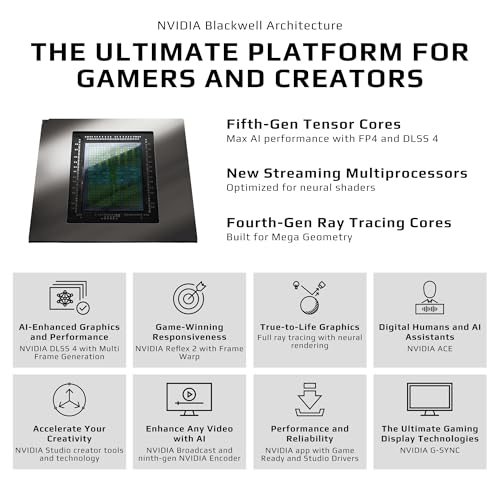
DLSS 4 appears in the title. It covers upscaling and multi-frame generation on RTX 50 cards, and game support varies by title. Frame generation can raise displayed frame rates, but it adds processing and works best when the base frame rate is already decent.
Hardware reading, piece by piece
Cooling and size
The Dual design uses two Axial-tech fans, and the title notes a 2.5-slot thickness, so make sure the case has two empty expansion slots plus a little breathing room, and measure the card’s length against the case from ASUS’s spec page. The 0dB feature stops the fans at light loads, which suits quiet desktops and media machines.
Display outputs
HDMI 2.1b and DisplayPort 2.1b are both listed. That is enough for high-refresh 1440p monitors, and it keeps you ready for newer displays. Confirm the number of each port on the product page, since the title does not state counts.
Memory and the 128-bit bus
GDDR7 raises memory bandwidth over older types for the same bus width, but capacity stays 8GB. Capacity, not bandwidth, is the constraint that shows up when a game asks for more textures than the card can hold.
What the title does not say
- Exact card length and weight.
- Boost clock and board power for this OC model.
- Power connector type and count.
- Whether a support bracket or backplate is included.
Who it suits and who should skip
- It suits: 1080p high-refresh players, first-time builders upgrading an older GTX or RX 5000-era card, and quiet-PC builders who value fan-stop behavior.
- It suits: small-power builds where a 550W supply is already in place.
- Skip if: you play at 1440p with high textures, edit video with large timelines in GPU-accelerated apps, or want to hold the card for many years without lowering settings.
- Skip if: your case offers fewer than 2.5 slots of space.
VRAM limits and what they mean
Video memory is where the 8GB card draws its critics. When a game needs more memory than the card has, data spills over the PCIe bus into system RAM, which is much slower. Symptoms include sudden stutters, textures that load late, or a game that lowers detail automatically. Lowering texture quality one notch usually fixes it.
Here is an illustrative budget, built on assumptions rather than measurements: a modern game at 1440p with high textures asks for about 7GB for textures and buffers, ray tracing adds roughly 1GB, frame generation adds a few hundred megabytes, and Windows plus background apps reserve about half a gigabyte. That sums to about 8.8GB, which is beyond 8GB. Drop the texture setting a notch and the total may fall to about 7.5GB, which fits. The exact numbers vary by game, so read patch notes and community reports for the titles you play.
| Line item (assumed) | Estimated VRAM |
|---|---|
| Textures and buffers, high setting, 1440p | about 7.0GB |
| Ray tracing structures | about 1.0GB |
| Frame generation overhead | about 0.3GB |
| Windows and background apps | about 0.5GB |
| Total | about 8.8GB, over an 8GB card |
| After lowering textures one notch | about 7.5GB, fits |
Power supply math
Assumptions: a mainstream processor with a 105W peak rating, the card at about 145W to 160W depending on the OC model, and 75W for the rest of the system. Totals reach roughly 325W to 340W of peak draw. ASUS and NVIDIA list a 550W recommendation for the class, which leaves room for transient spikes and for a supply that runs best around half load. Our RTX 5060 PSU wattage explainer walks through the method, and the best PSU picks for RTX 5060 and 5060 Ti lists models if you need a new unit.
| Component | Assumed peak |
|---|---|
| Processor, 105W class | about 105W |
| RTX 5060 OC | about 145W to 160W |
| Board, RAM, drives, fans | about 75W |
| Estimated total | about 325W to 340W |
| Recommended PSU per maker guidance | 550W or higher |
Alternatives from the same set
ASUS Dual GeForce RTX 5060 8GB White OC Edition
The same specifications as the subject card with a white shroud. The title lists PCIe 5.0, HDMI 2.1b, DisplayPort 2.1b, a 2.5-slot design, Axial-tech fans and 0dB technology; it does not repeat the 3-year warranty line, so confirm that on the page. It sits at a higher price tier, so you are paying for looks.
- Pros: matches white builds; same performance class as the black card.
- Cons: costs more for appearance only; warranty detail missing from the title.
ASUS Dual GeForce RTX 5050 8GB GDDR6 OC Edition
One class lower. The title lists 8GB of GDDR6, PCIe 5.0, HDMI 2.1b, DisplayPort 2.1b, a 2-slot design, Axial-tech fans, 0dB and Dual BIOS. NVIDIA’s published specs put the RTX 5050 at 2,560 CUDA cores and GDDR6 memory, which is a clear step below the 5060. This listing is a weaker-class card that is not much cheaper in this set.
- Pros: slimmer 2-slot design; Dual BIOS switch.
- Cons: weaker GPU and slower memory type; the price gap to the 5060 is small.
ASUS Dual GeForce RTX 5050 8GB GDDR6 (non-OC)
A near duplicate of the previous listing without the OC wording, and the title repeats the word “Gaming” twice. It sits at the lowest price tier here. Treat the title typo as a prompt to verify the model number on the product page.
- Pros: lowest price in the set; same cooler and features.
- Cons: weaker class again; a messy title raises questions about listing accuracy.
ASUS Dual GeForce RTX 5060 Ti 16GB GDDR7 OC Edition
The step-up card. 16GB of GDDR7 removes the memory ceiling discussed above, and the title lists the same ports, a 2.5-slot design and Dual BIOS. It sits at a higher price tier, and the processor and monitor you own should justify it.
- Pros: 16GB of VRAM; strong 1440p positioning; Dual BIOS.
- Cons: price tier well above the 5060; check the PSU recommendation on ASUS’s page, which may be higher.
ASUS Dual GeForce RTX 5060 Ti 16GB White OC Edition
Same card in white, and the highest price tier in the set. Dual BIOS is not mentioned in this title, though the black version lists it, so verify that if it matters to you.
- Pros: 16GB and a white finish for matching builds.
- Cons: priciest option; extra cost buys appearance only.
GIGABYTE GeForce RTX 5060 Ti WINDFORCE OC 8G
The title lists 8GB, a 128-bit bus, GDDR7, PCIe 5.0 and the WINDFORCE cooling system, model GV-N506TWF2OC-8GD. It is a Ti-class chip paired with only 8GB, so it does not escape the VRAM limit that applies to the subject card. Buyers should compare it against the 16GB Ti and against the plain 5060.
- Pros: Ti-class chip from another brand; mid-to-upper price tier.
- Cons: 8GB of memory on a card that costs more than the base 5060; ports are not listed in the title.
Living with 8GB: a settings plan
If you buy the 8GB card, a simple routine keeps it comfortable. Start every new game at the preset that matches your resolution, then adjust texture quality first, because it is the setting that most directly fills video memory. Shadow quality and ray tracing are the next biggest consumers. Upscaling modes such as DLSS lower the internal render resolution, which reduces memory pressure and raises frame rates at once, and that makes them the first tool to reach for at 1440p.
Many games show a video-memory meter in the graphics menu. Treat that meter as a rough guide, not a guarantee, and watch for stutter during fast turns or when entering new areas, which tends to signal a spill into system memory. Having 32GB of system RAM softens the penalty a little, because the spilled data has more room to sit, but it never matches the speed of onboard memory.
| Setting | Memory impact | First move on an 8GB card |
|---|---|---|
| Texture quality | High | Drop one notch if you see stutter |
| Ray tracing | High | Use only where the game offers a light mode |
| Upscaling (DLSS) | Lowers memory use | Quality mode as default at 1440p |
| Frame generation | Adds some memory | Enable only if base frame rate is already smooth |
| Shadows and effects | Medium | Medium preset is often visually close to high |
Installation and first boot
Switch the PC off, unplug it and touch bare metal on the case to discharge static. Remove the old card, seat the new one in the top x16 slot until the latch clicks, and secure it to the case with screws. Connect the power cable that ASUS names for this model directly from the supply, not through a splitter, and make sure the connector clicks fully into place. Fit the support bracket if one is supplied and your case is mounted upright, because a heavy 2.5-slot card can sag over time.
After the first boot, install the latest driver from NVIDIA’s site, ideally after removing the old one with a clean install option. Plug the monitor into the graphics card, not the motherboard, and set the refresh rate in Windows display settings, since monitors often default to 60Hz. Follow the manufacturer’s instructions throughout.
Mistakes buyers make with this card
- Treating the RTX 5060 and 5060 Ti as interchangeable. They are different chips, and the Ti listings range from 8GB to 16GB, so read the memory figure in each title.
- Buying the OC or white edition for performance. The gain is small, and the premium is mostly cosmetic.
- Ignoring the 2.5-slot thickness and discovering the card blocks a second expansion card.
- Reusing an old power supply without checking its age, connectors and rated output.
- Plugging the monitor into the motherboard, which routes the picture through integrated graphics, or finding no output at all on a CPU with none.
- Expecting 4K at high settings from an 8GB, 128-bit card.
Which card for which player
| You are | Pick | Reason |
|---|---|---|
| A 1080p high-refresh gamer | ASUS Dual RTX 5060 8GB OC | Right-sized and quiet |
| A 1440p player who wants high textures | RTX 5060 Ti 16GB | Memory headroom |
| On the tightest budget | RTX 5050 listings | Lowest cost but a lower class |
| Building in white | White OC editions | Looks; check the price gap |
| Upgrading from an older mid-range card | RTX 5060 | See our RX 5700 XT versus RTX 5060 comparison |
Pre-install checklist
| Check | Why |
|---|---|
| Case has two free slots plus clearance for 2.5-slot thickness | The card is thicker than a standard dual-slot design |
| Card length fits the case | The title does not give dimensions |
| PSU wattage and the right power cable | Maker recommends 550W or more |
| Motherboard slot version | PCIe 3.0 boards limit bandwidth on eight-lane cards |
| Monitor inputs match HDMI 2.1b or DisplayPort 2.1b | Cable and port versions affect refresh rate at 1440p |
| Old driver removed | A clean driver install avoids conflicts |
If you are upgrading an AM4 system, the platform pages on our ASUS TUF Gaming B550-PLUS WiFi II review cover the slot and BIOS checks for that generation. Follow the manufacturer’s instructions for power connectors, and switch off the PC and unplug it before opening the case.
Verdict
The ASUS Dual RTX 5060 8GB OC is a competent, quiet-minded card for 1080p and moderate 1440p. Its limit is the 8GB of memory, which is a reason to compare it with the 16GB Ti if you play new games at high texture settings. The RTX 5050 listings are a clearly lower tier and the white versions mostly add cost. If your budget stretches, the Ti 16GB buys longevity; if not, the plain RTX 5060 is the sensible mainstream choice.
One last pointer: read the most recent buyer comments on the exact listing before ordering. They are the best available signal for early failures, coil whine reports, fan behavior and how the seller handles returns, none of which the specification sheet covers. If several recent comments describe the same fault, weigh that more heavily than any single glowing or angry review.
Frequently asked questions
Is 8GB of VRAM enough on the ASUS Dual RTX 5060?
For 1080p gaming it is usually adequate, and many players at 1440p lower texture settings to stay inside it. Newer games with high-resolution texture packs, ray tracing or frame generation can push past 8GB, which causes stutter or forced setting cuts. If you plan to keep the card for years or play at 1440p with high textures, consider a 16GB card.
What power supply does the ASUS Dual RTX 5060 need?
ASUS and NVIDIA list a 550W recommended system power for the RTX 5060 class, but check the exact figure on ASUS’s spec page for the OC model. Also confirm the connector: the card needs the power cable type the page names. A quality 550W to 650W unit is the usual starting point for a mainstream CPU.
Will the card work on an older PCIe 3.0 motherboard?
It should physically fit and run, because PCIe is backward compatible. However, the RTX 5060 class is built around eight PCIe lanes, so on a PCIe 3.0 board the link has lower bandwidth, and reviewers of similar cards have noted small losses in some games. Check current reviews before pairing it with an older platform.
What does the 0dB feature mean?
ASUS describes 0dB technology as stopping the fans at low load, so the card is silent when you browse or watch video. The fans spin up as temperature rises during gaming. Check the card’s fan-stop behavior in the manual, because the temperature thresholds vary by model.
Is the RTX 5060 Ti better than the RTX 5060?
The Ti sits a tier higher, with more compute resources per NVIDIA’s published specifications, and it comes in 8GB and 16GB versions. The 16GB model avoids the memory limits of the 8GB cards, but it costs noticeably more in this listing set. If you game at 1440p, the extra memory is the main reason to pay the difference.
Is the OC Edition worth paying extra for over a non-OC card?
Usually the gain from a factory overclock is small and varies by game. A better cooler, lower noise and a longer warranty are more tangible reasons to prefer one model over another. Compare the price gap, and choose the OC version only if the difference is minor.