The ECHOGEAR ShockBlocker 8 is the best overall surge protector for most PC setups in this group. It offers eight outlets in a slim body, a 3,420 joule energy rating, a 15 amp, 1,800 watt electrical rating and a stated 330 volt line-to-neutral clamping level, which is the lowest UL 1449 let-through category. A surge protector absorbs voltage spikes before they reach a computer, and a higher joule rating means more energy capacity before it wears out. If you need many outlets and USB charging, the SUPERDANNY 22-outlet strip is the alternative, and the APC unit adds battery backup.
Our Top Picks
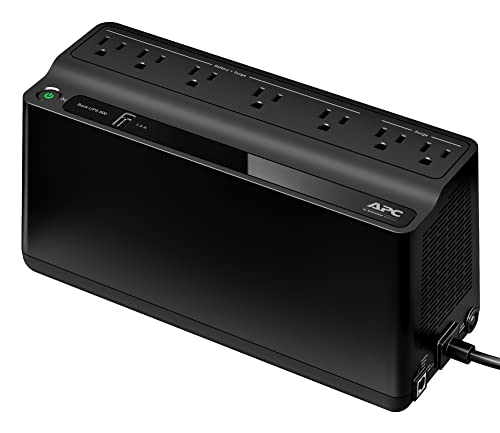 APC BE600M1 UPS Battery Backup & Surge Protector4.13D x 10.79W x 5.47H inches10.79 x 4.13 x 5.47 inches7.5 PoundsCheck on Amazon


Top 3 picks at a glance
Quick List
- SUPERDANNY 22-outlet strip – best for a crowded desk with many adapters and USB charging
- 4000J gaming surge protector – best for RGB lighting and a high stated joule rating
- ECHOGEAR ShockBlocker 8 – best for a PC, monitors and peripherals with a strong joule rating
- 18-outlet flat plug strip – best for home offices with lots of power bricks
- BSEED single-outlet surge protectors – best for protecting one device at a wall outlet (runner-up for desks)
- APC BE600M1 UPS – best for short battery backup for a router, NAS or light PC
Which One Is Right for You?
| If you… | Choose |
|---|---|
| need to power a PC, two monitors and speakers with a strong surge rating | ECHOGEAR ShockBlocker 8 |
| have a crowded workstation with lots of chargers and adapters | SUPERDANNY 22-outlet strip |
| want RGB lighting and 20 W USB fast charging | 4000J gaming surge protector |
| run a home office with a printer, router, lamps and chargers | 18-outlet flat plug strip |
| want a few wall-mounted protectors for single devices | BSEED single-outlet pack |
| need a few minutes of battery backup for a router or NAS | APC BE600M1 |
The right choice depends on how many devices you plug in and whether an outage would cost you unsaved work. A surge strip stops spikes, but it does nothing when the power goes out, so add a UPS if you are worried about blackouts.
All 6 Picks in Detail
1. SUPERDANNY 22-outlet strip – Best for a crowded desk
As an Amazon Associate we earn from qualifying purchases at no extra cost to you.

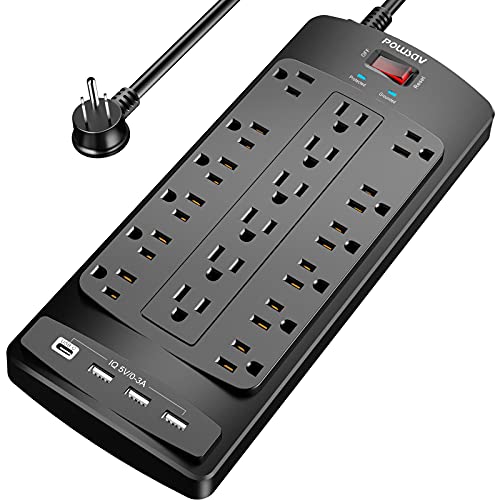
This is a large power strip with 22 AC outlets and 6 USB ports, a 2,100 joule rating, a 6.5-foot cord and a 1,875 watt, 15 amp rating. The listing describes a heavy-duty extension cord and flat plug. It suits desks with lots of power bricks, such as streaming gear, a PC, monitors and chargers.
The manufacturer describes a three-level protection circuit using TVS, MOV and GDT parts, and a flat plug that fits behind furniture. The outlets are widely spaced for large adapters, and keyholes on the back let you mount the strip under a desk. Remember that 22 outlets do not raise the 15 amp limit.
For a PC desk, the main appeal is that the strip can absorb a printer, a dock, a capture card power brick, lamps and every phone charger at once. Treat it as an expansion hub for low-draw items and keep the big loads, like a tower and monitors, in mind when you add up total watts. If you are not sure how much you draw, a plug-in watt meter takes the guesswork out.
- 22 AC outlets and 6 USB ports (5 USB-A and 1 USB-C on the main version)
- 2,100 joule surge rating
- 1,875 W / 15 A total rating
- 6.5-foot flat-plug cord; wall-mountable
- USB charging speeds vary by listing, so confirm on the product page
- Safety certification marks: confirm on listing
Pros
- Plenty of outlets for adapters
- Flat plug fits tight spaces
Cons
- Easy to overload the single 15 A circuit
- Lower joule rating than the ECHOGEAR
Compared with the 18-outlet strip, it adds more outlets and USB-C, but the load limit is the same.
2. 4000J gaming surge protector – Best for RGB lighting and high joules

This gaming-styled strip advertises 4,000 joules, six wide-spaced outlets, USB ports, PD 20 W fast charging and RGB lighting. It is aimed at gaming PCs, desk setups, homes and offices. The high joule claim is attractive, though the listing excerpt we reviewed does not state the cord length, voltage protection rating or total amperage.
It suits builders who want lighting and fast charging from a short strip. The wide spacing is practical for large power adapters such as a monitor brick or a docking station.
A joule rating is only one part of protection, and a large number on a title does not replace a listed safety mark or a stated clamping voltage. Before buying, check the full listing for certification, the amp rating and whether the USB ports share a total output. The RGB lighting is a cosmetic extra and should be switchable if you sleep near the desk.
- 4,000 joule rating as stated in the title
- Six wide-spaced AC outlets
- USB ports with 20 W PD charging
- RGB lighting
- Cord length and amp rating: confirm on listing
- Safety certification and clamping voltage: confirm on listing
Pros
- High stated energy rating
- Fast charging for a phone or tablet
Cons
- Fewer outlets than the large strips
- Safety details are not stated in the title
It offers fewer outlets than the SUPERDANNY but a higher stated joule rating.
3. ECHOGEAR ShockBlocker 8 – Best for a PC with a strong joule rating

The ShockBlocker 8 is a slim eight-outlet strip with a 3,420 joule rating. The listing says it can protect a TV, office or gaming setup, and the manufacturer specifies 15 amps, 120 volts and 1,800 watts, along with three fireproof metal oxide varistors and EMI/RFI noise filtering of 58 dB.
It suits a typical PC desk with a tower, monitors, speakers and a router. Clamping voltage is listed at 330 volts line-to-neutral and 400 volts line-to-ground, and the low profile helps it slide behind furniture. It has no USB ports, so you will need a separate charger.
Slim strips like this one tuck behind a desk or under a TV stand, and the safety covers over unused outlets are a nice touch in homes with kids or pets. If you need USB charging, add a separate wall charger instead of hunting for a strip with ports. Reported coverage also notes a multi-year warranty, so read the terms on the product page.
- Eight outlets, with built-in safety covers on unused outlets
- 3,420 joules; maximum spike current of 204,000 A
- 15 A, 120 V, 1,800 W rating
- 330 V line-to-neutral clamping level
- Three metal oxide varistors and 58 dB noise filtering
- Cord length of about 6 feet according to published coverage
Pros
- Strong energy rating and detailed protection specifications
- Slim body
Cons
- No USB charging ports
- Only eight outlets
It carries a higher joule rating than the SUPERDANNY and 18-outlet strips, with far fewer outlets.
4. 18-outlet flat plug strip – Best for home offices with lots of adapters

This strip has 18 widely spaced outlets, 4 USB ports, a 6-foot flat-plug cord and a 2,100 joule rating. The listing says it is ETL listed, which is a third-party safety mark. It suits a home office where printers, lamps, chargers and PC gear share one location.
The flat plug helps when the outlet is behind a desk, but note that more outlets increase the temptation to plug in too much. Keep high-draw devices such as space heaters off this and any other surge strip.
Because the listing is thin on electrical detail, check the amp and watt rating before you plan the load. The ETL mark is a third-party certification similar in purpose to UL, so it is a good sign, but you should still confirm the model number on the listing. It is a practical choice for a spare-room office where the number of outlets matters more than the joule rating.
- 18 AC outlets and 4 USB ports
- 2,100 joule surge rating
- 6-foot flat-plug extension cord
- ETL listed per the listing title
- Amp and wattage rating: confirm on listing
- USB output per port: confirm on listing
Pros
- Large number of outlets at a moderate size
- Third-party listing mark
Cons
- Fewer USB ports than the SUPERDANNY
- Few electrical details are stated
Compared with the SUPERDANNY, it offers fewer ports but a more compact layout.
5. BSEED single-outlet surge protectors – Best for single devices (runner-up for desks)

This listing is not a multi-outlet strip. The title describes a 1,620 joule single-outlet mini surge protector rated at 1,800 watts and sold as a 6-pack with an LED indicator. It is meant for individual items such as a refrigerator, TV, game console or PC, so it does not match the whole-desk idea behind this guide.
That makes it a runner-up. It could protect a single PC tower directly at the wall, but you would still need a strip for monitors and accessories, and it takes up a wall outlet’s second socket.
If you want to use it near your PC, it can sit directly at the wall and protect a tower, with a separate strip behind the desk for the rest. Keep in mind that single-outlet units shield only what is plugged into them, and a mini unit may cover the adjacent socket on a duplex outlet. For a whole-desk solution, one of the strips above is usually more efficient.
- Single outlet per unit; pack size described as six
- 1,620 joule rating per unit
- 1,800 W / 120 V rating as stated
- LED protection indicator
- Amp rating and certification: confirm on listing
- Physical size: confirm on listing
Pros
- Protects individual devices around the home
- Compact
Cons
- Does not power a full desk
- May block the neighboring outlet
It suits single devices better than the multi-outlet strips above.
6. APC BE600M1 UPS – Best for short battery backup
The APC BE600M1 is a battery backup unit, rated 600 VA and 330 W, that also provides surge protection. The listing describes it for a computer, router or NAS with USB charging and a 490 joule surge rating. It suits users who want to save work and shut down safely during a short outage.
Published specifications list seven outlets, five of which have battery backup and two with surge protection only, plus one USB charging port. The output is a stepped approximation of a sine wave, and runtime is short: roughly 3 minutes at full load and about 12 minutes at half load. A gaming PC with a large graphics card will usually exceed 330 watts, so this unit suits a light system or network gear.
The unit includes a replaceable battery, and the battery will wear out in a few years, so plan on a replacement cycle. The surge-only outlets are for things like a printer, which should not draw from the battery. Check your computer’s power draw first, because overloading a UPS triggers an alarm or shutdown.
- 600 VA / 330 W capacity
- Seven outlets: five battery-backed, two surge-only
- 490 joule surge rating
- One USB charging port
- Stepped approximated sine wave output
- Replaceable lead-acid battery
Pros
- Provides battery power during outages
- Good for routers, modems and NAS drives
Cons
- Too small for a high-end gaming tower
- Lower joule rating than dedicated strips
Next to the ECHOGEAR, it has a lower surge rating but adds battery backup.
Specs Compared
| Model | Outlets | Surge rating | Electrical rating | USB | Cord / form |
|---|---|---|---|---|---|
| SUPERDANNY | 22 AC | 2,100 J | 1,875 W / 15 A | 6 ports | 6.5 ft flat plug |
| 4000J gaming strip | 6 AC | 4,000 J | Confirm on listing | USB with PD 20 W | Confirm on listing |
| ECHOGEAR ShockBlocker 8 | 8 AC | 3,420 J | 1,800 W / 15 A | None | About 6 ft, slim body |
| 18-outlet strip | 18 AC | 2,100 J | Confirm on listing | 4 ports | 6 ft flat plug, ETL listed |
| BSEED single outlet | 1 per unit | 1,620 J | 1,800 W | None | Mini plug-in unit |
| APC BE600M1 | 7 (5 battery, 2 surge-only) | 490 J | 600 VA / 330 W | 1 port | UPS with lead-acid battery |
How We Chose These
We began with the six protection products in current catalog listings and checked their ratings against manufacturer specification pages, published product coverage and retailer fields. We looked for a stated joule rating, outlet count, electrical rating and any safety listing, and we separated pure surge protectors from the battery backup unit. Where a listing did not state a cord length, amp rating or clamping voltage, we marked it to confirm on the product page. We did not make electrical measurements of our own, and none of the protection claims here come from our own electrical measurements.
What to Look For
Joules, clamping voltage and UL 1449
The joule rating tells you how much energy the protector can absorb before its components wear out. It is a lifespan measure, so higher is better. Clamping voltage, formally the voltage protection rating under UL 1449, shows how much voltage passes through during a standardized surge. The standard levels for 120 volt systems are 330, 400 and 500 volts, and lower is better. Look for a “UL listed” or similar third-party mark rather than a vague claim.
Amps, watts and total load
A US wall circuit is typically 15 or 20 amps, and a power strip is usually rated at 15 amps and 1,800 watts at 120 volts. Keep continuous load under about 80 percent of that rating, or 1,440 watts. Here is a worked example: a PC with a 650 watt draw under load, two monitors at 40 watts each and speakers at 30 watts total about 760 watts, which is comfortable. A PSU is rated for output, so an 850 watt unit at 80 percent efficiency can pull around 1,060 watts from the wall at full load.
Outlet spacing, plug shape and cord
Big power adapters block neighboring sockets on tightly spaced strips. Wide spacing or rotating outlets avoid that. A flat plug lets furniture sit closer to the wall, and a longer cord helps when the outlet is far away. Do not use an extension cord on top of a strip, because it adds resistance and a fire risk.
Surge strip versus UPS
A surge strip protects against spikes only. A UPS keeps the power on for minutes and filters some power problems, which helps prevent file corruption. Sizing is the key: add up your devices in watts and choose a UPS with at least that capacity, with a buffer for startup load. Some UPS models use a stepped sine wave, and a few PC power supplies with active power factor correction do not like that, so read the PSU manual.
Reading the packaging and listing
A trustworthy listing states the joule rating, the amp rating, the clamping or voltage protection rating and a recognized listing mark such as UL or ETL. Vague claims such as “military grade” or “8-fold protection” are less useful than numbers. Look for a protection indicator light, a metal oxide varistor count and a connected equipment warranty. When specifications are missing, ask whether the product is worth the risk for expensive hardware such as a graphics card.
Noise filtering and USB charging
Some strips add EMI and RFI filtering, which smooths electrical noise from nearby motors and chargers. The ECHOGEAR lists 58 dB of filtering, for example. Filtering is a bonus for audio gear, but it does not replace surge protection. For USB, check the combined output: a strip with six ports may share a total of 20 to 25 watts, so a laptop and a phone charging at once can be slow. A dedicated wall charger is usually quicker.
Safety habits
Never daisy-chain strips, and keep high-heat appliances such as space heaters off them. Check that the wall outlet is grounded, since a surge protector depends on a ground path. A protection indicator light that goes out means the surge components have worn out and the strip should be replaced, even if it still passes power. After a major surge or lightning event, replace the unit.
Questions
Do surge protectors wear out?
Yes. The metal oxide varistors inside absorb energy and degrade over time, especially after large surges. Replace the unit when the protection light goes out or after a significant event.
Is a higher joule rating always better?
A higher joule rating generally means longer life, but it does not tell you about clamping voltage. Check both numbers and a third-party safety listing.
Can I plug a surge protector into another surge protector?
No. Daisy-chaining strips can overload the first circuit and may create a fire risk. Use one strip with enough outlets or a second strip on a separate wall outlet.
Does a PC need a UPS?
Not always, but a UPS helps if outages are common or if you cannot afford to lose unsaved work. Make sure the capacity covers your computer and monitor.
Are USB ports on a surge protector useful?
They are convenient for phones and accessories, but speeds and wattage vary and ports often share a total output. Check the per-port and combined ratings.
Should I use a surge protector for a refrigerator?
Many compressors benefit from protection, but follow the appliance maker’s guidance and use a unit rated for the load. A single-outlet protector, like the BSEED listing, is built for that kind of single-device use.
Update History
- October 20, 2026 – Initial publication; product set drawn from current catalog listings.
- Check the product page for current specifications and availability before buying.
Sources
- Manufacturer product and specification pages for ECHOGEAR, SUPERDANNY and APC
- Retailer listing titles and specification fields
- UL 1449 voltage protection rating levels as described in published electrical safety guides