The RTX 4070 Ti is the far stronger card, roughly 45% to 70% faster than the RTX 4060 Ti at 1440p with 12 GB of VRAM instead of 8 GB, making it the right choice for 1440p high-refresh and entry-level 4K gaming; the RTX 4060 Ti only makes sense for 1080p players on a tighter budget, in smaller cases, or with power supplies around 550 W. These cards share the Ada Lovelace architecture and feature set, so the decision is mostly about performance tier, memory and power rather than technology.
As an Amazon Associate we earn from qualifying purchases at no extra cost to you.


Our Top Picks
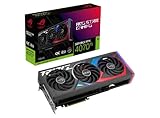
 ASUS ROG Strix NVIDIA GeForce RTX 4070 TiRTX4070Ti|OC|12GB13.2 x 5.9 x 2.5 inches3.9 PoundsCheck on Amazon

Top 3 picks at a glance
Key Differences at a Glance
| Specification | RTX 4060 Ti | RTX 4070 Ti |
|---|---|---|
| Architecture | Ada Lovelace | Ada Lovelace |
| Release date | 18 May 2023 | 3 January 2023 |
| Launch MSRP | Check on Amazon | Check on Amazon |
| CUDA cores | 4352 | 7680 |
| Boost clock | 2535 MHz | 2610 MHz |
| Process | 5 nm | 4 nm |
| Memory | 8 GB GDDR6 | 12 GB GDDR6X |
| Memory bus | 128-bit | 192-bit |
| Bandwidth | 288.0 GB/s | 504.2 GB/s |
| L2 cache | 32 MB | 48 MB |
| Board power (TDP) | 160 W | 285 W |
| Interface | PCIe 4.0 x8 | PCIe 4.0 x16 |
| Power connector (reference) | 1x 16-pin | 1x 16-pin |
| Length / width | 240 mm / 2-slot | 285 mm / 2-slot |
| Display outputs | 1x HDMI 2.1, 3x DisplayPort 1.4a | 1x HDMI 2.1, 3x DisplayPort 1.4a |
The RTX 4070 Ti has about 76% more CUDA cores, 75% more memory bandwidth and 50% more VRAM. Clocks are similar, so the core count and memory system account for nearly all of the performance difference. This table covers the 8 GB RTX 4060 Ti; a 16 GB version also exists with the same core configuration.
Gaming Performance: A Full Tier Apart
Published review data consistently places these cards in different performance classes. The RTX 4060 Ti performs around the level of an RTX 3070 at 1440p according to TechSpot’s review, and TechPowerUp’s data showed it only modestly ahead of the RTX 3060 Ti. The RTX 4070 Ti, by contrast, lands near RTX 3090 Ti territory. Direct comparisons of the two put the RTX 4070 Ti roughly 45% to 55% ahead at 1080p and around 45% to 70% ahead at 1440p, depending on the game suite. The gap grows with resolution because the 4060 Ti’s 128-bit bus and 288 GB/s of bandwidth become a bottleneck.
For a practical sense of scale, a demanding game around 55 fps at 1440p high on an RTX 4060 Ti will often land somewhere around 85 to 95 fps on an RTX 4070 Ti. These are approximate ranges; real frame rates vary with game, settings, CPU and patch.
Ray tracing
Both cards use the same third-generation RT cores, so ray tracing efficiency per core is identical. The 4070 Ti’s larger chip and memory mean its ray-traced lead is similar to or larger than its raster lead, and it is the only one of the two that handles 1440p ray tracing comfortably with DLSS. Ray tracing also adds VRAM pressure, which can push the 8 GB RTX 4060 Ti over its limit in newer games.
Shared Features
Both cards support the full RTX 40 feature set:
- DLSS super resolution, including the DLSS 4 transformer model
- DLSS 3 frame generation
- Nvidia Reflex for reduced latency
- AV1 hardware encoding for streaming and recording
Neither supports Multi Frame Generation, which is exclusive to RTX 50 cards. Frame generation works best when the base frame rate is already around 50 to 60 fps, which favors the RTX 4070 Ti: its higher base performance produces a better result from the same feature.
VRAM Headroom by Resolution
Approximate VRAM use in current AAA games:
- 1080p high: about 6 to 9 GB. The 4060 Ti 8GB is mostly adequate but tight in heavy titles.
- 1440p high: about 8 to 12 GB. The 4060 Ti 8GB often needs lower textures; the 4070 Ti handles most games.
- 1440p with ray tracing and frame generation: often 10 GB or more. Frame generation itself consumes extra memory.
- 4K high: frequently 12 GB or more. The 4070 Ti can be tight in a few titles; the 4060 Ti is not a 4K card.
TechPowerUp’s testing of the 16 GB RTX 4060 Ti found almost no average performance gain over the 8 GB model, but the extra memory still helps avoid stutter in specific VRAM-heavy games. It does not close the gap to the RTX 4070 Ti, which is a much faster chip.
Power, Connectors and Case Fit
Sizing a PSU with GPU power plus CPU power plus about 150 W of headroom, using a 125 W CPU:
| Card | Calculation | Estimate | Sensible PSU |
|---|---|---|---|
| RTX 4060 Ti | 160 + 125 + 150 | 435 W | 550 W quality unit |
| RTX 4070 Ti | 285 + 125 + 150 | 560 W | 700 to 750 W quality unit |
The reference specification lists a 16-pin (12VHPWR/12V-2×6) input for both cards. Many partner RTX 4060 Ti cards use a single 8-pin instead, while most RTX 4070 Ti models use the 16-pin with an adapter. When using a 16-pin connector, push it in fully and avoid tight bends near the plug.
Size differs noticeably. The RTX 4060 Ti reference length is 240 mm, and many models are compact dual-fan designs suitable for small cases. The RTX 4070 Ti is listed at 285 mm, and many partner versions are longer and thicker than two slots, so measure the case before buying.
Platform note: the RTX 4060 Ti uses a PCIe 4.0 x8 link. On PCIe 3.0 motherboards, it runs at PCIe 3.0 x8, which typically costs only a few percent, though the loss grows when the 8 GB buffer overflows. The RTX 4070 Ti uses a full x16 link.
Cost per Performance
Setting the RTX 4060 Ti at 100 points and the RTX 4070 Ti at about 160 (roughly the middle of the 1440p range):
At launch MSRPs, the RTX 4060 Ti offered more performance per dollar, but at the cost of 8 GB of memory and limited 1440p capability. The 4070 Ti charged a premium for a much more capable card.
Current alternatives deserve a look. The RTX 5060 Ti 16GB improves on the 4060 Ti with more memory and Multi Frame Generation, while the RTX 5070 and RTX 5070 Ti cover the 4070 Ti’s performance class with newer features. Radeon’s RX 9070 and RX 9070 XT offer 16 GB at competitive performance levels.
Decision Table by Resolution and Budget
| Use case | Better pick |
|---|---|
| 1080p at 60 to 144 Hz, budget-focused | RTX 4060 Ti |
| 1440p at high refresh | RTX 4070 Ti |
| 4K with DLSS | RTX 4070 Ti |
| Ray tracing at 1440p | RTX 4070 Ti |
| Small form factor or 550 W PSU | RTX 4060 Ti |
| Older PCIe 3.0 platform | RTX 4070 Ti (full x16 link) |
| Long-term ownership | RTX 4070 Ti (more VRAM) |
Frequently Asked Questions
How much faster is the RTX 4070 Ti than the RTX 4060 Ti?
Published comparisons place the RTX 4070 Ti roughly 45% to 55% ahead at 1080p and about 45% to 70% ahead at 1440p. The gap widens at higher resolutions because the RTX 4060 Ti’s 128-bit memory bus limits it. In VRAM-heavy games, the difference can be even larger against the 8 GB model.
Does the 16 GB RTX 4060 Ti close the gap?
No. TechPowerUp found the 16 GB version essentially equal to the 8 GB version on average, because both use the same chip. The extra memory helps in specific VRAM-limited games but does not approach RTX 4070 Ti performance.
What PSU does the RTX 4070 Ti need?
A quality 700 to 750 W unit is sensible with a mainstream CPU. Most models use a 16-pin connector, either via a native cable from an ATX 3.x PSU or an included adapter. Make sure the connector is fully seated.
Is the RTX 4060 Ti good for 1440p?
It can run 1440p in many games with DLSS, but it is best suited to 1080p. In newer AAA titles at 1440p, its 8 GB of memory and narrow bus often require reduced settings. Buyers focused on 1440p get a much better experience from the RTX 4070 Ti or a current 16 GB card.
Do both cards support DLSS 4?
Both support DLSS 4 transformer upscaling and DLSS 3 frame generation. Multi Frame Generation, the headline DLSS 4 feature, is exclusive to RTX 50 cards. The feature set is otherwise identical between these two GPUs.