The best gas grills for most households are the Weber Spirit E-310 for compact everyday cooking, the Napoleon Rogue 425 for flexible three-burner cooking, and the Weber Genesis E-325s when you regularly cook for a crowd and want stronger heat management.
As an Amazon Associate we earn from qualifying purchases at no extra cost to you.


Our Top Picks
 GRILL DEPOTS 4-Burner Propane Gas Grill and Griddle4-Burners19.1 x 48.2 x 45.6 Inches64 PoundsCheck on Amazon
 Monument Grills 4 Burner Propane Gas Grill with4-Burner M2-410FBZ21.4 x 50.6 x 41.9 InchesCheck on Amazon
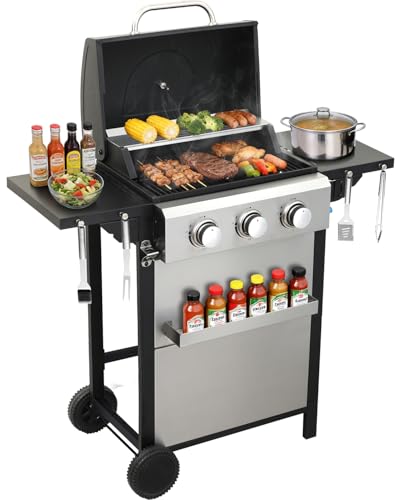

Top 3 picks at a glance
Best gas grills by household and cooking style
| Household situation | Best fit | Why it makes sense | Typical market range |
|---|---|---|---|
| One to three people, balcony or small patio | Weber Q 1200 | Portable footprint, one main burner, and quick setup | Varies |
| Two to four people, everyday grilling | Weber Spirit E-310 | Three burners provide useful two-zone cooking without excessive size | Varies |
| Four to six people, mixed foods | Napoleon Rogue 425 | Three burners, side shelves, and a practical indirect-cooking area | Varies |
| Frequent entertaining and large meals | Weber Genesis E-325s | Larger primary area, strong burner zoning, and room for simultaneous foods | Varies |
| High-heat searing as a priority | Napoleon Rogue XT 425 or a comparable three-burner grill with an infrared side burner | Dedicated searing hardware avoids sacrificing the whole cooking surface to maximum heat | Varies |
How to match grill size to the people you feed
Grill size is more useful when measured by the amount of food you cook at once rather than by the number of burners alone. A practical estimate is 70–100 square inches of primary cooking area per person for a meal containing a main protein and vegetables. That is not a strict rule: thin burgers need less space than bone-in chicken, and crowded food browns poorly because it releases steam instead of searing.
For two people, about 280–400 square inches is usually comfortable. For four people, 400–550 square inches gives enough room for direct and indirect zones. For six or more people, look for approximately 550–700 square inches, particularly if you want to cook in batches without making the first batch wait too long.
A useful capacity calculation
Suppose four diners each need two 4-ounce burgers. Sixteen ounces of raw meat sounds modest, but each patty needs separation for flipping and airflow. If you allow about 25 square inches per burger, eight burgers require roughly 200 square inches. Add 150–200 square inches for vegetables, buns, a cooler zone, and safe working space, and a 400-square-inch grill becomes the sensible minimum. This is why a nominally large grill can still feel cramped when its warming rack is counted as part of the advertised area.
Burner layouts: the feature that changes how you cook
Two burners
Two burners are efficient for small households and allow basic two-zone cooking: one side on for direct heat and one side off for indirect heat. Their limitation is width. A large roast, several chicken pieces, or a full batch of vegetables can quickly use most of the available surface.
Three burners
Three burners are the best general-purpose layout for many homes. You can run the outside burners while leaving the middle off for indirect cooking, or create hot, medium, and cool zones. This arrangement is especially useful for food that needs to start hot and finish gently, such as thick pork chops or bone-in chicken.
Four or more burners
Additional burners increase usable zones and capacity, but they also consume more fuel and add more parts to clean or replace. Choose four burners when you routinely cook for six or more people, use large pans, or want separate heat for meat, vegetables, and warming. Do not buy one merely because the burner count is higher.
Heat distribution matters more than headline BTUs
Total BTU input describes how much gas the burners can consume per hour; it does not directly predict how evenly the grates cook. A grill with 40,000 BTUs spread across 500 square inches has a nominal input of 80 BTUs per square inch, but insulation, lid design, burner spacing, grates, wind, and grease-management parts determine how much heat reaches the food.
Look for burners that run across the width of the firebox, heat shields that protect them from drippings, and grates with enough thermal mass to recover after cold food is added. Stainless-steel rod grates generally heat and clean quickly. Porcelain-enameled cast iron retains heat well and leaves pronounced sear marks, but damaged enamel can expose the iron to rust.
For more even results, preheat with all burners on high for 10–15 minutes, then adjust the controls before adding food. Keep the lid closed during preheating. If one section is much hotter, use that area for searing and reserve the cooler side for finishing rather than constantly moving food at random.
Ignition, fuel efficiency, and operating cost
Most modern gas grills use electronic or battery-assisted ignition. A reliable igniter should light the burner quickly without repeated clicking. If a grill has a manual lighting procedure, learn it before the first use; ignition failure is inconvenient, but repeatedly releasing gas while searching for a spark is unsafe.
Propane grills are convenient because a cylinder can be exchanged or refilled, while natural-gas grills avoid cylinder handling and are practical when a properly installed gas line already reaches the patio. A natural-gas model is not automatically more economical: installation, a compatible connector, and permanent placement can cost more than the fuel savings.
Here is a realistic fuel-budget example. A three-burner grill rated at 39,000 BTUs per hour uses about 13,000 BTUs per burner at full output. If you preheat all burners for 12 minutes and then cook with two burners at roughly half power for 25 minutes, the estimated input is:
- Preheating: 39,000 × 0.20 hours = 7,800 BTUs
- Cooking: 26,000 × 0.42 hours = 10,920 BTUs
- Total session: approximately 18,720 BTUs
A standard 20-pound propane cylinder contains roughly 430,000 BTUs of usable energy under common rating assumptions, so that session represents about 4% of a cylinder. Real consumption varies with wind, temperature, lid opening, regulator condition, and how accurately the burners hold their settings. The practical efficiency lesson is simple: preheat once, keep the lid closed, and turn unused burners off instead of running the entire grill at maximum.
Cleanup design can determine whether you keep using the grill
Removable grates are easier to brush and wash than permanently fixed sections. Stainless heat deflectors usually tolerate repeated cleaning better than thin painted steel, while disposable foil liners can simplify grease collection but should not block ventilation or be placed where the manufacturer forbids them.
After cooking fatty foods, leave the burners on medium for 5–10 minutes to burn off loose residue, then brush the grates after they have cooled enough to handle safely. Do not rely on burn-off to remove grease from the drip tray. Empty and wash the tray regularly; accumulated grease is a fire risk, not merely a cosmetic problem.
Five-minute post-cook routine
- Move delicate food away and close the lid.
- Run the active burners on medium for 5–10 minutes.
- Brush the grates in several directions once residue loosens.
- Inspect the grease tray after every few cooks, especially after burgers or marinated meat.
- Turn off the burner controls first, then close the propane-cylinder valve if using propane.
Which grill should you buy?
Choose the Weber Q 1200 when storage, portability, or a small balcony matters more than multi-zone cooking. Its single-burner design is simple, but it is not the right choice for indirect cooking across separate heat zones.
Choose the Weber Spirit E-310 when you want a durable, uncomplicated three-burner platform for a small family. It is a strong value when your meals usually involve burgers, steaks, sausages, vegetables, and occasional indirect cooking rather than large entertaining sessions.
Choose the Napoleon Rogue 425 when you want three-burner flexibility and a broad range of configurations, particularly if a side burner or infrared searing option is important. Check the exact trim level because features vary between Rogue versions.
Choose the Weber Genesis E-325s when you regularly cook for four to six people, want more working area, or dislike cooking in several batches. Its larger footprint and higher price are justified only if you use the extra capacity; otherwise, a smaller three-burner grill will heat faster and cost less to operate.
Frequently asked questions
Can I use a gas grill for indirect cooking?
Yes, but the grill needs at least two burners so one area can provide heat while another remains off. Three burners offer more flexibility because you can run the outside burners and leave the middle off, creating a cooler center. A single-burner grill is not suitable for indirect cooking across separate heat zones.
Should I choose propane or natural gas?
Choose propane when you want the convenience of exchanging or refilling a cylinder. Natural gas is practical when a properly installed gas line already reaches the patio and you prefer permanent placement. Natural gas is not automatically more economical because installation and a compatible connector may cost more than the fuel savings.
How much cooking area do I need if I cook different foods together?
Plan for about 70–100 square inches of primary cooking area per person when a meal includes a main protein and vegetables. Allow additional room for separation, flipping, airflow, buns, vegetables, and a cooler zone. Advertised capacity can be misleading when it counts the warming rack, which does not provide the same working space as the primary grate.
What should I do if one part of the grill is hotter than another?
Use the hotter section for searing and the cooler section for finishing. Before cooking, preheat with all burners on high for 10–15 minutes with the lid closed, then adjust the controls. Do not move food randomly in response to uneven heat; use the grill’s temperature differences as separate cooking zones.
How can I reduce the risk of a grease fire?
Clean the grease tray regularly, especially after cooking fatty foods such as burgers or marinated meat. Burn-off can loosen residue from the grates, but it does not remove grease from the tray. Empty and wash the tray rather than treating buildup as cosmetic. Disposable foil liners may simplify collection, but they must not block ventilation or violate the manufacturer’s instructions.
Final buying checklist
- Measure the patio and leave safe clearance around the grill, not just room for the cart.
- Prioritize primary cooking area over warming-rack area.
- Choose two burners for compact cooking, three for the most versatile layout, and four or more for frequent large meals.
- Confirm whether the model is configured for propane or natural gas before purchasing.
- Check replacement-burner, grate, igniter, and drip-tray availability.
- Prefer a grill whose grease tray and heat shields can be removed without dismantling the firebox.
- Buy an infrared side burner only if you regularly sear steaks or boil outdoors; otherwise, it adds cost and another part to maintain.