The best camping lanterns depend on whether you need a wide, comfortable glow inside a tent, maximum brightness for a cooking area, a long emergency runtime, or a compact rechargeable light for backpacking.
| Campsite need | Best fit | Useful target specification | Why it matters |
|---|---|---|---|
| Backpacking and small tents | Compact rechargeable lantern | 100–300 lumens, USB-C, under 350 g | Enough light without consuming much pack space |
| Family campsite | High-output area lantern | 500–1,000 lumens, 6–12 hours on medium | Illuminates tables, chairs, and cooking areas |
| Long trips away from power | Battery-efficient lantern | 50–200 lumens, 20–100 hours of useful runtime | Reduces spare-battery requirements |
| Wet or unpredictable weather | Water-resistant rechargeable or hybrid lantern | At least IPX4; IPX7 is better for heavy exposure | Protects the lantern from rain and accidental immersion |
| Emergency car camping | Lantern with power-bank output | USB charging, battery indicator, 5–10 W USB output | Can provide light and top up a phone |
As an Amazon Associate we earn from qualifying purchases at no extra cost to you.


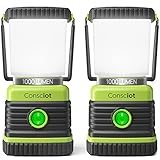
Our Top Picks
 Collapsible Portable LED Camping Lantern XTAUTO Lightweight Waterproof4-pack3.54 x 3.54 x 7.68 inchesCheck on Amazon
 MalloMe Camping Lights LED Lantern Flashlights2 Pack3.7 x 3.4 x 3.7 inches0.36 PoundsCheck on Amazon
 Consciot 1000LM Battery Powered LED Camping Lantern2 Pack3.54 x 3.86 x 7.28 inches2.2 poundsCheck on Amazon

Top 3 picks at a glance
What to look for in the best camping lanterns
Lantern specifications are useful, but they do not tell the whole story. A 1,000-lumen lantern can be excellent for a picnic table and uncomfortable inside a small tent. Conversely, a 100-lumen model may feel dim outdoors but provide pleasant reading light in a two-person tent.
Brightness: choose usable lumens, not the biggest number
For a tent, 50–150 lumens is often sufficient. A compact two- or three-person shelter generally benefits from 150–300 lumens. For a cooking table or communal campsite, look for 300–800 lumens. Outputs above 800 lumens are useful when you need to illuminate a large area, but they usually consume more power and can create glare.
Multiple brightness levels are more valuable than a single maximum-output figure. A good lantern should offer a low mode for overnight use, a medium mode for eating or reading, and a high mode for setup and cleanup. A red-light mode is also useful because it preserves night vision better than white light and is less disruptive inside a tent.
Beam coverage: area light versus directional light
Camping lanterns normally use one of three lighting patterns:
- 360-degree area lighting: Best for tables, tents, and shared campsites. The light is spread around the lantern rather than projected in one direction.
- Directional lighting: Better for finding a trail, checking distant equipment, or signaling. It sacrifices some nearby coverage.
- Hybrid lighting: Combines an area lantern with a flashlight or downward-facing beam. This is the most versatile option for car camping.
For a tent, a frosted diffuser is usually preferable to a clear lens because it softens shadows and reduces harsh glare. For a large campsite, a lantern that can hang from a branch or shelter frame is more useful than one that only sits on a flat surface. Check the shape of the base as well: a tall, narrow lantern may provide good overhead coverage but can be easy to knock over.
Battery life and charging options
Runtime depends on brightness, temperature, battery age, and whether the lantern is powering another device. Treat the advertised maximum runtime as a low-mode figure unless the manufacturer states otherwise.
A simple power-budget calculation helps compare models. Suppose a rechargeable lantern has a 5,200 mAh battery at a nominal 3.7 volts:
5.2 Ah × 3.7 V = approximately 19.2 Wh of stored energy.
If its LED and electronics use about 2 watts on a chosen brightness setting, the theoretical runtime is:
19.2 Wh ÷ 2 W = 9.6 hours.
Real runtime may be closer to eight or nine hours because of conversion losses, automatic thermal management, and the battery reserve that prevents deep discharge. If the same lantern runs at 0.2 watts on low, the theoretical figure rises dramatically, but the practical result will still be limited by the lantern’s control electronics and battery self-discharge.
| Runtime priority | Recommended approach | Charging or battery choice | Trade-off |
|---|---|---|---|
| One evening | Rechargeable lantern, 200–500 lumens | USB-C or built-in lithium battery | Convenient, but requires charging before departure |
| Several nights | Lantern with efficient low mode | Rechargeable battery plus USB power bank | Medium and high modes must be used sparingly |
| Extended remote trip | Replaceable-cell lantern | AA, D, or manufacturer-replaceable battery pack | Heavier, but spare cells are easy to carry |
| Emergency preparedness | Hybrid lantern | Rechargeable battery with replaceable-cell backup or solar panel | More flexibility, usually larger and less simple |
USB-C is generally the most convenient charging interface because it works with modern phone chargers and power banks. A micro-USB lantern can still be perfectly usable, but it may require carrying a separate cable. Solar charging is best considered a backup rather than the primary charging method: small integrated panels often recharge slowly and require direct, strong sunlight.
Strong choices by campsite type
For backpacking: compact rechargeable lanterns
Backpackers should prioritize weight, packability, and low-mode efficiency. A lantern producing 100–300 lumens with a hanging loop, USB-C charging, and a reliable battery indicator is usually a better choice than a large high-output model.
The Black Diamond Moji R+ is a suitable example of this category. It is compact, rechargeable, and designed for close-range area illumination rather than lighting a whole campsite. Similar compact lanterns are ideal for tent organization, reading, and locating gear without adding unnecessary bulk.
Look for a lantern that can run at least one full night on low or medium. If the specification lists only maximum lumens and no low-mode runtime, treat that as a warning that the product may not provide useful battery information.
For family camping: bright 360-degree lanterns
Family campsites benefit from broad, comfortable illumination and simple controls. The BioLite AlpenGlow 500 is an example of a lantern designed around ambient area lighting, with adjustable brightness and color modes. A lantern in this class is well suited to a picnic table, tent vestibule, or cooking area.
The Goal Zero Lighthouse 600 is another example of a higher-output campsite lantern. Its directional controls can be useful when you want to light only one side of a table instead of wasting battery illuminating empty space. Models in this category are often larger, but the extra battery capacity and physical stability are valuable for car camping.
For maximum runtime: efficient low-output lanterns
If your priority is several nights of basic light, choose a lantern with a genuinely low setting rather than one that merely advertises a very high maximum. The UST 30-Day Duro is an example of a lantern class built around extended low-output operation and replaceable batteries.
Long-runtime lanterns are useful in remote camps, emergency kits, and cabins. Their low mode may be too dim for outdoor cooking, so consider carrying a separate headlamp for close work. This two-light approach is often more efficient than operating a powerful lantern all night.
For mixed tasks: hybrid lanterns with a flashlight mode
A hybrid lantern is useful when one device needs to cover setup, table lighting, and short walks to the car. The Goal Zero Lighthouse 600, for example, combines area illumination with directional control. Other hybrid models may include a top-mounted flashlight or a downward light for illuminating the ground.
Choose this style when reducing the number of devices matters more than minimizing weight. For serious night hiking, however, a dedicated headlamp is usually more practical because it keeps both hands free and aims wherever you look.
Weather resistance: understand the IP rating
Weather resistance is especially important because lanterns are often left on tables, hung under tarps, or handled with wet hands.
- IPX4: Resistant to water splashes from any direction. Suitable for ordinary rain when the lantern is not submerged.
- IPX5 or IPX6: Better protection against stronger water jets and heavy weather.
- IPX7: Designed to tolerate temporary immersion under specified test conditions. It does not mean the lantern should routinely be stored underwater.
- IP54 or similar: Includes some dust protection as well as splash resistance, useful in dry, sandy campsites.
Keep charging ports closed whenever the lantern is outside. Water resistance generally applies only when the port cover is properly sealed. Do not charge a wet lantern until both the connector and cover are completely dry.
A practical buying decision
Use this sequence before choosing a model:
- Define the area: Tent lighting needs fewer lumens than a cooking or social area.
- Set the minimum runtime: Multiply the number of nights by the hours you expect to use the lantern each night. For example, four nights at three hours per night requires at least 12 hours of useful runtime on your chosen brightness.
- Choose the power system: USB-C is convenient for rechargeable use; replaceable batteries are easier to replenish far from electricity.
- Check the beam pattern: Select 360-degree diffusion for shared spaces and directional or hybrid output for mixed tasks.
- Verify weather protection: Choose at least splash resistance for exposed campsites and stronger protection for frequent wet-weather use.
- Account for controls: A physical button, battery indicator, lockout mode, and remembered brightness setting can be more useful than extra lighting effects.
For most campers, the best camping lantern is a rechargeable 200–500-lumen model with a diffuse 360-degree beam, multiple brightness levels, USB-C charging, and at least splash resistance. Choose a high-output hybrid lantern for a family campsite, a low-output replaceable-battery model for long trips, and a compact rechargeable lantern when every gram in the pack matters.
Frequently asked questions
Is a red-light mode useful in a camping lantern?
Yes, a red-light mode can preserve night vision better than white light and is less disruptive inside a tent. It is especially useful when someone needs to move around or read without creating harsh glare. Multiple brightness levels still matter because low, medium, and high modes serve different needs, from overnight use to setup and cleanup.
Can a camping lantern charge a phone?
Yes, some lanterns include power-bank output that can provide light and top up a phone. Look for USB charging, a battery indicator, and USB output if emergency charging matters. Using the lantern to power another device reduces available runtime, so this feature is most useful for emergency car camping or situations where reducing the number of devices matters.
Should solar charging be the main way to recharge a lantern?
No, solar charging is best treated as a backup rather than the primary charging method. Small integrated panels often recharge slowly and require direct, strong sunlight. USB-C is generally more convenient because it works with modern phone chargers and power banks. A rechargeable lantern should still be charged before departure when possible.
Do I still need a headlamp if I bring a lantern?
A headlamp can still be useful because it keeps both hands free and aims wherever you look. A lantern provides area illumination for tents, tables, and shared campsites, but it may not be ideal for close work or serious night hiking. For extended low-output use, carrying a separate headlamp can be more efficient than operating a powerful lantern all night.
How can I avoid choosing a lantern that is too bright for a tent?
Choose adjustable brightness rather than focusing only on the maximum output. A tent often needs 50–150 lumens, while a compact two- or three-person shelter generally benefits from 150–300 lumens. A frosted diffuser can soften shadows and reduce harsh glare. Low and medium modes are useful for overnight use, reading, and eating without excessive brightness.