The best Orion telescopes for beginners are the StarBlast 4.5 for easy tabletop observing, the SkyQuest XT6 or XT8 for the best visual detail, and the Apex 90 or ShortTube 80 for compact travel—provided you match the telescope’s aperture and mount to what you actually want to view.
Orion sold several beginner-friendly telescope families, although availability in 2026 can vary because many models are now found through remaining inventory or the used market. The most useful way to choose is not by the highest advertised magnification, but by viewing goal, aperture, mount stability, setup time, and your tolerance for carrying and collimating equipment.
As an Amazon Associate we earn from qualifying purchases at no extra cost to you.


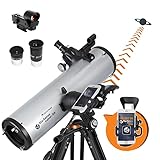

Our Top Picks
 Celestron StarSense Explorer DX 130AZ Smartphone Guided Newtonian130 DX Reflector18 PoundsCheck on Amazon



Top 3 picks at a glance
Quick match: which Orion telescope fits your situation?
| Your situation | Best Orion type | Why it fits | Main compromise |
|---|---|---|---|
| Apartment, balcony, or first telescope | StarBlast 4.5 Astro Reflector | Compact, quick to use, and has enough aperture for the Moon, planets, and brighter deep-sky objects | Needs a sturdy table and manual tracking |
| Maximum beginner value for visual observing | SkyQuest XT6 Classic | 150 mm aperture gathers substantially more light than small tabletop scopes | Less portable and requires occasional mirror alignment |
| Best all-round deep-sky upgrade | SkyQuest XT8 Classic | 203 mm aperture provides a noticeable jump in galaxy, nebula, and star-cluster visibility | Bulky enough that storage and transport matter |
| Backpacking, travel, or daytime viewing | Apex 90 Maksutov-Cassegrain | Short, enclosed optical tube with sharp views of the Moon and planets | Narrower field of view and usually needs a separate solid tripod |
| Wide-field views and simple setup | ShortTube 80 refractor | Lightweight, forgiving, and useful for large star fields and terrestrial targets | Limited planetary detail and chromatic aberration at high power |
What matters more than magnification?
Aperture determines how much you can see
Aperture is the diameter of the telescope’s main lens or mirror. It controls both resolving power and light-gathering ability. A 150 mm telescope has an approximate light-gathering area of:
π × (150 ÷ 2)2 = about 17,700 mm².
A 90 mm telescope has about 6,360 mm² of collecting area. Dividing the two gives 17,700 ÷ 6,360, or approximately 2.8 times more light for the 150 mm instrument. That does not make every object appear 2.8 times larger, but it can make faint clusters, nebulae, and galaxies noticeably easier to detect.
For beginners, 80–90 mm is practical and forgiving, 114–130 mm is a strong compact reflector range, and 150–203 mm is where visual deep-sky observing becomes much more rewarding. Larger aperture is useful only if you can carry, store, and set up the telescope often enough to use it.
Magnification is calculated, not fixed
Magnification equals the telescope’s focal length divided by the eyepiece focal length. For example, a SkyQuest XT8 with a 1,200 mm focal length and a 25 mm eyepiece produces:
1,200 ÷ 25 = 48×.
Using a 10 mm eyepiece produces 120×. Atmospheric turbulence, imperfect alignment, and the telescope’s optical quality may make 120× useful on some nights but blurry on others. A beginner should prioritize a stable mount and clear, low-to-medium-power views before buying very short eyepieces.
Best Orion telescopes by viewing goal
Best for learning the sky: StarBlast 4.5 Astro Reflector
The StarBlast 4.5 is a 114 mm Newtonian reflector on a tabletop mount. It is small enough to keep assembled near a window or carry outside in one trip, while its aperture is large enough for lunar craters, Jupiter’s main cloud bands and moons, Saturn’s rings, open clusters, and brighter nebulae.
Choose it if setup time is more important than maximum detail. Put the base on a solid table, insert a low-power eyepiece, and you can begin observing within minutes. The trade-off is that the tabletop mount must be placed on something stable, and manual tracking becomes more demanding at high magnification because objects drift across the view as Earth rotates.
Best visual value: SkyQuest XT6 Classic
The XT6 uses a 150 mm Newtonian reflector on a Dobsonian mount. Its simple altitude-azimuth design is stable, intuitive, and usually more satisfying for visual observing than a lightweight tripod mount. You move the tube by hand, without electronics, alignment routines, or batteries.
This is a strong choice for a beginner who wants to spend most sessions observing from a garden or driveway. The 150 mm mirror is large enough to reveal structure in bright nebulae, resolve many globular-cluster stars, and show more planetary detail than compact 80–90 mm instruments under steady skies.
Best for deeper visual observing: SkyQuest XT8 Classic
The XT8 increases aperture to 203 mm while retaining the simple Dobsonian format. Compared with a 150 mm mirror, its light-gathering area is approximately:
(203 ÷ 150)2 = about 1.83 times greater.
That increase is meaningful on faint targets, especially under dark skies. The XT8 is often the better long-term choice for someone who has room to store it and can transport a fairly large optical tube and base. It is not the best pick if carrying equipment down stairs is likely to discourage regular use.
Best compact planetary option: Apex 90 Maksutov-Cassegrain
The Apex 90 has a compact Maksutov-Cassegrain optical design with a long effective focal length. This makes it well suited to the Moon, Jupiter, Saturn, and daytime distant subjects. Its enclosed tube is less exposed to dust than an open Newtonian, and it generally has a narrow, sharp field.
The optical tube is portable, but the complete setup still depends on the mount. A shaky photographic tripod can undermine a good telescope, particularly at planetary magnifications. Pair this type with a tripod rated comfortably above the telescope’s weight, not one that merely supports it on paper.
Best for wide views: ShortTube 80 refractor
The ShortTube 80 is an 80 mm short-focus refractor aimed at wide fields and portability. It is a practical choice for scanning the Milky Way, viewing large open clusters, watching eclipses with an appropriate certified solar filter, and handling occasional terrestrial observation.
Its short focal ratio makes large objects easy to frame, but bright objects can show colored fringes. It is therefore better for broad, relaxed viewing than for extracting the finest detail from planets. Confirm that the specific package includes a stable astronomical mount; the optical tube alone is not a complete beginner setup.
Mount stability and setup time
Aperture cannot compensate for vibration. If the image shakes every time you touch the focus knob, you will use less magnification and see less detail. Dobsonian mounts such as those supplied with the SkyQuest XT6 and XT8 are stable because their broad bases keep the center of gravity low. Tabletop designs such as the StarBlast are also stable when placed on a heavy, rigid surface.
For a rough portability comparison, expect a small refractor or Maksutov setup to be carried in separate optical-tube and tripod pieces, while a six- or eight-inch Dobsonian normally involves moving both a tube and a large base. The best telescope is the one you can take outside on an ordinary weeknight, not only on planned observing trips.
Beginner setup: a reliable first-night procedure
- Let the telescope reach outdoor temperature. Set it outside for roughly 20–40 minutes when moving from a warm room into cold air. This reduces air currents inside the tube that can soften high-power views.
- Start with the longest supplied eyepiece. Use roughly 30–50× first. The wider view makes it easier to locate the Moon, a planet, or a bright star cluster.
- Focus slowly. Turn the focuser through the sharpest point rather than stopping at the first recognizable image.
- Increase power only after centering the target. Move from about 40× to 80–120× when the image remains steady. If detail disappears, return to the lower-power eyepiece.
- For Newtonian reflectors, check collimation periodically. Mirror alignment is a normal maintenance task. A simple collimation cap or Cheshire tool is sufficient for beginner checks; do not force adjustment screws.
Choosing between the top three beginner picks
Choose the StarBlast 4.5 when fast setup, compact storage, and low cost matter most. Choose the XT6 when you want the best balance of aperture, stability, and manageable size. Choose the XT8 when faint deep-sky objects are a priority and you have a permanent storage spot or a vehicle.
Treat these as broad ranges rather than fixed 2026 prices.
Frequently asked questions
Can I use one of these telescopes to observe the Sun?
The ShortTube 80 can be used to view eclipses only with an appropriate certified solar filter. The article does not recommend looking at the Sun without one. It describes this refractor as especially useful for wide views and occasional terrestrial observation, rather than fine planetary detail.
Will I need to align the mirrors on every Orion telescope?
No, mirror alignment is a periodic maintenance task for Newtonian reflectors, not every telescope listed. The StarBlast 4.5, SkyQuest XT6, and SkyQuest XT8 are Newtonian reflectors, so their collimation should be checked periodically. A collimation cap or Cheshire tool is enough for beginner checks; do not force adjustment screws.
Can I observe from a balcony or apartment?
The StarBlast 4.5 is the article’s suggested option for an apartment or balcony because it is compact and quick to use. Its tabletop mount still needs a sturdy table or another stable surface, and manual tracking becomes more demanding at high magnification. The article does not say that every balcony will provide suitable viewing conditions.
How long should I wait before observing after taking a telescope outside?
Allow the telescope roughly 20–40 minutes to reach outdoor temperature when moving it from a warm room into cold air. This can reduce air currents inside the tube that soften high-power views. Start with the longest supplied eyepiece and a low magnification while the telescope settles.
Can I take good planetary views with a ShortTube 80?
The ShortTube 80 can show planets, but it is better suited to wide, relaxed views than to extracting the finest planetary detail. The article notes that bright objects can show colored fringes with this short-focus refractor. For compact planetary observing, it identifies the Apex 90 as a better fit.
Final recommendation
For most first-time visual observers, the SkyQuest XT6 is the safest all-purpose recommendation because its 150 mm aperture and stable Dobsonian mount provide a substantial view without the bulk of larger instruments. The StarBlast 4.5 is the better beginner telescope when portability and immediate setup determine whether you will observe regularly, while the XT8 is the better choice for a committed observer who wants the most deep-sky performance that remains relatively simple and manual.