Our Top Picks


Top 3 picks at a glance
Best Aquarium Heaters for Small Tanks
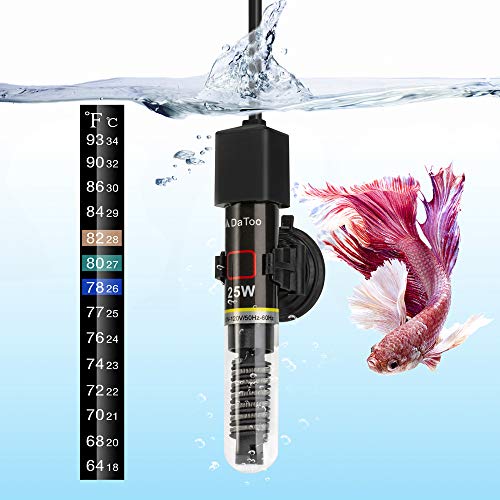
The best aquarium heaters for small tanks are low-wattage, fully submersible models with a thermostat, a clear temperature indicator, and automatic overheat protection; choose the wattage for your tank’s actual water volume and the room’s coldest temperature, not the aquarium’s advertised size alone.
For a stable room and a tank of about 5–10 gallons, a 25–50-watt heater is usually the practical starting range. A 2–3-gallon tank often suits a 10–25-watt model, while a 10–20-gallon tank may need 50–100 watts. These are starting points, not guarantees: cold rooms, drafts, uncovered tanks, and large temperature increases can require more power. A separate thermometer is essential because the dial or indicator on a heater is not a precision measuring instrument.
As an Amazon Associate we earn from qualifying purchases at no extra cost to you.

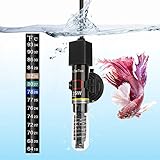

Quick wattage guide
| Actual water volume | Starting wattage in a typical room | When to consider more wattage | Small-tank priority |
|---|---|---|---|
| 2–3 gallons | 10–25 W | Room is consistently cold or tank is exposed to drafts | Short, compact heater that cannot extend above the waterline |
| 5 gallons | 25 W | Water must stay roughly 10°F or more above room temperature | Low output and reliable shutoff to limit temperature overshoot |
| 10 gallons | 50 W | Cold room, poor insulation, or substantial day-to-night temperature swings | Adjustable thermostat and room for water circulation around the heater |
| 15–20 gallons | 75–100 W | Tank is in a chilly location or needs a larger temperature increase | Position near filter flow for even heat distribution |
These ranges assume a normally heated home and a temperature increase of roughly 5–10°F. They are not a substitute for the manufacturer’s tank-size guidance. If the room is much colder than the aquarium target, use the manufacturer’s guidance for that temperature difference and verify the result with a thermometer.
Three heaters worth considering
| Model | Useful size range | What stands out | Best fit |
|---|---|---|---|
| Hygger Mini Glass Aquarium Heater, 50 W | Small tanks, subject to the specific version’s stated capacity | Compact form and adjustable temperature control | Owners who want a small adjustable heater rather than a preset unit |
| Fluval P25 Submersible Aquarium Heater | Small aquariums within the model’s published capacity | Low wattage and a compact profile | Small tanks that need modest heating in a reasonably warm room |
| EHEIM Jager TruTemp, 25 W | Small tanks within the manufacturer’s capacity guidance | Adjustable thermostat and recalibration feature | Buyers who value temperature adjustment and calibration over the smallest possible footprint |
Product dimensions, temperature ranges, and tank-capacity recommendations can vary by model revision and region. Check the exact version’s manual before buying, particularly for minimum water depth and whether it must be fully submerged. No heater should be chosen on brand name alone: wattage, fit, and safe installation matter more than a feature list.
Match the heater to your tank
1. Estimate the water volume, not just the tank label
Substrate, rocks, and decorations displace water. A nominal 5-gallon aquarium may hold noticeably less than 5 gallons after setup. For a closer estimate, measure the filled water volume during setup or use the tank’s internal dimensions. For a rectangular tank, gallons are approximately length × width × water depth in inches divided by 231.
For example, a tank with an internal water footprint of 16 × 8 inches and 7 inches of water holds about 3.9 gallons: 16 × 8 × 7 ÷ 231 = 3.88. That tank should be treated as a roughly 4-gallon system, not automatically paired with a heater intended for 10 gallons.
2. Consider the room-to-tank temperature difference
Heater workload depends on how much warmer the aquarium must be than the room. A tank kept at 78°F in a 72°F room needs a 6°F increase. The same tank in a 62°F room needs a 16°F increase, so a heater at the bottom of the usual wattage range may struggle to hold temperature. Measure the room near the aquarium during its coldest part of the day rather than relying on the thermostat setting elsewhere in the home.
3. Leave space for circulation
A heater works best where water moves around it, often near a filter outlet or in a well-circulated area. Avoid wedging it into a corner behind decorations where warm water can collect and the thermostat may switch off before the rest of the tank reaches its target. In very small tanks, confirm that the heater fits without touching gravel, plants, or the glass at an angle.
Decision matrix: what should you buy?
| Your situation | Choose | Why |
|---|---|---|
| 2–3 gallons, warm and stable room | 10–25 W compact heater, sized to the actual volume | Lower output reduces the risk of rapid overshoot in a small amount of water |
| 5 gallons, target about 5–10°F above room temperature | About 25 W, with thermostat and independent thermometer | A common starting point for modest heating needs |
| 10 gallons or a cooler room | About 50 W; consider the next suitable size if the room is unusually cold | More capacity can help maintain the target, but still needs thermostat control |
| Tank has almost no spare space | Shortest heater that meets the wattage requirement | A heater that fits safely is better than a more powerful model that must be angled or partly exposed |
| Temperature readings drift from the heater setting | Adjustable model plus a reliable separate thermometer | Lets you set the control based on measured water temperature rather than the dial marking |
Thermostat accuracy, safety, and stability
“Accurate” can mean the heater stops near its set point, while “stable” means the water temperature stays reasonably consistent over time. A heater’s dial may not match the actual aquarium temperature, and small tanks can change temperature quickly because they contain little water. Set the heater, then use a separate thermometer to check the water after it has had time to circulate and settle. Adjust in small increments rather than making repeated large changes.
Look for automatic shutoff or over-temperature protection where available, but treat it as a backup—not a replacement for correct sizing and monitoring. A heater should also have clear minimum immersion markings, an intact power cord, and a guard or robust housing appropriate to the tank’s occupants. For fish that may rest against equipment, a heater guard can reduce contact with the hot surface.
Temperature stability also depends on the aquarium itself. Keep the tank away from windows, exterior doors, and heating vents; use a lid if suitable for the animals; and avoid frequent, large water changes with water at a very different temperature. These steps can reduce heater cycling and make a modestly sized heater more effective.
Safe setup in a small aquarium
- Read the manual first: confirm wattage, minimum tank size, immersion depth, and whether the model is fully submersible.
- Place it in moving water: leave clearance around the heater and keep it away from gravel and decorations.
- Wait before powering on: follow the manufacturer’s required immersion and cooling time, especially after installing or moving the heater.
- Use a drip loop: route the cord below the outlet so water cannot run along it into the socket. Use a suitable protected outlet and keep plugs dry.
- Verify with a thermometer: check the aquarium’s temperature at least once daily during the first several days and after any adjustment.
- Unplug before maintenance: switch off and allow the heater to cool before lowering the water level or removing it.
Frequently asked questions
Do I need a separate thermometer if the heater has a digital display or temperature dial?
Yes, use a separate thermometer because a heater’s dial or indicator is not a precision measuring instrument. Set the heater, allow the water to circulate and settle, then compare the aquarium temperature with the thermometer. Adjust the heater in small increments rather than making repeated large changes, and check the temperature at least once daily during the first several days.
Can I place a small aquarium heater behind decorations?
No, avoid wedging the heater behind decorations or into a corner where warm water can collect. Place it in moving water, often near a filter outlet, and leave space around it for circulation. In a very small tank, confirm that it fits without touching gravel, plants, or the glass at an angle, and make sure it remains properly immersed.
What should I do if my room is much colder than the aquarium’s target temperature?
Choose the heater using the larger room-to-tank temperature difference and follow the manufacturer’s guidance for that condition. A heater at the bottom of the usual wattage range may struggle when the room is cold. Measure the room near the aquarium during its coldest part of the day, then verify the aquarium temperature with a separate thermometer.
How can I reduce temperature changes in a small aquarium?
Keep the aquarium away from windows, exterior doors, and heating vents, and use a lid if it is suitable for the animals. Avoid frequent, large water changes with water at a very different temperature. These steps can reduce heater cycling and help a modestly sized heater maintain a more consistent temperature in the aquarium.
What should I check before turning on or removing the heater?
Read the manual to confirm the required immersion depth and cooling time. Follow the manufacturer’s instructions before powering the heater after installation or movement. Before lowering the water level or removing it, unplug the heater and allow it to cool. Use a drip loop, keep plugs dry, and use a suitable protected outlet.
Bottom line
For most small aquariums, begin with about 10–25 W for 2–3 gallons, 25 W for 5 gallons, or 50 W for 10 gallons—then account for the coldest room temperature and the actual water volume. Prioritize a heater that physically fits, has a dependable thermostat and safety features, and can be checked against a separate thermometer. In a small tank, careful placement and measured temperature matter as much as the wattage printed on the heater.