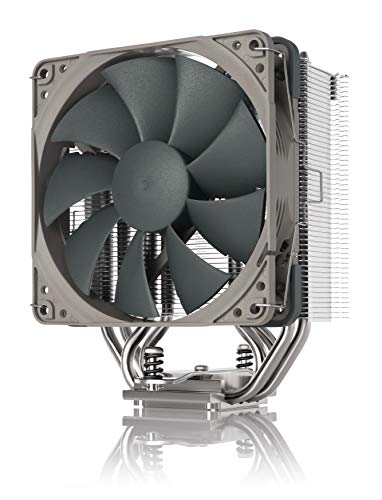
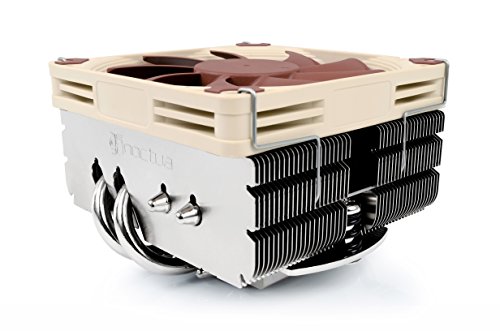
Look at any tower CPU cooler and you will see a handful of shiny copper tubes arcing from the base up into the fin stack. Those heat pipes are the single most important reason a chunk of aluminum can pull 200W+ off a CPU. They are not solid rods, and they move heat far faster than copper alone could. Understanding how they work explains why cooler specs like pipe count and diameter actually matter.
As an Amazon Associate we earn from qualifying purchases at no extra cost to you.

Our Top Picks
The phase-change trick inside a sealed tube
A heat pipe is a hollow, sealed copper tube containing a tiny amount of fluid (usually water) under partial vacuum. The vacuum lowers the boiling point dramatically, so the fluid vaporizes at the warm end even at CPU temperatures. Here is the cycle:
- Evaporation: At the base touching the CPU, the fluid absorbs heat and boils into vapor, soaking up huge energy as latent heat.
- Transport: The vapor rushes to the cooler end (the fins) almost instantly, carrying that heat with it.
- Condensation: At the fins, the vapor releases its heat to the aluminum and condenses back to liquid.
- Return: A wick structure lining the pipe wicks the liquid back down to the base by capillary action, and the loop repeats.
Why this beats solid metal
Moving heat as latent heat of vaporization transfers far more energy per gram than conduction through solid copper, which is why an effective heat pipe can have an effective thermal conductivity many times that of a solid copper rod. The whole cycle is passive, silent, and self-sustaining.
| Cooler class | Typical heat pipes | Pipe diameter | Rough heat capacity |
|---|---|---|---|
| Budget tower | 3-4 | 6mm | ~120-150W |
| Mainstream dual-tower | 5-6 | 6mm | ~180-220W |
| High-end dual-tower | 7-8 | 6mm | ~250W+ |
What pipe count and contact method mean for you
More pipes and larger diameters give more parallel paths for vapor, raising the wattage a cooler can shed before the base saturates. How the pipes meet the CPU matters too: direct-touch designs flatten the pipes against the CPU, while soldered-base designs press pipes into a copper block. Soldered bases usually spread heat more evenly across all pipes, especially on larger CPUs.
Orientation and the wick
Because the wick returns liquid by capillary action, heat pipes work in any orientation, but they are slightly most effective when the hot end is below the cold end (gravity assists return). This is why cooler makers state a recommended mounting direction, and why a tower cooler flat in a horizontal case can lose a little efficiency.
FAQ
Do more heat pipes always mean better cooling?
Generally yes up to a point, since more pipes move more heat in parallel. But fin area, base quality, and fan airflow matter just as much. A well-designed 6-pipe cooler can beat a poorly balanced 8-pipe one, so judge the whole design, not just pipe count.
Can a heat pipe wear out or fail?
They rarely fail in normal use since they are sealed with no moving parts. The risk is physical damage (a crushed or punctured pipe loses its vacuum and stops working) or, over many years, tiny fluid loss. For practical purposes, the cooler’s fan and mount fail long before the pipes do.
Bottom line
Heat pipes use a sealed evaporate-condense cycle to shuttle heat from your CPU to the fins far faster than solid metal could. Pipe count, diameter, and base design set how much wattage a cooler can handle, and mounting orientation gives a small assist. That is why the tube layout, not just the size of the fin stack, defines an air cooler’s ceiling.
It is worth knowing the failure mode, too. If an air cooler suddenly performs far worse than it used to, and the mount and paste are fine, a physically damaged heat pipe is a rare but real cause: a crushed pipe from a drop or over-tightening loses its internal vacuum and effectively becomes a dead aluminum rod, dragging temps up. You cannot repair it, the cooler is done. This is also why you should never use a tower cooler’s heat pipes as a handle when installing or removing it; grip the fin stack or base instead, and support a heavy cooler during transport so a bumpy move does not bend the pipes against the socket.