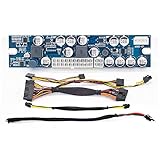
A Pico PSU is a tiny power supply that plugs directly into the motherboard’s 24-pin connector and converts a single DC input, usually 12V from an external brick, into the voltages a PC needs. It replaces the big rectangular ATX unit entirely. For ultra-small, low-power builds, it is a clever space and noise solution, but it comes with strict wattage limits that make it wrong for gaming rigs.
As an Amazon Associate we earn from qualifying purchases at no extra cost to you.

How a Pico PSU works
Instead of converting wall AC to DC inside the case like an ATX unit, a Pico PSU offloads that job to an external laptop-style power brick that feeds 12V DC into the board. The small circuit board then generates the +5V, +3.3V, and other rails on-board. The result is a nearly component-sized power solution with no internal fan and very little bulk.
The defining limit: wattage
Pico PSUs typically deliver 60-200W depending on the model and brick. That is plenty for a fanless office PC, a home server, a media box, or a mini-ITX build with integrated graphics, but nowhere near enough for a discrete gaming GPU that alone can pull 150-400W.
| Use case | Power need | Pico PSU suitable? |
|---|---|---|
| NAS / home server | 25-80W | Yes |
| HTPC / media box | 30-90W | Yes |
| iGPU mini-ITX desktop | 50-120W | Yes, size the brick |
| Entry gaming (low GPU) | 150-250W | Marginal to no |
| Mainstream/high gaming | 350W+ | No |
When a Pico PSU is the right call
Silent, tiny, efficient builds
Because there is no internal fan, a Pico PSU enables truly silent operation and frees up case volume for smaller enclosures. Paired with an efficient low-power CPU and integrated graphics, it makes for a cool, quiet, compact machine that sips power, ideal for always-on servers or living-room PCs.
Matching the brick to the load
The Pico board and the external brick are sized together. If your peak draw is 90W, a 120W-capable Pico and a 120W brick give safe headroom. Undersizing causes shutdowns under load, so total your components’ real draw and leave margin, just as with any PSU.
The limits to respect
Beyond wattage, Pico PSUs usually offer limited connectors, so heavy multi-drive or multi-fan builds may run short of power leads. Transient spikes from any add-in card must stay within the tight power envelope. For anything with a real gaming GPU, a standard SFX or ATX unit remains the only sensible choice.
Frequently asked questions
Can I game on a Pico PSU?
Only very light gaming on integrated graphics or a tiny low-power GPU within the wattage limit. A mainstream gaming GPU will exceed a Pico PSU’s capacity and cause shutdowns, so it is not a gaming power solution.
Is a Pico PSU less efficient than ATX?
Efficiency depends on both the Pico board and the external brick. Good combinations are efficient at low loads, which is exactly where these builds operate, but a poor brick can waste power, so choose a quality unit.
Bottom line
A Pico PSU shines in silent, compact, low-power builds like servers, media PCs, and integrated-graphics desktops, offering fanless operation and tiny size. Its 60-200W ceiling rules out real gaming GPUs. Size the board and brick to your actual draw with headroom, and it is an elegant answer for small, cool, quiet systems.