A living room media PC that whirs like a hair dryer ruins movie night, and a home-office rig that hums through Zoom calls makes you sound unprofessional. The problem usually isn’t your components — it’s the case. Thin steel panels, cheap sleeve-bearing fans, and mesh everywhere sound like a jet spooling up every time the CPU boosts. The fix is a case with sound-dampened panels, quality PWM fans, and enough airflow that the fans never need to scream.
. Here’s how they stack up.
As an Amazon Associate we earn from qualifying purchases at no extra cost to you.




Our Top Picks
 DARKROCK Classico Storage Master ATX NAS Computer Case18.3 x 9.06 x 18.78 inches18 PoundsCheck on Amazon
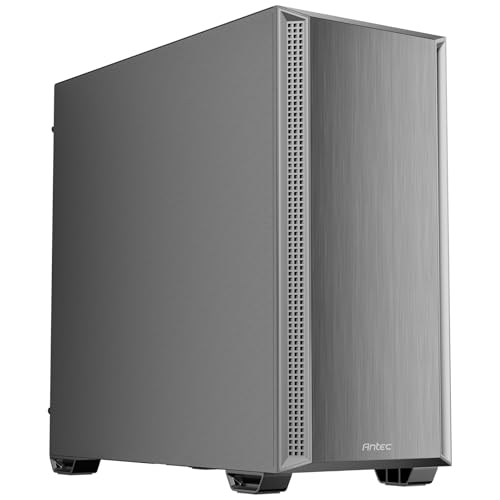

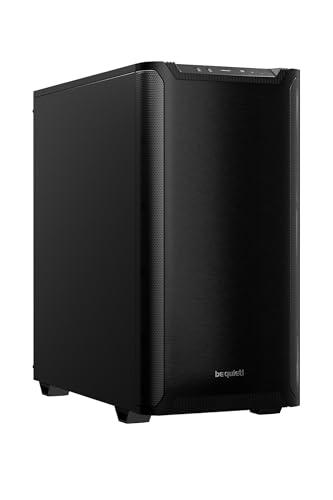


Top 3 picks at a glance
Quick Picks
| Product | Best for | Price |
|---|---|---|
| Antec P7 S Mid-Tower ATX PC Case | Best overall value for silent builds | Check on Amazon |
| DARKROCK Classico Storage Master | Best for NAS and home servers | Check on Amazon |
| Lian Li V100-ATX Mid-Tower (Black) | Best compact mid-tower design | Check on Amazon |
| be quiet! Pure Base 501 Black ATX | Best true silence-focused case | Check on Amazon |
| Antec Flux Wood Mid-Tower E-ATX | Best for high-airflow quiet cooling | Check on Amazon |
| Cooler Master Q300L V1 Micro-ATX | Best budget pick | Check on Amazon |
| CORSAIR 3500X RS ARGB Panoramic | Best for showpiece builds | Check on Amazon |
| Antec Flux SE Silent Mid Tower E-ATX | Best silent case for big GPUs | Check on Amazon |
How We Compared
To make this list, a case had to hit four criteria. Second, out-of-the-box acoustics: we favored cases that ship with PWM fans — ideally three or more — because PWM fans can spin down at idle instead of running a fixed, droning speed. Third, noise-management design: sound-dampened side panels, sealed tops, or front intakes that don’t act like megaphones all scored points. Fourth, real-world fitment: we checked GPU clearance, radiator support, and drive bays so you’re not buying a case your parts won’t fit.
We did not manufacture lab decibel readings, and you should be skeptical of any roundup that claims a case measured “18 dBA at load” — results depend entirely on your fans, your fan curve, and your room. Instead, we focused on design choices that measurably reduce noise and flagged trade-offs honestly.
The 8 Best Picks
1. Antec P7 S Mid-Tower ATX PC Case — around $69
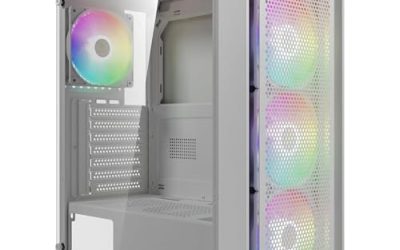
The P7 S is the rare budget case that treats silence as a feature rather than an afterthought. It’s a straightforward mid-tower ATX chassis aimed at first-time builders and home-office users who want a machine that disappears into the background. The headline number is the four PWM fans included in the box — at this price, most competitors give you one or two — which lets you run every fan at low RPM for the same airflow a two-fan setup forces at high RPM. For a quiet workstation or family PC, this is the smartest spend on the list.
- Four PWM fans included, so low-RPM quiet operation is achievable without extra purchases
- It’s a no-frills chassis — don’t expect tempered-glass flair or ARGB lighting
Skip it if you’re building a showpiece; this case is built to be heard never, not seen.
2. DARKROCK Classico Storage Master ATX NAS Case — around $89
If your “silent PC” is actually a home server or NAS sitting in a hallway closet, the Classico Storage Master deserves a hard look. It’s built around storage: an ATX chassis designed for NAS duty, with 4x120mm fans included to keep a stack of hard drives cool. Those fans matter more than usual here, because a dozen spinning drives generate real heat, and overheated drives shorten their lifespan. Run the four 120mm fans on a gentle curve and you get steady airflow without the whine of fewer, faster fans.
- Purpose-built drive capacity for NAS and media-server builds
- Four 120mm fans included, ideal for slow, quiet curves over drive bays
- Overkill for a basic two-drive desktop build
Skip it if you’re not building storage-heavy — a standard mid-tower is smaller and cheaper for that job.
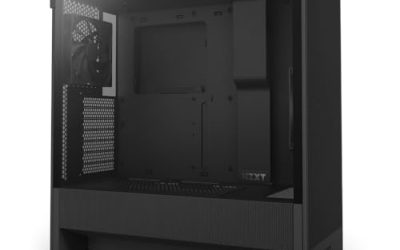
3. Lian Li V100-ATX Mid-Tower PC Case, Black — around $74
This is the pick for builders who want a smaller footprint without dropping to micro-ATX: a mid-tower that respects your desk space. Compact cases pose a noise challenge — less internal volume means components sit closer to panels — but the V100’s straightforward airflow path means fans don’t need to work hard. Pair it with quiet PWM fans and a mid-range CPU and you’ll have a near-silent everyday machine.
- Compact mid-tower footprint that still fits full ATX boards
- Fewer included fans than rivals like the Antec P7 S
Skip it if you’re planning a 360mm radiator and a triple-fan flagship GPU; the compact interior rewards restraint.
4. be quiet! Pure Base 501 Black ATX — around $94
be quiet! is the brand most associated with silent PCs, and the Pure Base 501 is their entry point into that philosophy. It ships with two preinstalled Pure Wings 3 140mm PWM fans — larger, slower-spinning fans that move air with less whoosh than 120mm equivalents. The case is tuned for optimized air pressure and supports vertical GPU installation, a nice bonus for showing off a graphics card.
- Two Pure Wings 3 140mm PWM fans preinstalled — big, slow, quiet
- Vertical GPU support and USB 3.2 Gen. 2 Type-C on the front panel
- Only two fans included, so a fuller build may need one or two more
Skip it if raw airflow for a hot, high-wattage rig matters more than acoustics.
5. Antec Flux Wood Mid-Tower E-ATX — around $89
The Flux Wood solves the classic silent-case dilemma: damping panels usually choke airflow, forcing fans to spin faster and louder. Antec’s Flux series pairs a wood-accented, design-forward exterior with an airflow-optimized layout, and it includes five PWM fans — the most of any case here at this price besides its sibling below. That fan count means you can run everything under 1,000 RPM and still cool a hot mid-range build. It’s the right choice for a powerful PC in a shared living space.
- Five PWM fans included — excellent out-of-the-box low-RPM cooling
- E-ATX support plus a distinctive wood-accent design
- Focus on airflow means less sound damping than the Flux SE
Skip it if you want maximum silence above all — the Flux SE below is the more acoustically focused variant.
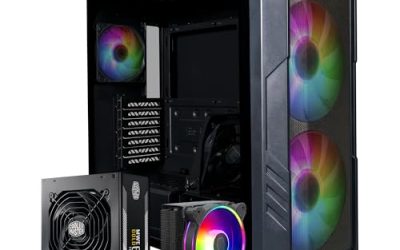
6. Cooler Master Q300L V1 Micro-ATX — around $39
It’s a micro-ATX case with a transparent panel and a high-airflow layout, aimed at students, first builds, and compact office PCs. Silence comes from strategy rather than damping: with a high-airflow front and modest hardware inside, fans can idle low. Pair it with a 65-watt CPU and a quiet cooler and it’s a genuinely discreet little machine.
- High-airflow design and transparent panel for an affordable showcase build
- Transparent panel offers no sound damping, and micro-ATX limits big GPUs and radiators
Skip it if you’re building an E-ATX board or a triple-fan flagship card.
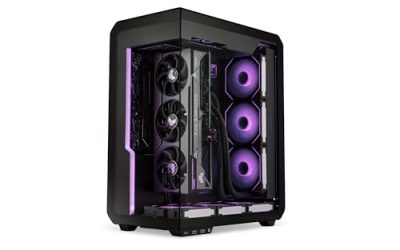
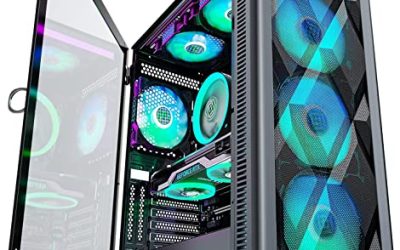
7. CORSAIR 3500X RS ARGB Panoramic Mid-Tower — around $82
The 3500X RS is the pick for builders who want their PC to look as good as it sounds quiet. Glass panels are acoustically denser than mesh, which helps contain fan noise, though this case is more about showmanship than pure silence. Choose low-RPM PWM fans and sensible fan curves, and a 3500X RS build can sit near-silent on your desk.
- Glass construction helps contain noise better than open mesh
- Lighting-first design — not the pick for pure acoustic minimalism
Skip it if you want a case that disappears; this one is built to be admired.
8. Antec Flux SE Silent Mid Tower E-ATX — around $91
The Flux SE is the acoustically tuned version of the Flux line, and its name says it plainly: “Silent” is in the product title. Like the Flux Wood, it includes five PWM fans and supports E-ATX motherboards, making it the best silent option under $100 for large builds — big motherboards, long triple-slot GPUs, and 360mm radiators. The difference is tuning: the SE prioritizes damping and noise containment over maximum raw airflow. If your build runs warm, use the five included fans on a custom curve and you’ll stay quiet without thermal compromise.
- E-ATX support accommodates large, powerful builds
- Slightly less airflow headroom than the standard Flux Wood
Skip it if you’re running a compact build — its mid-tower-plus footprint is more case than you need.
Buying Guide
Fans Matter More Than Panels
The single biggest noise factor in any build is fan speed, and fan speed follows heat. A case with four or five included PWM fans lets each spin at 800–1,000 RPM instead of two fans straining at 1,500 RPM. Every case here includes at least two fans; the Antec P7 S, DARKROCK Classico, Flux Wood, and Flux SE include four or five.
Airflow vs. Damping: Pick Your Trade-off
Silent cases come in two philosophies. Damped cases (like the Pure Base 501 and Flux SE) block noise with heavier, insulated panels — best for moderate-heat builds and offices. Airflow cases (like the Q300L V1 and Flux Wood) keep components so cool that fans barely need to spin — best for high-wattage CPUs and big GPUs. Match the philosophy to your hardware: a 65-watt CPU thrives in a damped case, while a 250-watt GPU wants airflow.
Check Fitment Before You Fall in Love
Measure three things against your parts list: GPU length, cooler height, and radiator support. Micro-ATX cases like the Q300L V1 restrict you to micro-ATX boards and mid-length graphics cards. Compact mid-towers like the Lian Li V100 fit ATX but reward modest coolers. The Flux Wood and Flux SE accept E-ATX boards and the longest GPUs. Also confirm front-panel I/O — the Pure Base 501’s USB 3.2 Gen. 2 Type-C is a genuine convenience if your motherboard supports it.
Our Verdict
If silence is your absolute top priority, stretch to the be quiet! Whichever you pick, spend the savings on a good CPU cooler — nothing quiets a PC faster.
FAQ
Do sound-dampened cases actually make a difference?
Yes, but mainly for mid- and high-frequency noise like fan whoosh and coil whine. Dampened panels and sealed tops take the edge off, especially at idle. They can’t silence a cooler or GPU fan running at full tilt, which is why fan quality and curves matter just as much as the case itself.
How many fans do I need for a quiet PC?
Three or more PWM fans is the sweet spot. More fans at lower RPM moves the same air with less noise.
They can be, with the right strategy. Put the money you save into a quality quiet CPU cooler, and a budget case can be nearly as silent as a damped one — as long as your hardware doesn’t run hot.
Is glass or mesh better for a quiet PC?
Glass panels, like those on the CORSAIR 3500X RS, block and reflect more sound than open mesh, so they’re slightly better for containment. Mesh fronts flow air better, letting fans spin slower. For silence in a low-heat build, either works well; for a hot build, prioritize airflow and compensate with slow, quality PWM fans.