Choosing a portable piano keyboard is really a decision about where the instrument will live between sessions, not about collecting the longest feature list. A keyboard that folds into a tote bag, runs on AA batteries on a train, or slides under a bed in a small flat gets played; a heavy slab that needs a dedicated stand and a free wall socket quietly becomes furniture, however good its piano voice sounds on paper.
This shortlist suits students moving between home and lessons, players in small apartments who must pack the instrument away after practice, and travellers who want a full key range away from home. Every pick is a portable digital piano keyboard chosen from its Amazon listing, with portability judged only on what that listing states: key count, weight, battery operation, folding design or included carry accessories.
Top 3 picks at a glance


Quick Picks
As an Amazon Associate we earn from qualifying purchases
| Product | Best for | Key spec from title |
|---|---|---|
| Casio Casiotone CT-S1 | Carrying to lessons and casual playing anywhere | 61-Key Touch-Sensitive Portable Keyboard |
| Yamaha Piaggero NP-15 | A light piano-first keyboard for home and travel | 61-Key Ultra-Portable Digital Piano |
| Carry-on Folding Piano 88 | Full 88-key range that folds into a bag | 88 Keys Portable Folding Digital Piano with Rechargeable Battery |
| Yamaha P-145BT | Weighted 88 keys in a compact, movable body | 88-Key Digital Piano with Weighted Keys, Compact Design, Bluetooth |
| Casio Privia PX-S1100 | Slim weighted piano that still runs on batteries | 88-Key Touch-Responsive Weighted Digital Piano, Ultra-Portable |
How to Choose
Decide how many keys your music actually needs
Key count is the first portability trade-off, because it sets both the length of the instrument and the repertoire it can handle. A 61-key board covers pop songs, chord work and early lesson pieces, and it fits on a desk or a lap far more easily than a full-size instrument. An 88-key model matches the range of an acoustic piano, which matters once lessons reach pieces that run into the lowest and highest octaves. Check the listing’s stated key count against the music you play now, not the music you might attempt one day, because carrying extra length you never use is a daily cost.
Read the stated weight, not the marketing words
Almost every listing in this category calls itself portable, so the number that matters is the weight printed in the product information. The lightest picks here are around ten pounds or less and can be carried under one arm or in a tote bag, while the weighted 88-key models sit near twenty-five pounds and realistically move by car or on a stand with wheels. Match the stated weight to your actual journey: stairs, a bus ride and a walk to a classroom punish every extra pound, while a keyboard that only moves between two rooms at home can afford a heavier, more solid action.
Check how it is powered away from a wall socket
Battery operation is what separates a keyboard you can play in a park, a camper or a classroom corner from one that is merely easy to relocate. Some listings here state AA battery power, one folding model states a built-in rechargeable battery with a stated playing time, and the heavier weighted models are mains-led designs that assume a nearby outlet. Look for the power source line in the listing and whether batteries are included or sold separately, then think about where you will actually sit down to play. A stated battery option is only useful if you are willing to keep spare cells charged.
Separate key action from key count
Two keyboards can both offer 88 keys and feel completely different under the fingers. Listings describe actions in distinct ways: touch-sensitive piano-style keys on the light 61-key models, natural-feel keys on the folding piano, and weighted hammer actions with names such as Graded Hammer Compact or Smart Scaled Hammer Action on the heavier slabs. If you are learning piano technique that must transfer to an acoustic instrument, the listing-stated weighted action is worth its extra pounds. If you mainly play chords, melodies and synth tones, a lighter touch-sensitive action keeps the whole package easier to carry.
The 5 Best Options
Casio Casiotone CT-S1

The CT-S1 is built around the idea that a piano keyboard should follow you around the house and out of it. Its listing states a weight of 9.9 pounds, six AA batteries as an alternative to the included adaptor, and strap fittings that let you play standing up, which makes it a natural fit for casual players, songwriters sketching ideas in different rooms, and students who carry an instrument to a friend’s house. Sixty-one AiX tones headed by a stereo grand piano give it more sound variety than its simple, screen-free panel suggests.
Specs
- Keys: 61 full-size keys with touch response, 3 sensitivity levels
- Sound source: AiX, with 61 tones including a stereo grand piano
- Polyphony: 64 notes
- Speakers: built-in stereo speakers, 2.5 W + 2.5 W amplification, horizontal bass reflex
- Power: AC adaptor included, or 6 AA batteries
- Weight: 9.9 pounds
- Connectivity: USB-MIDI, 3.5 mm headphone jack, audio input
- Colour of this listing: White, model CT-S1WE
Best for: players who want the lightest full-featured 61-key option for lessons, travel and playing in different rooms.
Watch out for: Bluetooth is not built in; the listing points to a separately available WU-BT01 adaptor, and the batteries are not included.
ASIN: B091XNB1J3
Yamaha Piaggero NP-15
Yamaha’s Piaggero line strips a piano keyboard down to the functions a practising player touches daily, and the NP-15 listing leans on that focus: 61 touch-sensitive piano-style keys, a concert grand voice drawn from Yamaha’s CFIIIS, a recording function and a metronome, all in a body the listing weighs at 5.2 kilograms. It suits beginners and returning players who want a piano-led instrument rather than an arranger workstation, and who move between a bedroom desk, a lesson room and the occasional trip away. Battery operation from six AA cells means a garden table or a holiday rental can become the practice room.
Specs
- Keys: 61 touch-sensitive, piano-style box-type keys
- Voices: 15, with the main piano voice sampled from the Yamaha CFIIIS concert grand
- Polyphony: 64 notes
- Speakers: built-in stereo speakers, 2.5 W x 2 amplifiers
- Power: PA-130 AC adaptor included, or 6 AA batteries
- Weight: 5.2 kg, about 11.5 pounds without batteries
- Features: recording function, metronome, 15 voice demo songs and 10 piano songs
- Connectivity: USB to Host, headphone/output jack, sustain pedal connection
Best for: piano-focused learners who want a light, simple keyboard that still records practice and runs on batteries.
Watch out for: the keys are touch-sensitive but unweighted, so it will not prepare fingers for an acoustic piano’s heavier action.
ASIN: B0C9F3NL3S
Carry-on Folding Piano 88
This is the extreme answer to the portability question: a full 88-key piano keyboard that folds down to about 33 centimetres and weighs 1.6 kilograms, small enough for the included tote bag. The listing states a built-in sound engine with 128 voices, built-in stereo speakers and an internal rechargeable battery, so despite also offering MIDI over USB it plays as a standalone piano keyboard with nothing else connected. It fits travellers, students in halls of residence and anyone whose practice space is a kitchen table that must be cleared afterwards, provided they accept a light, natural-feel key action rather than weighted keys.
Specs
- Keys: 88 natural-feel keys in a folding design
- Folded size: 331 x 126 x 85 mm; unfolded 1324 x 126 x 21 mm
- Weight: 1.6 kg
- Voices: 128, with 128 accompaniment styles and 30 demo songs
- Speakers: built-in stereo speakers, 2 x 2 W
- Battery: internal rechargeable battery, up to 8 hours of playing on a full charge
- Connectivity: MIDI over USB, 3.5 mm stereo headphone output, sustain pedal input
- Included: sustain pedal, tote bag and USB charging cable
Best for: travellers and students who need the full 88-key range in a bag, for practice away from home.
Watch out for: the keys are not weighted and this listing’s version is not touch-sensitive in the way the Touch variant is, so dynamics come from volume rather than finger pressure.
ASIN: B08M1L9KNJ
Yamaha P-145BT
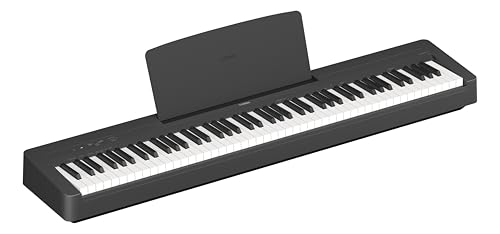
The P-145BT is the point where portable stops meaning featherweight and starts meaning movable by one person: the listing describes an 88-key digital piano with weighted keys and a compact design, states a weight of 11.1 kilograms, and includes a music rest and a sustain foot switch in the box. Its Graded Hammer Compact keyboard is the draw for learners whose teacher expects acoustic-style technique, while Bluetooth audio lets a phone play lesson tracks through the piano’s own speakers. It suits a small flat, a student’s bedroom or a second practice space where the piano must be lifted onto a table or stand and put away again.
Specs
- Keys: 88 weighted keys, Graded Hammer Compact (GHC) keyboard with matte black keytops
- Voices: 10, with the Yamaha CFIIIS concert grand piano sound and damper resonance
- Polyphony: 64 notes
- Speakers: built-in speakers, 7 W x 2 amplification
- Weight: 11.1 kg, about 24.5 pounds
- Connectivity: Bluetooth audio, USB to Host, headphone jack
- Included in this listing: music rest and sustain foot switch
- Dimensions: 1326 x 268 x 129 mm
Best for: learners who need a genuinely weighted 88-key action in a slim body one person can still move.
Watch out for: there is no battery option in the listing, so every playing spot needs a mains socket nearby.
ASIN: B0F9H3SHFJ
Casio Privia PX-S1100

Casio pitches the PX-S1100 as an ultra-portable weighted piano, and its listing backs that with a slim body that weighs less than 25 pounds while still housing 88 Smart Scaled Hammer Action keys with simulated ebony and ivory textures. Eighteen tones led by a German concert grand, Bluetooth connectivity and compatibility with the Casio Music Space app make it a self-contained practice instrument, and the listing text notes optional battery power from six AA cells for playing away from an outlet. This listing is the Mellow Beige finish. It suits advancing students and gigging players who move a weighted piano by car several times a week.
Specs
- Keys: 88 touch-responsive weighted keys, Smart Scaled Hammer Action Keyboard
- Tones: 18, including a German concert grand piano tone
- Speakers: built-in speakers, 2 x 8 W
- Weight: 24.69 pounds
- Design: slim body, stated depth of 232 mm in the PX-S1100 line
- Connectivity: Bluetooth, USB-MIDI, line out and headphone connections
- Power: AC adaptor, with 6 AA battery operation stated as an option
- Colour of this listing: Mellow Beige, model PX-S1100
Best for: players who want the slimmest weighted 88-key piano here, with battery freedom for rehearsals and small gigs.
Watch out for: confirm the finish before ordering, because this ASIN is the Mellow Beige version, and a stand and three-pedal unit are optional extras rather than included items.
ASIN: B0CGKBQ39R
Which One Fits Your Situation
You practise in a dorm room or a shared flat
Space you cannot dedicate to an instrument points to the Carry-on Folding Piano 88 or the Casio CT-S1. The folding piano disappears into its tote bag after practice and still gives you all 88 keys, while the CT-S1 leans against a wall or slides under a bed at 9.9 pounds. Both run on batteries, so a free corner and a pair of headphones are all the setup either one asks for.
Your teacher expects real piano technique
Choose between the Yamaha P-145BT and the Casio Privia PX-S1100, the two listings here that state a weighted hammer action across 88 keys. The P-145BT keeps things simple with ten voices and Bluetooth audio for lesson tracks; the PX-S1100 is slimmer, adds battery operation and offers eighteen tones. Either will build finger strength and control that transfer to an acoustic piano in a way the lighter actions cannot.
You travel and want to keep practising
The Carry-on Folding Piano 88 is the only pick designed to fly in hand luggage, folding to about 33 centimetres with a rechargeable battery for the hotel room. If your travel is by car and your repertoire stays within five octaves, the Yamaha NP-15 or Casio CT-S1 travel almost as easily at around ten to eleven pounds each, and both keep a more conventional, rigid keyboard feel.
You play chords, songs and synth tones more than classical pieces
The Casio CT-S1 was made for this: 61 AiX tones, a one-button recorder for catching ideas, and a strap-and-batteries setup that suits playing standing up or on a sofa. The Yamaha NP-15 is the alternative if your song playing is piano-led, trading the Casio’s tone count for a concert grand voice, a recording function and a calmer, simpler panel.
Common Mistakes
- Buying an 88-key weighted slab for a fourth-floor flat without checking the listing’s stated weight, then leaving it unplayed because moving it is a chore.
- Assuming a keyboard is battery powered because it is small, when the listing only states mains power and every practice spot then needs a socket.
- Treating a folding or light touch-sensitive action as a substitute for weighted keys when a teacher is grading technique against an acoustic piano.
- Forgetting that stands, sustain pedals, carry bags and Bluetooth adaptors are included on some listings and sold separately on others, so the box contents differ.
- Choosing a colour or bundle variant without confirming the ASIN matches that exact version, since finishes and bundles carry different codes.
Frequently Asked Questions
Is 61 keys enough for a beginner?
For most first and second year material, yes. Sixty-one keys cover five octaves, which handles beginner lesson books, pop songs and chord-based playing comfortably. The limit appears when pieces start using the extreme low and high notes of an acoustic piano. If your teacher’s syllabus reaches that repertoire soon, start with an 88-key model instead of buying twice.
Can a portable keyboard replace a piano for exam practice?
Only the weighted models come close. A listing that states a hammer action, such as the Graded Hammer Compact or Smart Scaled Hammer Action keyboards above, builds the finger strength and control examiners expect. Light touch-sensitive and folding keyboards are excellent for keeping up daily practice while travelling, but treat them as companions to a weighted instrument rather than full replacements.
How long do these keyboards play on batteries?
It depends on the model and how loudly you play. The folding piano’s listing states up to eight hours from its internal rechargeable battery. The AA-powered models here, the CT-S1, NP-15 and PX-S1100, run on six AA cells, so playing time varies with battery type and volume; keeping a charged spare set is the practical answer for regular battery use.
Do portable piano keyboards need a stand?
Not always. The lightest models are designed for a table, a desk or even strap-held playing, and the folding piano needs a flat surface long enough to support its unfolded length. Weighted 88-key models feel far more stable on a stand at proper piano height, so check whether the listing includes one or lists it as an optional extra.
Related guides
More from Amazon
Programs that pair well with the guide above. Offers and eligibility are set by Amazon and may change.
Free shipping on eligible items, Prime Video and more. Eligible new members can start with a free trial.
Start a Prime free trialAd-free music streaming. Eligible new subscribers can start with a free trial.
Try Music Unlimited freeA Prime membership for ages 18-24 with a trial period. Eligibility is set by Amazon.
See Prime for Young AdultsAudiobooks and podcasts to listen to on the go. Eligible new members can start with a free trial.
Try Audible freeAs an Amazon Associate we earn from qualifying purchases.