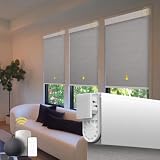
The best smart motorized window blinds and shades for most homes are custom-fit rechargeable roller shades with quiet motors, Matter or major voice-assistant support, and a reliable schedule system; the right choice depends more on window measurements, sunlight control, and installation than on the app alone.
As an Amazon Associate we earn from qualifying purchases at no extra cost to you.


Our Top Picks


Top 3 picks at a glance
Quick comparison: which smart shade fits your situation?
| Situation | Best-fit option | Why it makes sense | Typical motor noise | Typical power approach |
|---|---|---|---|---|
| Quiet bedroom or office | Premium rechargeable roller shade | Lower motor noise, soft-start movement, dependable schedules | About 30–40 dB at close range | Rechargeable battery, commonly several months per charge |
| Many windows and a permanent installation | Hardwired or professionally installed system | No charging routine and better support for large shades | About 35–45 dB | Low-voltage wiring or mains-connected power supply |
| Renter or do-it-yourself installation | Retrofit motor or clamp-on blind controller | Uses existing blinds and avoids drilling in some installations | About 40–55 dB | Rechargeable or replaceable batteries |
| Apple-focused smart home | Eve MotionBlinds-compatible shade | Matter and Thread support on compatible products; strong privacy controls through Apple Home | Varies by shade fabric and motor | Rechargeable battery or wired, depending on configuration |
| Broadest established ecosystem | Lutron Serena with the required Lutron hub | Reliable automation, wide integration support, and professional-grade options | Quiet, model-dependent | Battery or wired options |
Noise and battery figures are practical ranges rather than guarantees. Fabric weight, shade width, mounting surface, temperature, and how often the shade moves can change the result. If a silent bedroom is your priority, request the motor’s published sound rating or a demonstration before ordering.
The main buying decision: complete shade or retrofit motor?
Custom smart shades
A complete shade replaces the existing blind or roller assembly with a matched tube, motor, fabric, brackets, and control system. This is usually the best route for large windows, blackout rooms, and clean-looking installations. Lutron Serena, Somfy-powered shades, and shades built around Eve MotionBlinds motors are examples of this category.
The advantages are accurate sizing, better load matching, neater wiring, and more predictable movement.
Retrofit controllers
A retrofit product operates an existing roller blind, chain, or horizontal slat blind. SwitchBot Blind Tilt is an example of the retrofit approach for compatible tilt mechanisms. Check the exact blind type, chain size, tilt rod shape, available clearance, and whether the existing blind moves smoothly by hand.
Retrofit motors are attractive for renters, but they may be more visible, louder, or less capable with heavy blinds. They also cannot fix a poorly aligned shade. If the blind sticks before automation is installed, the motor will usually amplify the problem rather than solve it.
Measure the window before comparing smart features
Incorrect measurements cause more failures than missing voice-assistant support. Measure each window separately, even if several windows appear identical.
- Inside mount: measure the top, middle, and bottom width. Use the smallest width, then follow the manufacturer’s deduction rules. Measure height on the left, center, and right and use the largest height.
- Outside mount: measure the window opening, then add the recommended overlap. A common starting point is 2–3 inches of extra width on each side, but the fabric roll and brackets may require more clearance.
- Check depth: confirm that the recess is deep enough for the cassette, roller, and brackets. A window handle can prevent the shade from sitting flat.
- Check obstructions: account for trim, locks, insect screens, curtain rods, alarm sensors, and window-opening paths.
- Check fabric width: the visible fabric is often narrower than the total shade width because of brackets and motor hardware.
For blackout performance, an outside-mounted shade with side channels or an overlapping cassette generally blocks more edge light than an inside-mounted roller. For ventilation and emergency egress, make sure the shade does not prevent the window from opening when needed.
Motor noise: what the numbers mean in a real room
Motor noise is usually measured close to the mechanism, while room noise is measured from the bed or desk. A difference of only a few decibels can be noticeable because decibels are logarithmic. A motor rated around 35 dB should be substantially less intrusive than one around 45 dB, even though the numerical difference looks small.
Choose the quietest motor available when the shade will move during sleep, recording, meetings, or gaming. Motors with soft-start and soft-stop behavior are more pleasant than units that begin at full speed. A wide blackout shade may also sound louder because the roller and fabric carry vibration into the wall.
Use a schedule that avoids unnecessary movement. For example, instead of opening the shade in several small increments, configure one opening event at 7:00 a.m. and one closing event at sunset. Fewer cycles reduce both noise and battery consumption.
Battery life: a simple calculation for your window
Manufacturers often quote battery life in months, but usage matters. Consider a rechargeable shade rated for 600 movement cycles per charge. If it opens and closes once each day, that is:
2 cycles per day × 30 days = 60 cycles per month.
600 cycles ÷ 60 cycles per month = about 10 months of nominal runtime.
Now add a sunrise routine, a privacy adjustment at midday, and a manual evening command. Four cycles per day becomes 120 cycles per month, reducing the same theoretical runtime to about five months. Cold rooms, a heavy fabric, weak sunlight for a solar panel, and end-of-travel calibration can reduce it further.
For a bank of eight windows, charging logistics matter. If every shade needs charging twice per year, that is approximately 16 charging visits annually. A wired system may cost more initially but can be the better choice for high windows, rental properties, or a large number of rooms.
Voice assistants, hubs, and schedules
Look for compatibility with the assistant you already use rather than choosing a shade because its app has the longest feature list. Lutron Serena systems typically require the appropriate Lutron bridge for remote control and third-party integration. Matter-compatible shades can be controlled through compatible Apple Home, Google Home, or Amazon Alexa setups, but Matter features may vary by motor, firmware, hub, and controller.
- Apple Home: useful for scenes, room-based control, presence automation, and privacy-focused local control where supported.
- Google Home: convenient for voice routines and household-wide control when the shade exposes the required Matter or platform integration.
- Amazon Alexa: useful for voice commands and routines, provided the motor or bridge is compatible with the relevant skill or Matter setup.
- Thread: generally uses less power than Wi-Fi for battery devices, but requires a compatible Thread border router and does not automatically guarantee interoperability.
- Wi-Fi: easy to deploy, but a battery-powered shade may consume more power if it maintains a network connection continuously.
Before buying, verify whether schedules run locally when the internet is down. A shade that continues its sunrise and sunset routines through a hub is more dependable than one that needs a cloud service for every event.
Privacy control is more than “close all blinds”
The most useful privacy automation combines time, sunlight, room occupancy, and window direction. A practical starting configuration is:
- Close bedroom and bathroom shades at sunset.
- Close street-facing shades 30 minutes before the room becomes dark enough to see indoors.
- Open east-facing living-room shades 15–30 minutes after sunrise, unless the room is occupied overnight.
- Keep west-facing shades partly closed during late-afternoon glare, using a 50–70% position rather than fully closing them.
- Set a vacation schedule with varied opening and closing times instead of repeating the same minute every day.
- Add a manual override so a voice command or wall control can temporarily suspend the schedule.
For nighttime privacy, a light-filtering fabric may still reveal silhouettes when the room is illuminated. Choose room-darkening or blackout fabric for bedrooms and bathrooms, and consider top-down/bottom-up designs if you want daylight without exposing the upper portion of the room.
Installation choices and long-term value
DIY installation is reasonable for small, lightweight shades with accessible mounting points. Professional installation becomes worthwhile for extra-wide windows, heavy blackout fabric, high ceilings, hardwired power, or multiple rooms that must align visually. Confirm whether measuring, drilling, wiring, programming, and removal of old blinds are included in the quoted service.
Compare the full project cost, including hubs, brackets, charging accessories, installation, and replacement batteries—not just the motor.
Frequently asked questions
Can smart shades still follow schedules if the internet goes down?
Some smart shades can continue scheduled routines without an internet connection, but this depends on whether schedules run locally through a compatible hub. Before buying, verify this feature. A shade that continues sunrise and sunset routines through a hub is more dependable than one that needs a cloud service for every event.
Should I choose an inside mount or an outside mount for better blackout performance?
An outside-mounted shade generally provides better blackout performance than an inside-mounted roller shade. Side channels or an overlapping cassette can block more edge light. However, you must account for trim, handles, curtain rods, insect screens, and other obstructions before choosing the mounting style.
What should I check before buying a retrofit smart blind motor?
Check the exact blind type, chain size, tilt rod shape, available clearance, and whether the existing blind moves smoothly by hand. Compatibility is narrow, and a retrofit motor cannot correct a poorly aligned shade. If the blind already sticks, automation will usually amplify the problem rather than solve it.
Do smart shades need a separate hub or bridge?
Some smart shades require a separate hub or bridge for remote control and third-party integration. Lutron Serena systems typically require the appropriate Lutron bridge, while Matter-compatible shades need compatible home platforms, hubs, or controllers. Thread-based shades also require a compatible Thread border router, so check the complete setup before buying.
How can I reduce unnecessary shade movement and battery use?
Use fewer, larger schedule events instead of several small adjustments. For example, configure one opening event at 7:00 a.m. and one closing event at sunset. Fewer movement cycles reduce both noise and battery consumption. Also consider sunlight, fabric weight, room temperature, and manual commands when estimating runtime.
Final recommendation
Choose a custom rechargeable roller shade with a quiet motor and Matter or established hub support for the best balance of appearance, scheduling, privacy, and installation flexibility. Choose Lutron Serena when dependable automation and a mature ecosystem matter more than minimizing upfront cost. Choose an Eve MotionBlinds-compatible shade for a Matter-and-Thread-oriented home, and choose a retrofit controller only after confirming mechanical compatibility and accepting potentially higher noise.
The strongest purchase is the one that fits the window correctly, has enough power for its fabric, continues scheduled behavior during an internet outage, and gives you a simple physical override when voice control or an app is inconvenient.